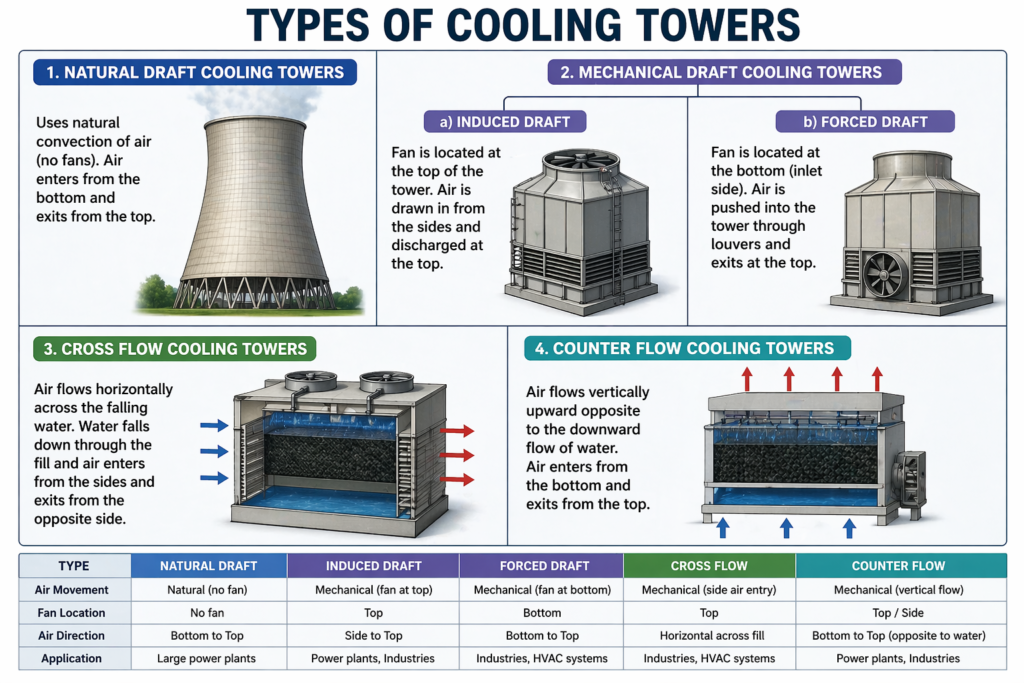
A Cooling Tower is a heat rejection device used to remove excess heat from water by cooling it through contact with air. It is commonly used in power plants, HVAC systems, refineries, and industries.
Cooling towers cool hot water from condensers or industrial processes and recirculate it back into the system.
Working Principle
Hot water enters the cooling tower.
Water is distributed over fill material.
Air flows upward/downward through tower.
A small portion of water evaporates.
Heat is removed from remaining water.
Cooled water collects in basin and returns to system.
Main Components
Fan
Fill Media
Drift Eliminator
Water Distribution System
Cold Water Basin
Pump
Louvers
Structure / Casing
Types of Cooling Towers
1. Natural Draft Cooling Tower
Uses natural air circulation.
2. Mechanical Draft Cooling Tower
Uses fans for air movement.
a) Induced Draft
b) Forced Draft
3. Crossflow Cooling Tower
Air flows horizontally.
4. Counterflow Cooling Tower
Air flows opposite to water flow.
Important Formulas for Calculation
1. Cooling Range
Range=Thot−Tcold
Where:
Thot = Hot water inlet temperature
Tcold = Cold water outlet temperature
2. Approach
Approach=Tcold−Twb
Where:
Twb = Wet bulb temperature
3. Cooling Tower Efficiency
Efficiency=Range+ApproachRange×100
4. Heat Removed
Q=m×Cp×(Thot−Tcold)
Where:
Q = Heat removed (kJ/hr)
m = Water flow rate
Cp = Specific heat of water
5. Evaporation Loss
EvaporationLoss=0.001×Flow×Range
6. Blowdown
Blowdown=COC−1EvaporationLoss
Where:
COC = Cycles of concentration
Applications
Thermal Power Plants
HVAC Systems
Chemical Plants
Steel Industries
Oil Refineries
Plastic Industries
Food Processing Plants
Maintenance of Cooling Tower
Daily Maintenance
Check fan operation
Check water level
Observe unusual noise/vibration
Weekly Maintenance
Clean basin
Check nozzles
Inspect belts and motors
Monthly Maintenance
Water treatment check
Remove scale deposits
Lubricate bearings
Yearly Maintenance
Replace damaged fill media
Structural inspection
Motor servicing
Common Problems
Scaling
Corrosion
Algae growth
Fan imbalance
Water leakage
Advantages
Saves water by recirculation
Reduces plant temperature
Energy efficient
Low operating cost
Cooling Tower Performance Chart
Parameter
Formula
Range
Hot Temp – Cold Temp
Approach
Cold Temp – Wet Bulb Temp
Efficiency
Range / (Range + Approach) ×100
Heat Removed
m × Cp × ΔT
Blowdown
Evaporation / (COC-1)
Cooling Tower Diagram
Conclusion
Cooling towers are essential for industrial heat rejection systems. Proper calculations and maintenance increase efficiency, reduce water losses, and extend equipment life.