Address
304 North Cardinal St.
Dorchester Center, MA 02124
Work Hours
Monday to Friday: 7AM - 7PM
Weekend: 10AM - 5PM
Address
304 North Cardinal St.
Dorchester Center, MA 02124
Work Hours
Monday to Friday: 7AM - 7PM
Weekend: 10AM - 5PM

Turbines are one of the most important machines used in modern engineering. They convert the energy of moving fluids such as water, steam, gas, or wind into mechanical energy, which is then used to generate electricity or drive equipment. Turbines are widely used in power plants, aircraft engines, hydropower stations, wind farms, and industrial systems.
In this blog, we will explain the different types of turbines, their working principles, applications, advantages, and major differences.
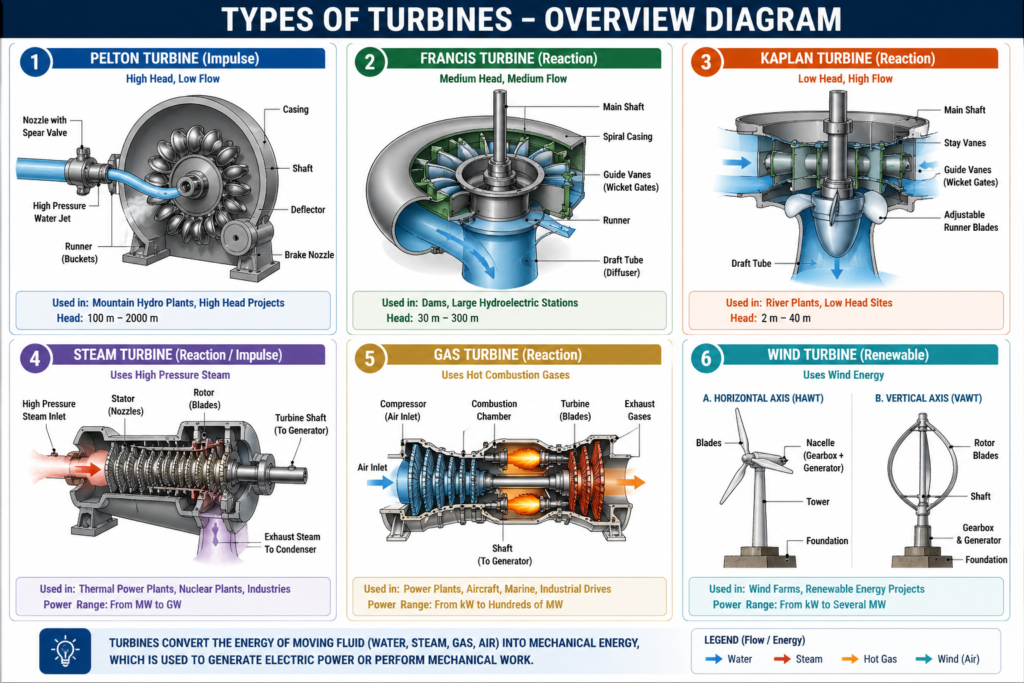
A turbine is a rotary mechanical device that extracts energy from a flowing fluid and converts it into useful mechanical power.
When a fluid strikes or passes through turbine blades, it causes the rotor to spin. This rotational motion can be connected to a generator to produce electricity.
Turbines are mainly classified based on the fluid used to rotate them:
Hydraulic turbines use flowing or falling water to produce power. These turbines are commonly used in hydroelectric power plants.
The Pelton turbine is an impulse turbine used for high-head and low-flow water conditions.
A high-speed water jet strikes the turbine buckets and rotates the runner.
The Francis turbine is a reaction turbine used for medium-head water systems.
Water enters radially and exits axially through the runner.
Kaplan turbine is a propeller-type reaction turbine used for low-head and high-flow water systems.
Steam turbines use high-pressure steam generated by boilers to rotate turbine blades.
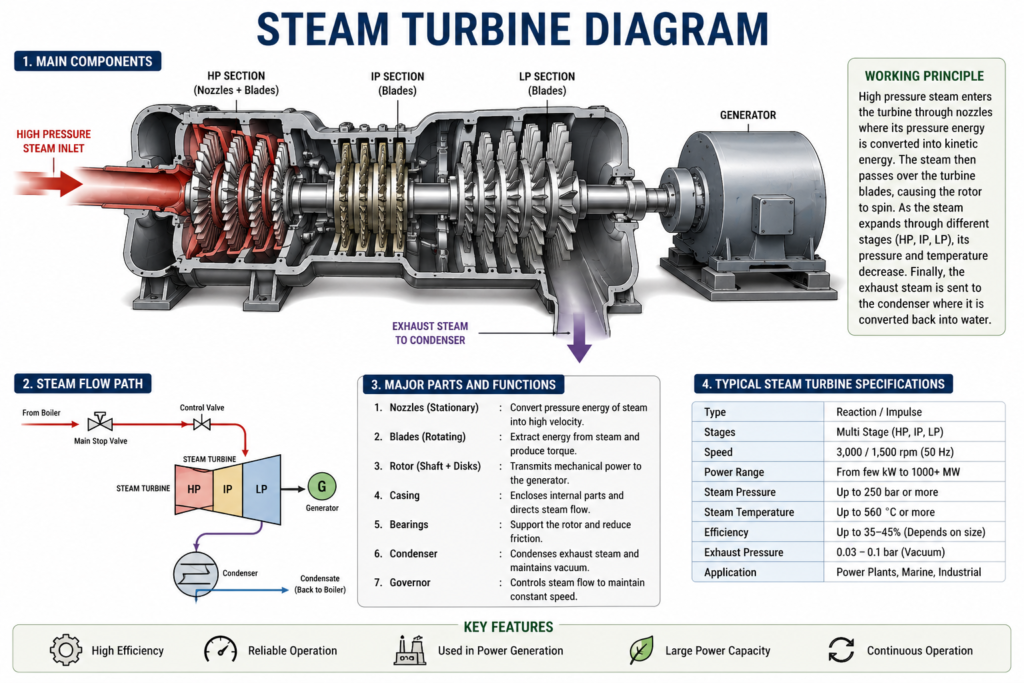
Steam expands through nozzles and blades, causing rotor rotation.
Gas turbines use hot combustion gases to rotate blades.
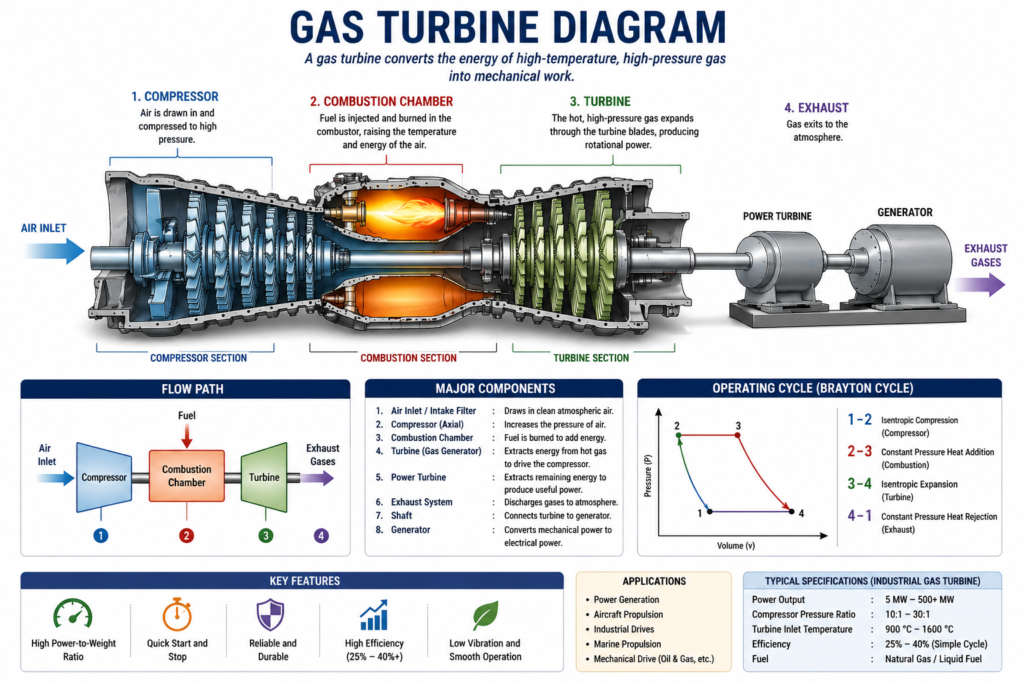
Air is compressed, mixed with fuel, burned, and expanded through the turbine.
Wind turbines convert wind energy into electricity.
Most common type with three blades.
Rotates around a vertical shaft.
| Feature | Impulse Turbine | Reaction Turbine |
|---|---|---|
| Pressure Drop | In nozzle only | In runner blades |
| Blade Contact | Jet strikes blades | Fully immersed |
| Examples | Pelton | Francis, Kaplan |
| Turbine Type | Working Fluid | Best Use | Example |
|---|---|---|---|
| Pelton | Water | High Head | Mountain Hydro |
| Francis | Water | Medium Head | Dam |
| Kaplan | Water | Low Head | River Plant |
| Steam | Steam | Large Power | Thermal Plant |
| Gas | Hot Gas | Quick Power | Power Station |
| Wind | Air | Renewable | Wind Farm |
Used in thermal, hydro, nuclear, and wind power plants.
Gas turbines power jet aircraft engines.
Used in ships and naval vessels.
Drive compressors, pumps, and generators.
Turbines are essential for modern energy production. They help convert natural resources like water, steam, wind, and gas into usable power efficiently.
Different types of turbines are designed for different energy sources and operating conditions. Hydraulic turbines use water, steam turbines use steam, gas turbines use hot gases, and wind turbines use air movement. Choosing the right turbine depends on efficiency, available energy source, and application requirements.
Turbines continue to play a major role in power generation and industrial development worldwide.

If you found this article useful, share it with engineering students and professionals.