Address
304 North Cardinal St.
Dorchester Center, MA 02124
Work Hours
Monday to Friday: 7AM - 7PM
Weekend: 10AM - 5PM
Address
304 North Cardinal St.
Dorchester Center, MA 02124
Work Hours
Monday to Friday: 7AM - 7PM
Weekend: 10AM - 5PM

Turbochargers are one of the most effective technologies used in modern engines to improve power, efficiency, and performance. They are commonly found in cars, trucks, generators, marine engines, and industrial machines. By using waste exhaust gases, turbochargers increase the amount of air entering the engine, allowing more fuel to burn and producing greater power.
In this blog, we will explain what turbochargers are, how they work, their types, advantages, disadvantages, and applications.
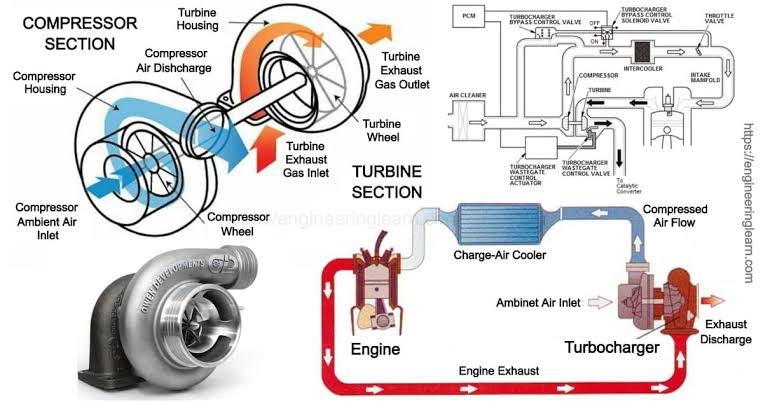
A turbocharger is a forced induction device that increases an internal combustion engine’s power output by compressing incoming air before it enters the engine cylinders.
👉 In simple words:
A turbocharger uses exhaust gas energy to force more air into the engine.
Engines need air and fuel for combustion. More air means more oxygen, which allows more fuel to burn efficiently.
Turbochargers help by:
A turbocharger mainly consists of two connected sections:
Exhaust gases from the engine spin the turbine wheel.
The turbine shaft rotates the compressor wheel, which draws in and compresses fresh air.
Contains bearings, lubrication system, and shaft connecting turbine and compressor.
Controls boost pressure by diverting excess exhaust gases.
Cools compressed air before it enters the engine.
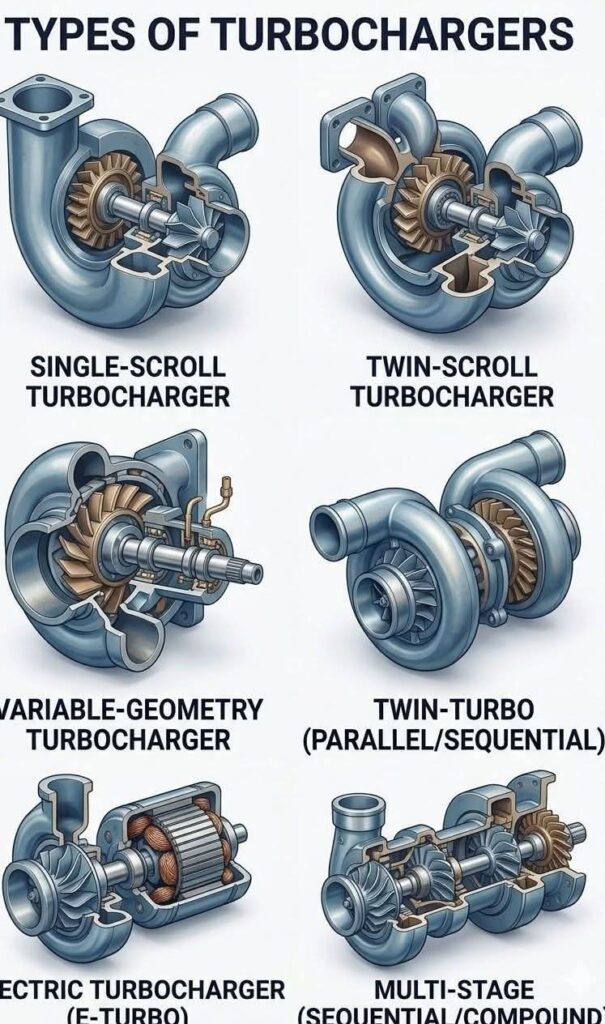
Uses one turbocharger.
Uses two turbochargers.
Uses adjustable vanes to control exhaust flow.
Uses electric motor assistance.
| Feature | Turbocharger | Supercharger |
|---|---|---|
| Power Source | Exhaust Gas | Engine Crankshaft |
| Efficiency | High | Lower |
| Engine Load | No direct load | Uses engine power |
| Lag | Possible | Very low |
✔ Higher engine power
✔ Better fuel economy
✔ Smaller engine can produce more power
✔ Lower emissions in many cases
✔ Uses waste exhaust energy
✘ Turbo lag at low RPM
✘ Higher maintenance cost
✘ Increased engine temperature
✘ Requires quality lubrication
Additional air pressure created by turbo.
Delay between throttle input and boost generation.
Cooling compressed air for better density and power.
Modern manufacturers use turbochargers to meet fuel economy and emissions standards while maintaining engine performance.
Example: Small turbocharged engines can replace larger naturally aspirated engines.
Turbochargers are powerful devices that improve engine performance by using exhaust gases to compress intake air. They increase power, improve efficiency, and are widely used in vehicles and industrial engines. With proper maintenance, turbochargers offer excellent performance and long service life.
