Address
304 North Cardinal St.
Dorchester Center, MA 02124
Work Hours
Monday to Friday: 7AM - 7PM
Weekend: 10AM - 5PM
Address
304 North Cardinal St.
Dorchester Center, MA 02124
Work Hours
Monday to Friday: 7AM - 7PM
Weekend: 10AM - 5PM

Gears are one of the most important mechanical components used to transmit power and motion between rotating shafts. They are widely used in automobiles, industrial machinery, robotics, clocks, conveyors, and heavy equipment. Gears help change speed, torque, and direction of motion efficiently.
In this blog, we will explain the different types of gears, their working principles, advantages, disadvantages, and industrial applications.
A gear is a rotating machine element with teeth that mesh with another gear to transmit torque and motion.
👉 In simple words:
Gears transfer mechanical power from one shaft to another.
Gears are used to:
Gears are generally classified according to shaft arrangement:
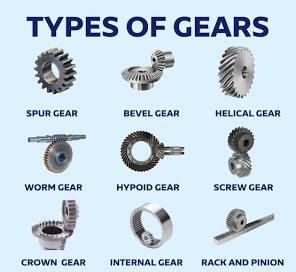
Spur gears have straight teeth parallel to the shaft axis.
✔ Low cost
✔ Simple design
✔ Reliable operation
✘ Noisy at high speed
Helical gears have teeth cut at an angle to the shaft.
✔ Less noise
✔ High strength
✔ Smooth power transfer
✘ Produces axial thrust
Consists of two opposite helical gears side by side.
Bevel gears are used for intersecting shafts, usually at 90°.
✔ Changes direction of power transmission
A worm gear consists of a worm (screw) and worm wheel.
✔ High reduction in small space
✔ Self-locking in some designs
✘ Lower efficiency due to friction
Converts rotary motion into linear motion.
Teeth are cut on the inside surface of a ring gear.
Consists of:
✔ Compact size
✔ High torque density
✔ Multiple gear ratios
| Gear Type | Shaft Arrangement | Main Use |
|---|---|---|
| Spur Gear | Parallel | General machinery |
| Helical Gear | Parallel | High-speed drives |
| Bevel Gear | Intersecting | 90° drives |
| Worm Gear | Non-parallel | High reduction |
| Rack & Pinion | Rotary to Linear | Steering |
| Planetary Gear | Coaxial | Transmissions |
Gear Ratio=Teeth on Driver GearTeeth on Driven Gear
Driver Gear = 20 teeth
Driven Gear = 40 teeth
Gear Ratio = 40 / 20 = 2:1
Meaning: Speed reduces, torque increases.
✔ Positive power transmission
✔ High efficiency
✔ Accurate speed ratio
✔ Long service life
✔ Compact design
✘ Requires lubrication
✘ Manufacturing cost can be high
✘ Noise at high speed (some types)
✘ Alignment required
Gears are essential components in mechanical systems used to transmit motion and power efficiently. Different gear types are selected based on shaft arrangement, speed, torque, and application needs. Spur, helical, bevel, worm, and planetary gears each offer unique advantages in engineering systems.
Understanding gear types helps engineers design efficient machines and reliable power transmission systems.
