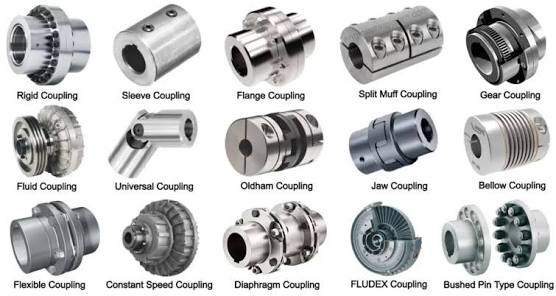
Types of Couplings: A Complete Guide for Mechanical Engineers

Couplings are essential mechanical components used to connect two shafts together for power transmission. They play a key role in ensuring smooth operation, accommodating misalignment, and reducing shock loads in machinery.

Understanding the different types of couplings is important for proper selection and efficient machine design.


What is a Coupling?

A coupling is a device used to join two rotating shafts at their ends to transmit torque while allowing slight misalignment and reducing vibration.


Main Functions of Couplings

  • Transmit power from one shaft to another
  • Accommodate misalignment (angular, parallel, axial)
  • Reduce shock and vibration
  • Protect machinery from overload

Types of Couplings

Couplings are broadly classified into two main categories:


1. Rigid Couplings

Rigid couplings are used where precise shaft alignment is required. They do not allow any misalignment.

Types of Rigid Couplings:

a) Sleeve (Muff) Coupling

  • Simplest type of coupling
  • Consists of a hollow cylinder (sleeve)
  • Used for light to medium torque applications

b) Split Muff (Clamp) Coupling

  • Consists of two halves bolted together
  • Easy to assemble and disassemble
  • Used in heavy-duty applications

c) Flange Coupling

  • Two flanges connected by bolts
  • Strong and widely used in industries
  • Suitable for high torque transmission

2. Flexible Couplings

Flexible couplings allow slight misalignment and absorb shocks and vibrations.

Types of Flexible Couplings:

a) Bushed Pin Coupling

  • Uses rubber or leather bushes
  • Absorbs shock and vibration
  • Common in motor and pump connections

b) Oldham Coupling

  • Handles parallel misalignment
  • Consists of three discs
  • Used in precision applications

c) Universal Coupling (Hooke’s Joint)

  • Transmits power between intersecting shafts
  • Common in automotive drive shafts

d) Gear Coupling

  • Uses gear teeth for torque transmission
  • High torque capacity
  • Suitable for heavy machinery

e) Grid Coupling

  • Uses a metallic grid for flexibility
  • Good shock absorption
  • Used in industrial drives

f) Fluid Coupling

  • Uses hydraulic fluid to transmit power
  • Provides smooth start and overload protection
  • Used in conveyors and heavy equipment

Applications of Couplings

  • Pumps and compressors
  • Power plants
  • Automotive systems
  • Industrial machinery
  • HVAC systems

Conclusion

Couplings are vital components in mechanical systems, ensuring efficient power transmission and protecting machinery from damage. Choosing the right type of coupling depends on factors like alignment, torque, speed, and operating conditions.

A proper understanding of coupling types helps engineers design reliable and efficient systems.

Leave a Reply

Your email address will not be published. Required fields are marked *