The piston moves from Bottom Dead Center (BDC) to Top Dead Center (TDC).
Air-fuel mixture is compressed.
Pressure and temperature increase.
No heat transfer occurs.
Characteristics
Volume decreases
Pressure increases
Temperature increases
2. Constant Volume Heat Addition (2 → 3)
At the end of compression:
The spark plug ignites the compressed fuel-air mixture.
Combustion occurs rapidly.
Heat is added at constant volume.
Characteristics
Sudden rise in pressure
Temperature increases sharply
Volume remains constant
3. Isentropic Expansion Process (3 → 4)
This is the power stroke of the engine.
High-pressure gases push the piston downward.
Work is produced.
Gas expands without heat transfer.
Characteristics
Volume increases
Pressure decreases
Temperature decreases
4. Constant Volume Heat Rejection (4 → 1)
In this process:
Exhaust gases release heat.
Pressure decreases.
System returns to its initial condition.
Characteristics
Heat rejected
Volume constant
Cycle repeats continuously
Otto Cycle Diagram
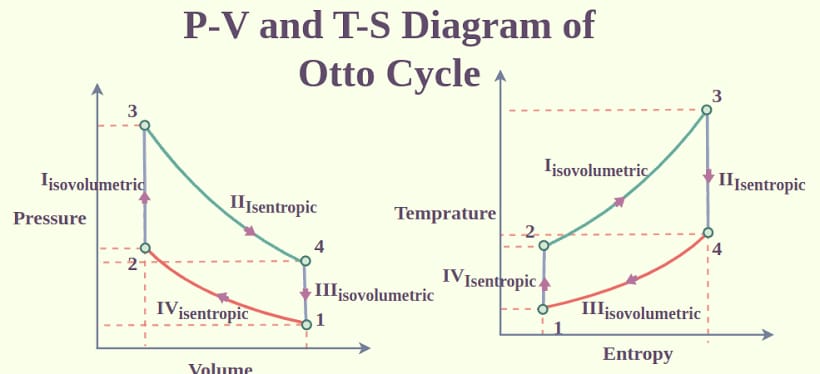
The Otto cycle is represented on:
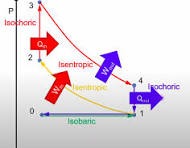
P-V and T-S Diagram of Otto cycle
Shows heat transfer and entropy changes.
Working of Four-Stroke Petrol Engine Based on Otto Cycle
The practical Otto cycle works in four strokes:
1. Suction Stroke
Intake valve opens.
Air-fuel mixture enters cylinder.
2. Compression Stroke
Piston compresses mixture.
Pressure and temperature rise.
3. Power Stroke
Spark plug ignites mixture.
Explosion pushes piston downward.
4. Exhaust Stroke
Exhaust valve opens.
Burnt gases leave cylinder.
Thermal Efficiency of Otto Cycle
The efficiency of the Otto cycle depends mainly on the compression ratio.
Efficiency Formula
η=1−r(γ−1)1
Where:
η = Thermal efficiency
r = Compression ratio
γ = Specific heat ratio
Factors Affecting Otto Cycle Efficiency
Compression ratio
Fuel quality
Combustion efficiency
Heat losses
Engine speed
Higher compression ratio generally gives higher efficiency.
Advantages of Otto Cycle
Simple engine design
Smooth operation
High-speed capability
Good power-to-weight ratio
Widely used in automobiles
Disadvantages of Otto Cycle
Lower efficiency than diesel cycle
Fuel consumption can be higher
Limited compression ratio due to knocking
Produces emissions
Difference Between Otto Cycle and Diesel Cycle
Feature
Otto Cycle
Diesel Cycle
Engine Type
Petrol Engine
Diesel Engine
Ignition
Spark Ignition
Compression Ignition
Heat Addition
Constant Volume
Constant Pressure
Efficiency
Lower
Higher
Compression Ratio
Lower
Higher
Real-Life Importance of Otto Cycle
The Otto cycle forms the foundation of modern gasoline engines and transportation systems. Engineers use it to:
Design engines
Improve fuel efficiency
Reduce emissions
Increase performance
Conclusion
The Otto cycle is the ideal thermodynamic cycle used in spark ignition petrol engines. It consists of four important processes: compression, heat addition, expansion, and heat rejection. Understanding this cycle is essential for studying engine performance, thermodynamics, and automotive engineering.
One comment
The Otto cycle converts fuel energy into mechanical power through controlled combustion inside an engine cylinder.”


The Otto cycle converts fuel energy into mechanical power through controlled combustion inside an engine cylinder.”