Address
304 North Cardinal St.
Dorchester Center, MA 02124
Work Hours
Monday to Friday: 7AM - 7PM
Weekend: 10AM - 5PM
Address
304 North Cardinal St.
Dorchester Center, MA 02124
Work Hours
Monday to Friday: 7AM - 7PM
Weekend: 10AM - 5PM

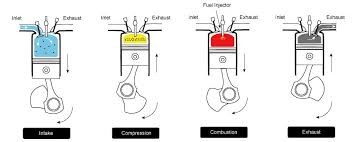
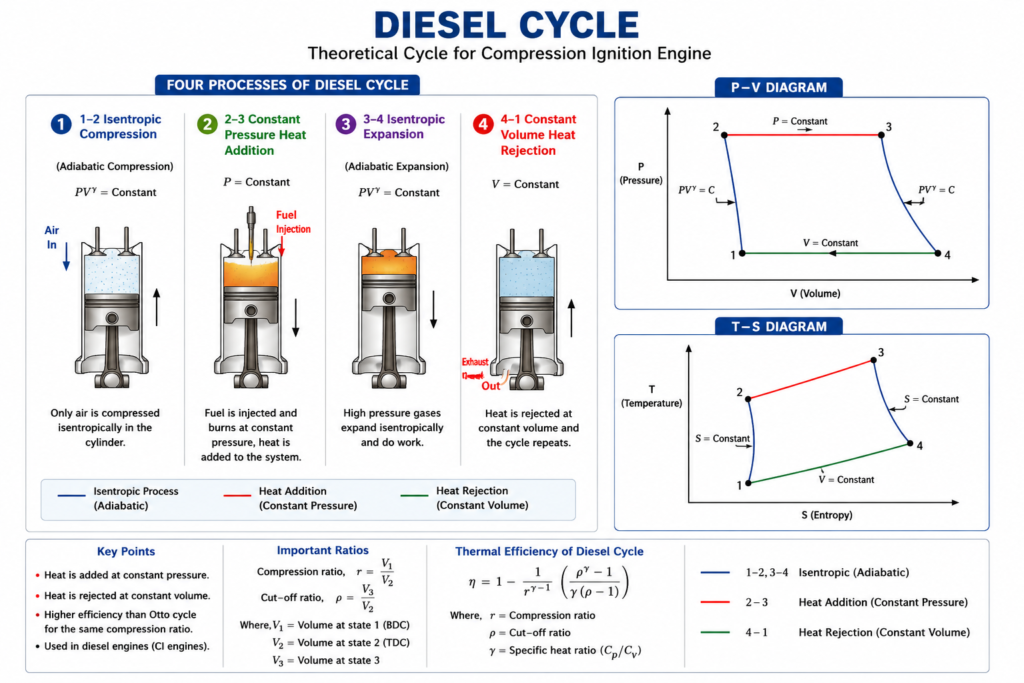
The Diesel cycle is one of the most important thermodynamic cycles used in mechanical and automotive engineering. It describes the working principle of a compression ignition (CI) engine, commonly known as a diesel engine. Diesel engines are widely used in trucks, buses, generators, ships, tractors, and industrial machinery because of their high efficiency and strong torque output.
The Diesel cycle converts heat energy from fuel into mechanical work through a series of thermodynamic processes involving compression, combustion, expansion, and exhaust.
In this blog, we will explain the Diesel cycle, its processes, P–V diagram, efficiency, advantages, disadvantages, and applications.
The Diesel cycle https://share.google/UdYBzMTAZngDWVh3q is a thermodynamic cycle that represents the operation of a diesel engine where fuel combustion occurs due to high compression temperature instead of a spark plug.
A diesel engine operates on the principle of:
The Diesel cycle consists of four thermodynamic processes:
The Pressure–Volume (P–V) diagram represents changes in pressure and volume during the Diesel cycle.
        P
        │
        │          2 ─────── 3
        │         /           \
        │        /             \
        │       /               \
        │      1                 4
│____________________________ VThe area enclosed by the cycle represents the net work output of the engine.
During this process:
PVγ=Constant
Where:
Air becomes extremely hot.
At the end of compression:
High-energy gases are produced.
This is the power stroke.
PVγ=Constant
Engine delivers useful power.
In this final process:
Cycle returns to initial condition.
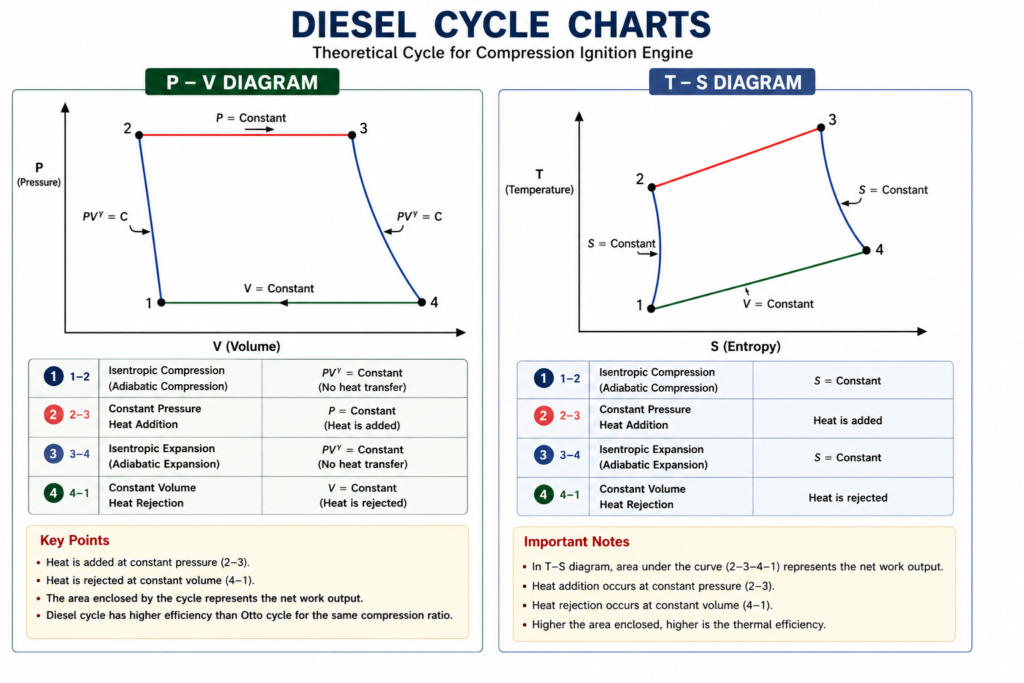
The Temperature–Entropy (T–S) diagram also represents the Diesel cycle thermodynamic processes.
The thermal efficiency is given by:η=1−rγ−11×(γ(ρ−1)ργ−1)
Where:
Diesel engines use high compression ratios:14:1 to 22:1
Higher compression ratios improve thermal efficiency.
- Higher thermal efficiency
- Better fuel economy
- High torque output
- Longer engine life
- Suitable for heavy-duty applications
| Feature | Diesel Cycle | Otto Cycle |
|---|---|---|
| Ignition | Compression ignition | Spark ignition |
| Fuel | Diesel | Petrol |
| Compression Ratio | High | Lower |
| Efficiency | Higher | Lower |
| Engine Type | CI Engine | SI Engine |
Diesel engines achieve higher efficiency because:
Modern diesel systems use:
These technologies reduce emissions and improve performance.
The Diesel cycle is a highly efficient thermodynamic cycle used in compression ignition engines. It consists of air compression, fuel injection, combustion, expansion, and exhaust processes represented through the P–V diagram and thermodynamic relations.
Because of high efficiency, durability, and strong power output, diesel engines remain essential in transportation, industry, agriculture, and power generation systems.
Understanding the Diesel cycle is fundamental for mechanical and automotive engineering students and professionals.
