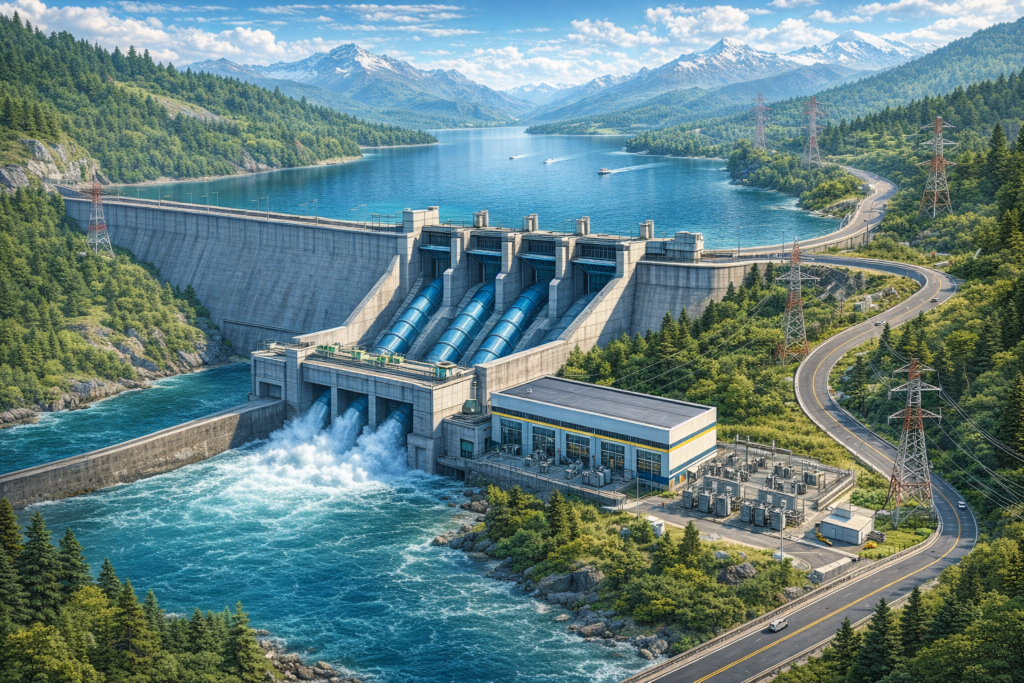
A Hydropower Plant is a power generation system that converts the energy of flowing or falling water into electrical energy. It is one of the oldest and cleanest renewable energy sources.
Hydropower plants use dams, reservoirs, turbines, and generators to produce electricity.
Main Components of Hydropower Plant
1. Dam
A large barrier built across a river.
Stores water in a reservoir.
2. Reservoir
Stores water at a high level.
Provides potential energy.
3. Intake Gate
Controls water flow into penstock.
4. Penstock
Large pipe carrying water to turbine.
5. Turbine
Water strikes turbine blades and rotates them.
6. Generator
Connected to turbine shaft.
Converts mechanical energy into electrical energy.
7. Transformer
Increases voltage for transmission.
8. Tailrace
Channel carrying used water back to river.
Working Principle of Hydropower Plant
Water is stored in the reservoir behind the dam.
When intake gates open, water flows through penstock under pressure.
High-speed water rotates the turbine.
Turbine shaft rotates the generator.
Generator produces electricity.
Electricity passes through transformer and transmission lines.
Water returns to river through tailrace.
Construction of Hydropower Plant
1. Site Selection
River with sufficient water flow.
Suitable height difference (head).
Strong geological foundation.
2. Dam Construction
Concrete or earth-fill dam built across river.
3. Reservoir Development
Water storage area formed behind dam.
4. Penstock Installation
Steel or concrete pipes installed.
5. Powerhouse Construction
Building for turbines and generators.
6. Transmission System
Transformers and power lines installed.
Types of Hydropower Plants
1. Storage Plant
Uses dam and reservoir.
2. Run-of-River Plant
Uses natural river flow.
3. Pumped Storage Plant
Pumps water upward during low demand.
Advantages
Renewable energy source
No fuel cost
Low operating cost
Clean and eco-friendly
Long service life
Disadvantages
High initial cost
Flooding of land
Environmental impact
Depends on rainfall
Applications
Electricity generation
Irrigation support
Flood control
Water supply
Hydropower Plant Diagram
Conclusion
Hydropower plants are reliable and sustainable sources of electricity. They play an important role in meeting energy demands while reducing pollution and fuel dependency.