Address
Malik Saleem Plaza, New City, Wah
Pakistan
WhatsApp: +92 327 5100047
Email: info@developmech.com
Work Hours
Monday to Friday: 3PM - 11AM
Weekend: 10AM - 5PM
Address
Malik Saleem Plaza, New City, Wah
Pakistan
WhatsApp: +92 327 5100047
Email: info@developmech.com
Work Hours
Monday to Friday: 3PM - 11AM
Weekend: 10AM - 5PM

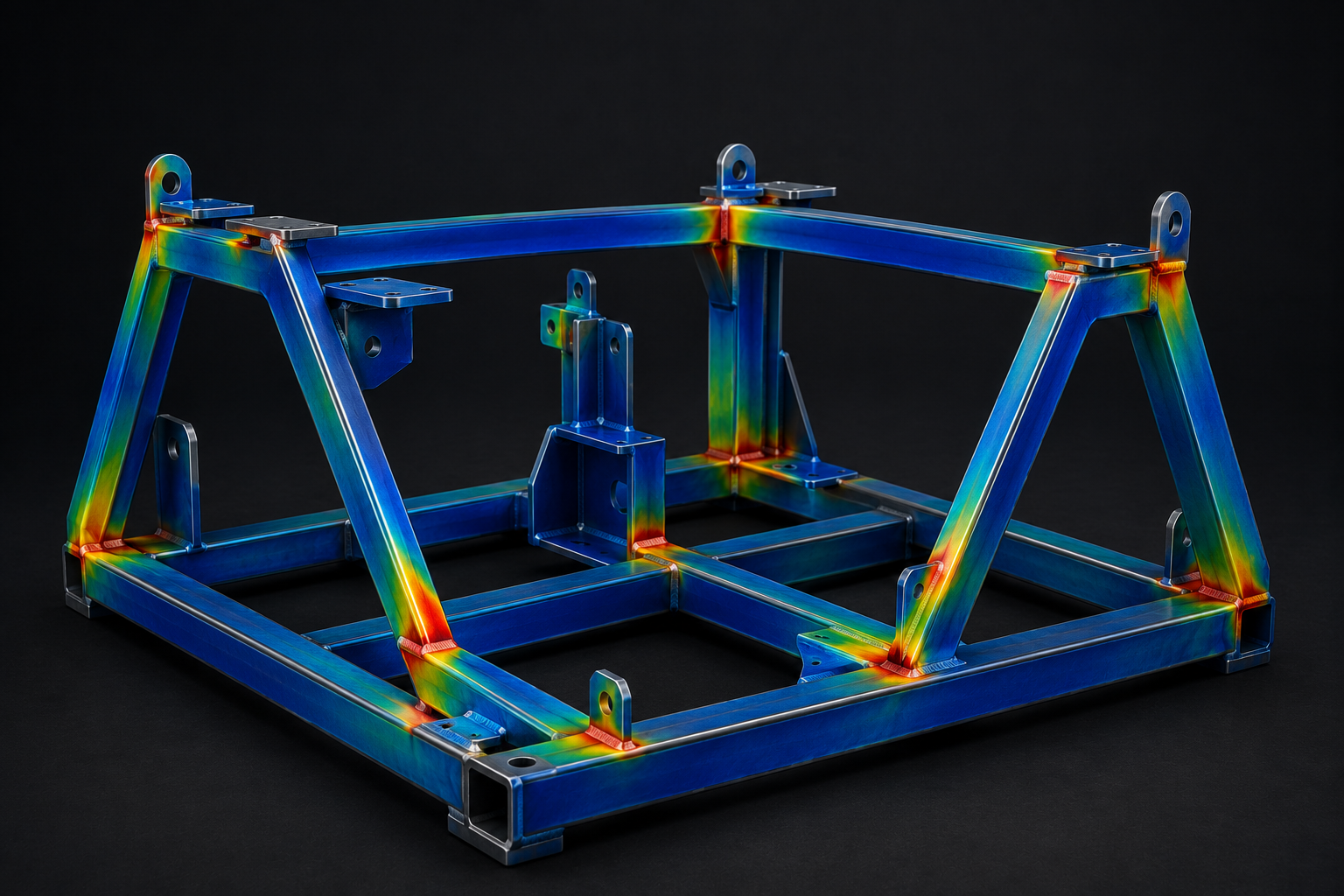
How the way a fabricated steel frame is designed, analyzed, and welded decides whether it ships over-built, fails in the field, or comes out right the first time
Developmech | Engineering Analysis & Weldments
A welded steel structure looks simple: cut some sections, weld them into a frame, paint it, ship it. That apparent simplicity is exactly why it’s so easy to get expensively wrong.
A machine frame, an equipment skid, a trailer chassis, an industrial support structure these carry real loads, often cyclic ones, and they’re joined by welds that behave nothing like the smooth CAD model they came from. Get the design or the analysis wrong and the structure doesn’t warn you. It just ships heavier than it needed to be, or it cracks in the field six months later. One of those is merely expensive; the other is dangerous.
Here are the six mistakes we see most often in fabricated steel structures what each one costs, and how to design it out before steel is cut.
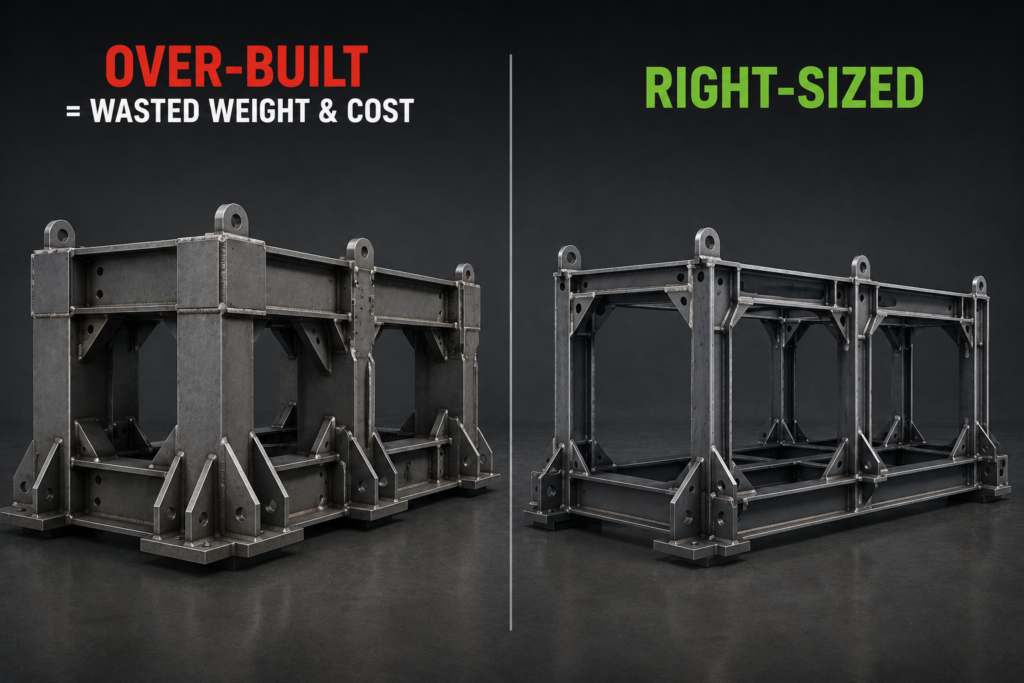
An over-built frame carries steel it never needed (left); a right-sized, stiffened frame does the same job for less weight (right).
The most common and most invisible mistake. An FEA shows an alarming stress number (often a meaningless one see #2), or the engineer simply adds material out of caution, so plates get thicker, sections get heavier, and gussets get added everywhere. The structure passes and carries steel it never needed.
The cost. Every extra kilogram is paid on every unit in material, in welding time, in freight, and in whatever that weight costs your product (payload, efficiency, handling). Over-design is a tax you pay forever.
The fix. Size to the actual loads and the appropriate code safety factors, not to a scary contour plot. Use FEA to remove material as much as to add it thinner webs with the right stiffeners routinely beat thick plate.
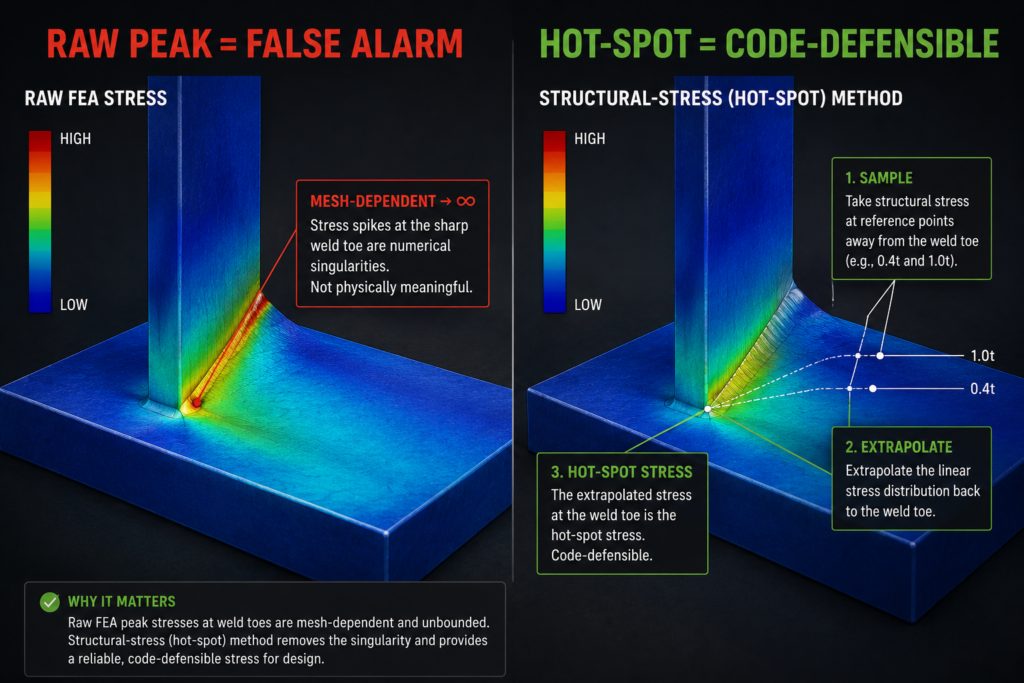
Raw peak stress at a weld toe is singular and mesh-dependent (left); a hot-spot / structural-stress method gives a stable, code-defensible value (right).
Weld toes are sharp re-entrant corners. In a shell or solid FEA they behave as stress singularities the reported stress keeps climbing as you refine the mesh and never converges. Read those numbers literally and every weld looks like a failure waiting to happen.
The cost. Teams either panic and thicken the whole structure, or worse they can’t separate the false alarms from the real fatigue risk and miss the one joint that actually matters.
The fix. Never judge welds on raw peak stress. Use a method built for it nominal stress with weld fatigue (FAT) classes, or hot-spot / structural-stress extrapolation per IIW or Eurocode 3 which returns a stable number instead of a mesh-dependent scare.
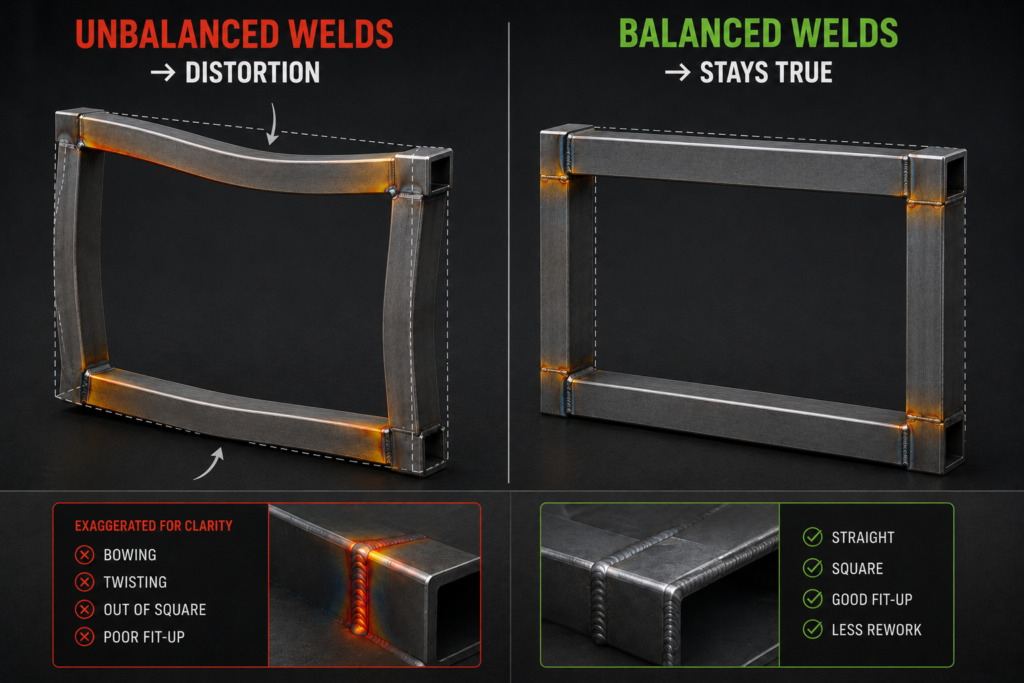
Unbalanced welds pull the frame out of shape (left); balanced welds and a planned sequence keep it true (right).
Welding is localized melting followed by uneven cooling. The steel shrinks as it cools, and that shrinkage pulls the whole assembly out of shape and locks in residual stress. A frame that’s dead-straight in CAD can come off the table bowed, twisted, and out of tolerance.
The cost. Rework, flame-straightening, fixtures, scrap, and parts that won’t assemble plus residual stresses that quietly eat into fatigue life at exactly the joints you care about.
The fix. Design for the weld, not just the geometry. Balance welds about the neutral axis, minimize weld volume, plan the weld sequence, and use intermittent welds where continuous ones aren’t needed. Distortion is a design problem long before it’s a shop-floor problem.
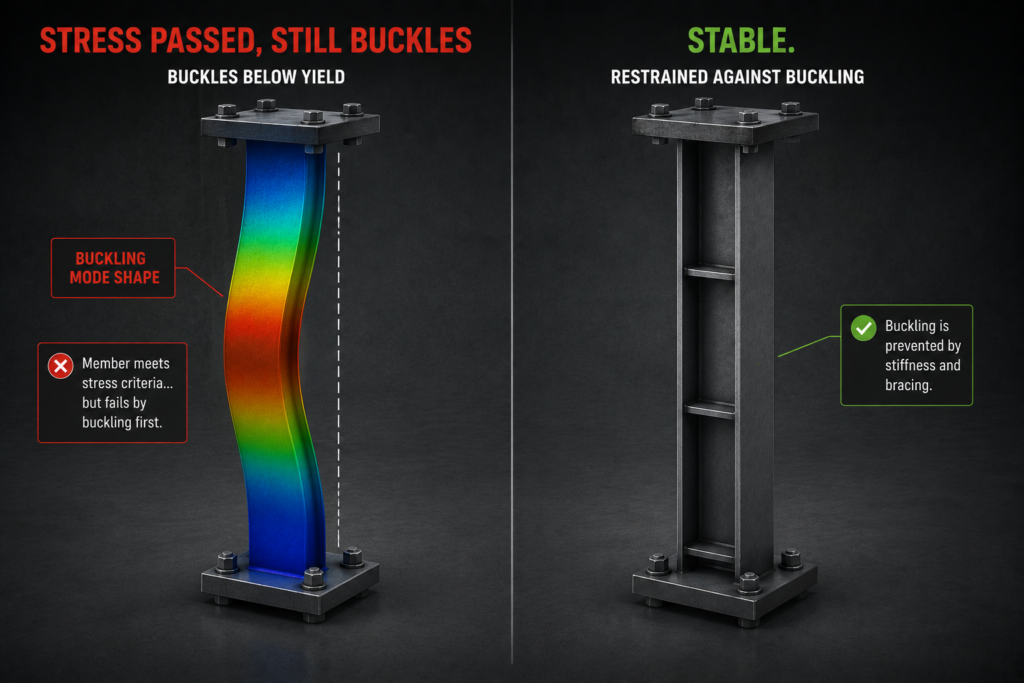
A slender member buckles well below yield (left); bracing or a stiffened / closed section keeps the compression path stable (right).
Steel structures are often governed by buckling, not strength. A slender compression member, a thin web, an unbraced flange any of these can collapse well below the yield stress your FEA is checking against. A stress plot that passes tells you nothing about whether the structure is stable.
The cost. Buckling failures are sudden and total. A frame that “passed” on stress can fold under a load it was supposedly designed for.
The fix. Run buckling analysis (linear eigenvalue as a screen, nonlinear where it matters), check member slenderness, and add stiffeners, bracing, or closed sections wherever the compression paths demand them.
How you support and load the model decides the entire result. Fix the structure at a single node and you invent both a singularity and an artificially stiff support. Bolt-mount it in reality but weld it rigidly in the model and your load paths, deflections, and reactions are all fiction.
The cost. You end up designing against a structure that doesn’t exist either falsely confident (hidden weakness) or falsely alarmed (needless mass).
The fix. Model supports the way the structure is actually mounted bolted feet, contact, distributed couplings, realistic stiffness and apply loads over real contact areas. Then sanity check that reactions and deflections match physical intuition before trusting a single stress number.
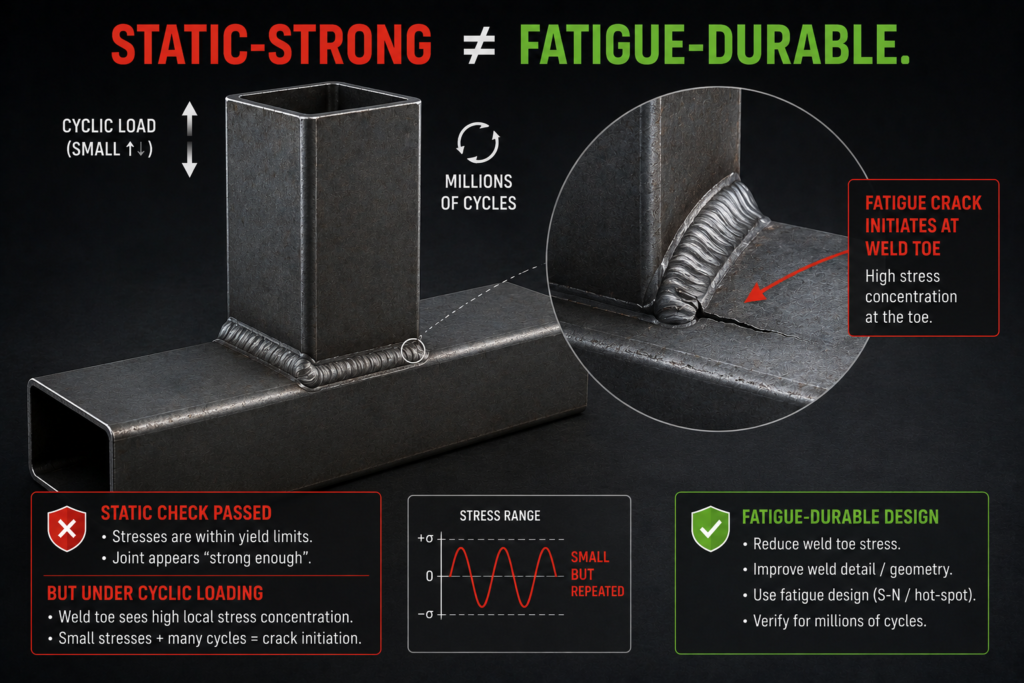
Under cyclic load, cracks initiate at the weld toe long before static strength is reached.
Machine frames, automotive structures, trailers, and vibrating equipment don’t see one static load they see millions of cycles. A structure that passes a static FEA with margin can still crack from fatigue, almost always starting at a weld.
The cost. Field failures, warranty claims, downtime, and recalls the most expensive way possible to learn that “static-strong” and “fatigue-durable” are not the same thing.
The fix. If the loading is cyclic, run a fatigue assessment real load spectra, S-N data, and weld FAT classes and improve the critical details (weld quality, toe grinding, smooth transitions) rather than just adding bulk.
Notice the theme: a welded steel structure is only as good as the assumptions behind it. The steel itself is cheap and forgiving; the money is lost in how it’s loaded, analyzed, welded, and evaluated. The difference between a frame that’s over-built, one that fails in the field, and one that’s exactly right is almost never the material it’s the engineering upstream of the first cut.
At Developmech, we design and analyze fabricated steel structures frames, skids, chassis, and weldments for exactly this: right-sized, fatigue-aware, and manufacturable before anything is welded. If you’ve got a structure that has to be light, durable, and correct the first time, we’re glad to take a look.
