Address
304 North Cardinal St.
Dorchester Center, MA 02124
Work Hours
Monday to Friday: 7AM - 7PM
Weekend: 10AM - 5PM
Address
304 North Cardinal St.
Dorchester Center, MA 02124
Work Hours
Monday to Friday: 7AM - 7PM
Weekend: 10AM - 5PM

The internal combustion (IC) engine is the heart of most vehicles, converting fuel into mechanical energy. The diagram above shows an exploded view of an engine, helping us clearly understand how different components are assembled and how they work together.
Let’s break down the major parts of an IC engine and their functions.
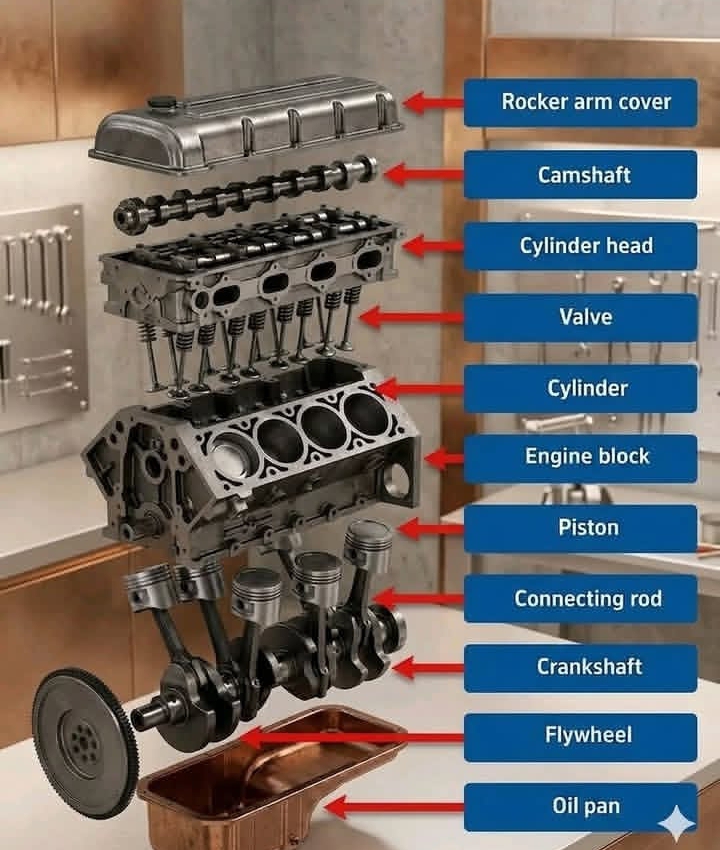
The rocker arm cover sits at the top of the engine and protects the valve mechanism from dust, dirt, and oil leakage. It also helps retain lubrication inside the system.
The camshaft controls the opening and closing of engine valves. It rotates in sync with the crankshaft and ensures proper timing for air-fuel intake and exhaust gas release.
The cylinder head is mounted above the engine block and houses valves, spark plugs, and sometimes the camshaft. It forms the top part of the combustion chamber.
Valves regulate the flow of gases:
The cylinder is the space where the piston moves up and down. It is the main area where combustion occurs.
The engine block is the main body of the engine. It contains cylinders, coolant passages, and oil galleries, providing structural support to all components.
The piston moves inside the cylinder due to combustion pressure. It converts the energy of expanding gases into mechanical motion.
The connecting rod links the piston to the crankshaft. It transfers motion from the piston (linear) to the crankshaft (rotational).
The crankshaft converts the reciprocating motion of the piston into rotational motion, which ultimately powers the vehicle.
The flywheel stores rotational energy and ensures smooth engine operation by reducing fluctuations in speed.
The oil pan is located at the bottom of the engine and stores lubricating oil. It helps in cooling and lubrication of engine components.
This continuous cycle produces power to run the engine.
An internal combustion engine is a complex system made up of precisely engineered components working in perfect synchronization. Understanding these parts is essential for mechanical engineers, students, and anyone interested in automotive technology.
