What is a Refrigeration System?

A refrigeration system is a mechanism that removes heat from one place and transfers it to another using a refrigerant. The main purpose is to maintain a lower temperature in a specific area or space.

In simple words:

Refrigeration = Removing Heat


Basic Principle of Refrigeration

The refrigeration cycle works on the principle that:

“Heat naturally flows from a high-temperature area to a low-temperature area.”

A refrigeration system forces this heat transfer process using a refrigerant and mechanical components.


Main Components of a Refrigeration System

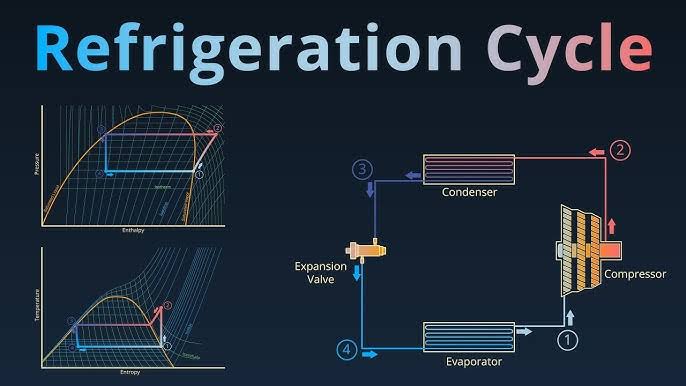
A basic vapor compression refrigeration system consists of four major components:


1. Compressor

The compressor is called the heart of the refrigeration system.

Function

  • Compresses low-pressure refrigerant vapor
  • Increases refrigerant pressure and temperature
  • Circulates refrigerant through the system

Types

  • Reciprocating compressor
  • Rotary compressor
  • Screw compressor
  • Centrifugal compressor

2. Condenser

The condenser removes heat from the refrigerant.

Function

  • Converts high-pressure vapor into liquid
  • Releases heat to surrounding air or water

Working

Hot refrigerant enters the condenser and cools down, changing into a high-pressure liquid.


3. Expansion Valve

The expansion valve controls refrigerant flow.

Function

  • Reduces refrigerant pressure
  • Lowers refrigerant temperature
  • Controls refrigerant entering the evaporator

Types

  • Thermostatic expansion valve (TXV)
  • Capillary tube
  • Electronic expansion valve

4. Evaporator

The evaporator absorbs heat from the refrigerated space.

Function

  • Converts liquid refrigerant into vapor
  • Absorbs heat from air or products

Working

Cold refrigerant enters the evaporator and absorbs heat, producing a cooling effect.


Working Cycle of Refrigeration System

The refrigeration cycle operates continuously in four main stages:


Step 1: Compression Process

  • Low-pressure refrigerant vapor enters the compressor.
  • Compressor compresses the vapor.
  • Pressure and temperature increase significantly.

Output: High-pressure, high-temperature vapor


Step 2: Condensation Process

  • Hot refrigerant enters the condenser.
  • Heat is released to surrounding air.
  • Refrigerant changes from vapor to liquid.

Output: High-pressure liquid refrigerant


Step 3: Expansion Process

  • Liquid refrigerant passes through the expansion valve.
  • Pressure drops suddenly.
  • Temperature decreases rapidly.

Output: Low-pressure, low-temperature refrigerant


Step 4: Evaporation Process

  • Cold refrigerant enters the evaporator.
  • Absorbs heat from the cooling area.
  • Refrigerant evaporates into vapor.

Output: Low-pressure vapor

The cycle then repeats continuously.


Refrigerants Used in Refrigeration Systems

Refrigerants are special fluids used to absorb and transfer heat.

Common Refrigerants

  • R-134a
  • R-410A
  • Ammonia (NH₃)
  • R-32
  • CO₂ refrigerant

Applications of Refrigeration Systems

Refrigeration systems are used in many industries:

  1. Domestic refrigerators
  2. Air conditioning systems
  3. Cold storage warehouses
  4. Food processing plants
  5. Pharmaceutical industry
  6. Chemical industries
  7. Ice plants

Advantages of Refrigeration Systems


  1. Preserves food and medicine
  2. Provides thermal comfort
  3. Improves industrial processes
  4. Reduces spoilage and waste
  5. Maintains controlled temperature

Common Problems in Refrigeration Systems

Some common operational issues include:

  • Refrigerant leakage
  • Compressor failure
  • Dirty condenser coils
  • Ice formation in evaporator
  • Low cooling performance

Regular maintenance helps improve efficiency and system life.


Maintenance Tips

  1. Clean condenser coils regularly
  2. Check refrigerant levels
  3. Inspect compressor operation
  4. Replace damaged filters
  5. Ensure proper airflow

Conclusion

A refrigeration system works by continuously transferring heat from a low-temperature area to a high-temperature area using a refrigerant. The four major components — compressor, condenser, expansion valve, and evaporator — work together to produce cooling efficiently.

Understanding refrigeration systems is important for mechanical engineers, HVAC technicians, and anyone interested in thermal engineering technologies.

Leave a Reply

Your email address will not be published. Required fields are marked *