Address
304 North Cardinal St.
Dorchester Center, MA 02124
Work Hours
Monday to Friday: 7AM - 7PM
Weekend: 10AM - 5PM
Address
304 North Cardinal St.
Dorchester Center, MA 02124
Work Hours
Monday to Friday: 7AM - 7PM
Weekend: 10AM - 5PM

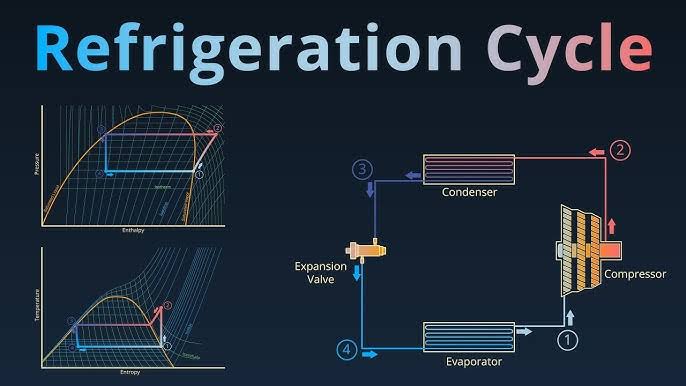
A refrigeration system is a mechanism that removes heat from one place and transfers it to another using a refrigerant. The main purpose is to maintain a lower temperature in a specific area or space.
In simple words:
Refrigeration = Removing Heat
The refrigeration cycle works on the principle that:
“Heat naturally flows from a high-temperature area to a low-temperature area.”
A refrigeration system forces this heat transfer process using a refrigerant and mechanical components.
A basic vapor compression refrigeration system consists of four major components:
The compressor is called the heart of the refrigeration system.
The condenser removes heat from the refrigerant.
Hot refrigerant enters the condenser and cools down, changing into a high-pressure liquid.
The expansion valve controls refrigerant flow.
The evaporator absorbs heat from the refrigerated space.
Cold refrigerant enters the evaporator and absorbs heat, producing a cooling effect.
The refrigeration cycle operates continuously in four main stages:
Output: High-pressure, high-temperature vapor
Output: High-pressure liquid refrigerant
Output: Low-pressure, low-temperature refrigerant
Output: Low-pressure vapor
The cycle then repeats continuously.
Refrigerants are special fluids used to absorb and transfer heat.
Refrigeration systems are used in many industries:
Some common operational issues include:
Regular maintenance helps improve efficiency and system life.
A refrigeration system works by continuously transferring heat from a low-temperature area to a high-temperature area using a refrigerant. The four major components — compressor, condenser, expansion valve, and evaporator — work together to produce cooling efficiently.
Understanding refrigeration systems is important for mechanical engineers, HVAC technicians, and anyone interested in thermal engineering technologies.
