Address
Malik Saleem Plaza, New City, Wah
Pakistan
WhatsApp: +92 327 5100047
Email: info@developmech.com
Work Hours
Monday to Friday: 3PM - 11AM
Weekend: 10AM - 5PM
Address
Malik Saleem Plaza, New City, Wah
Pakistan
WhatsApp: +92 327 5100047
Email: info@developmech.com
Work Hours
Monday to Friday: 3PM - 11AM
Weekend: 10AM - 5PM

The real difference between a petrol engine and a diesel is not the fuel, it is the load the structure has to survive, and none of it is on the spec sheet
Developmech | Structural, Fatigue & Vibration Analysis
The petrol against diesel argument is almost always about fuel: efficiency, torque, emissions, the cost of a mile. But an engine does not fail because of which fuel it burns. It fails because a part fatigues, a head cracks, a bearing wipes, or the whole thing shakes itself loose. The difference between petrol and diesel that actually decides how the engine is built is not the fuel at all. It is the peak pressure in the cylinder, and everything that pressure does to the structure around it.
A diesel runs peak pressures two to three times those of a petrol engine, so its pistons, rods, crank, bearings, head, and bolts all carry far higher loads, which is why a diesel of the same size comes out heavier and stiffer. That is not caution, it is the load. A petrol engine, in return, revs higher, so its reciprocating parts fight inertia instead. The same basic machine becomes two quite different structural problems.
Here are the six mechanical reasons engines fail, and where petrol and diesel part ways.
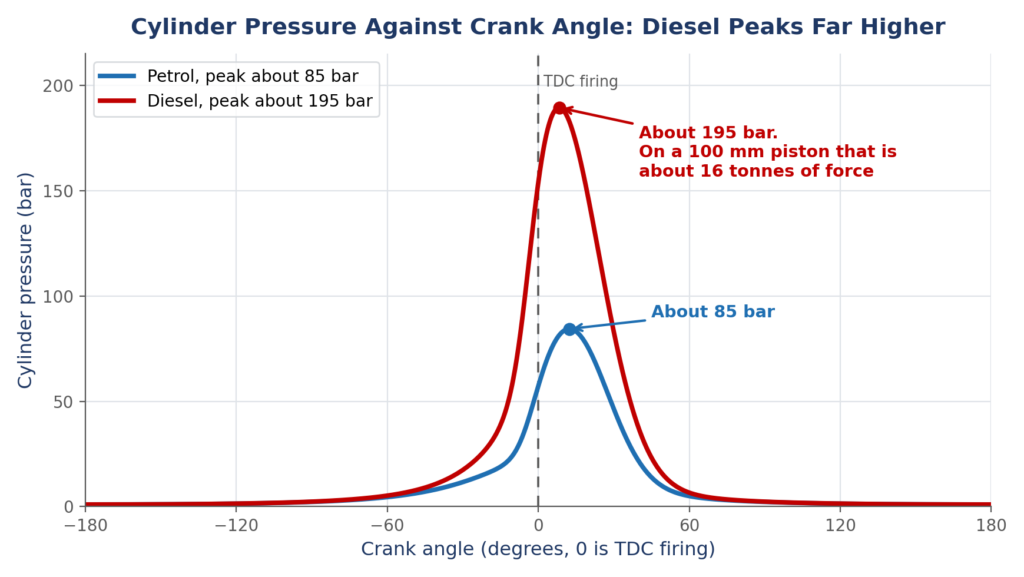
A diesel peaks around 180 to 200 bar, a petrol engine around 80 to 90. On a large piston that is over fifteen tonnes of force, every stroke.
Almost every difference between a petrol engine and a diesel follows from one number, the peak pressure in the cylinder at combustion. A petrol engine peaks somewhere around 80 to 90 bar. A diesel, with its high compression and its fuel burning as it is injected, peaks around 180 to 200 bar or more. Pressure acts on the piston area, so on a large bore that peak is well over fifteen tonnes of force pressing down through the piston, the rod, and the crank, thousands of times a minute. That single number sets how heavy the crank has to be, how thick the rod, how many bolts hold the head down, and how large the bearings are. The fuel is almost a side issue.
The cost. A structure sized for petrol pressures and asked to carry diesel loads, which then fails at the crank, the rod, the bearings, or the head, whichever had the thinnest margin.
The fix. Start from the real cylinder pressure trace, not a nominal figure. Size the piston, rod, crank, bolts, and bearings to the actual peak pressure and its rate of rise, and treat the two combustion systems as two different load cases, because that is what they are.

Every firing stroke bends and twists the crank. Over the life of the engine that is more than a billion load cycles, so the crank is designed to a fatigue limit.
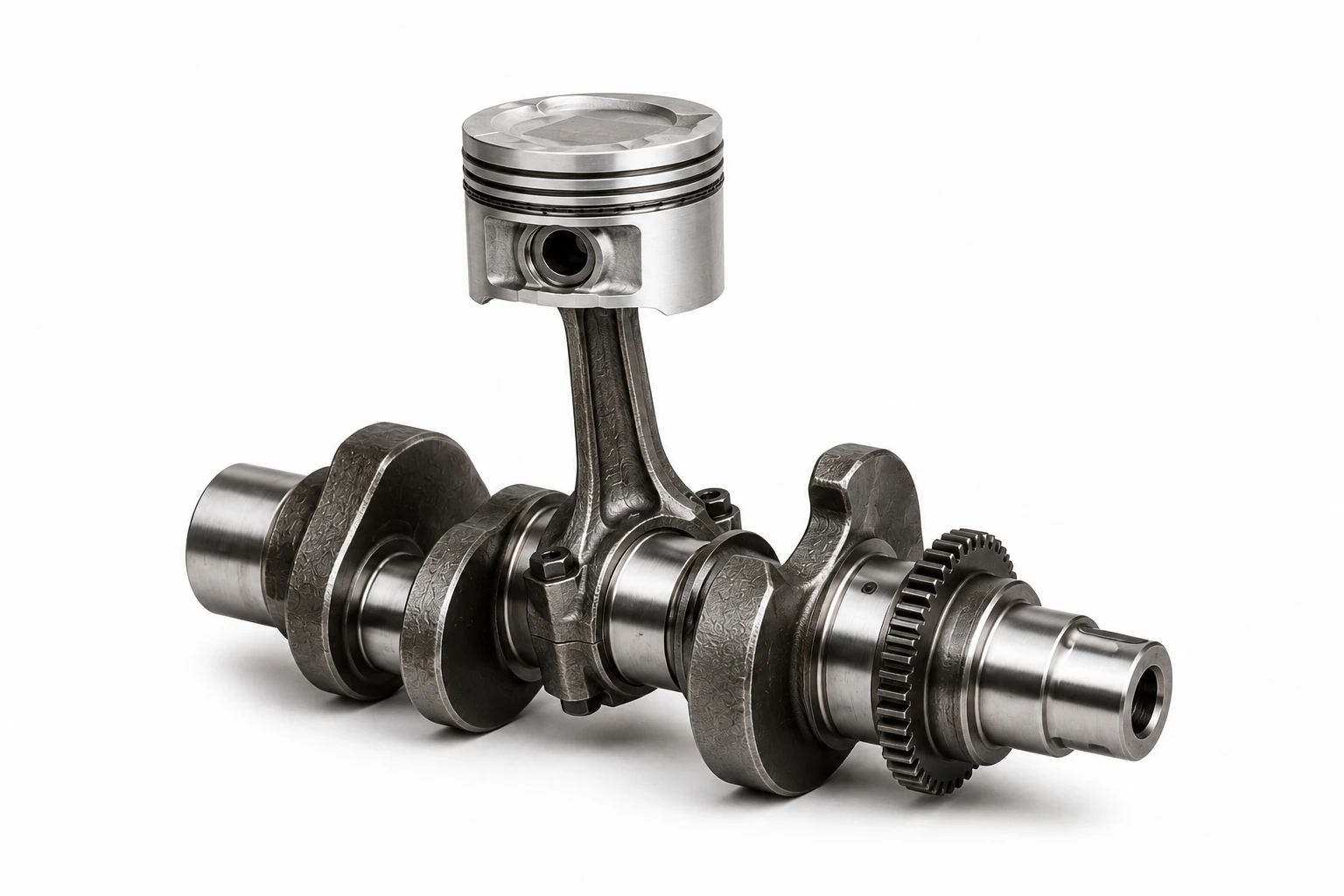
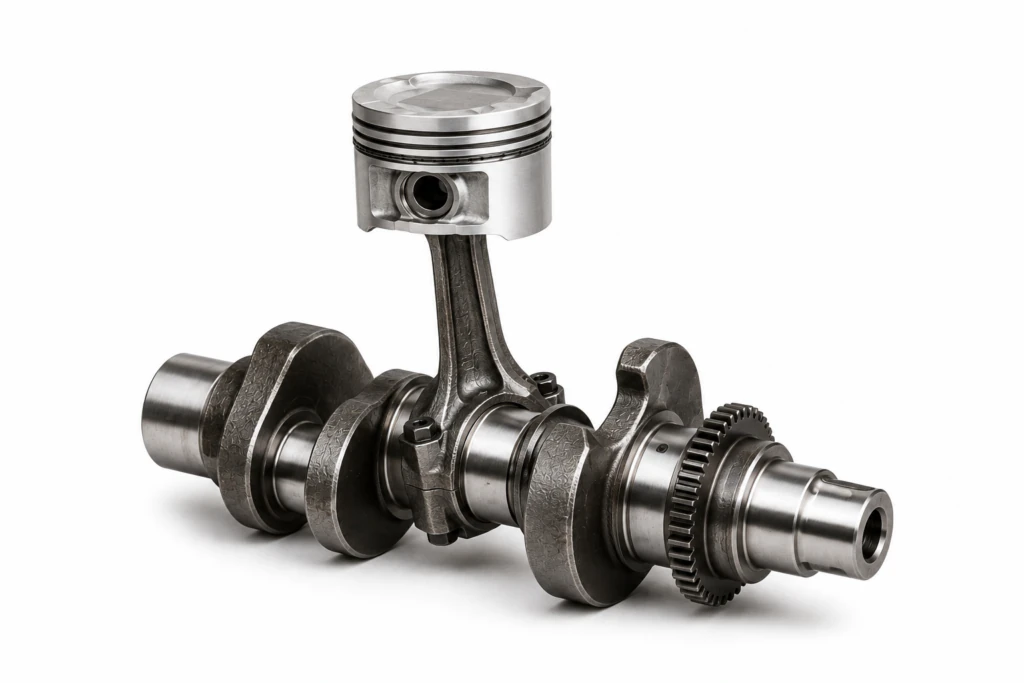
The crankshaft looks like a solid steel bar, but mechanically it is a fatigue component under a relentless load. Every firing stroke bends it between its main bearings and twists it along its length, and it sees that load once per cylinder every two revolutions, which adds up to well over a billion cycles across the life of the engine. The stress concentrates in the fillets where the crankpins and journals meet the webs, exactly where a forging flaw or a sharp radius will start a crack. Because the cycle count is so high, the number that governs is the fatigue limit at those fillets, not the yield strength of the steel.
The cost. A fatigue crack that starts in a crankpin fillet and runs until the crank breaks, which usually takes the block, the rods, and everything else with it.The fix. Design the crank to a fatigue limit at the fillets. Roll the fillets to leave them in compression, keep the radii generous, balance the shaft to cut the bending, and where torsional loads are high, damp them rather than let the crank absorb them

The head seals combustion pressure while cycling from cold to very hot. Thermal fatigue cracks it between the valves, and the gasket is where it lets go first.
The cylinder head has to seal the full combustion pressure while running from cold start to very hot and back, over and over. The thin bridges of metal between the valve seats reach the highest temperatures and swing the furthest, so that is where thermal fatigue cracks appear first. Holding all of it down is the head gasket, clamped by the head bolts, and it is usually where a struggling engine leaks first, letting combustion gas into the coolant or the oil. A diesel makes this far harder, because the same joint now has to hold two to three times the pressure.
The cost. Thermal fatigue cracks between the valves, a head gasket that fails and mixes combustion gas, coolant, and oil, and a warped head if it has been overheated.
The fix. Treat the head as a thermal and pressure part together. Analyze the thermal cycle and the combustion pressure on the head, design the valve bridges and the cooling to survive the swing, and specify the gasket, the bolt pattern, and the preload to hold the seal hot, cold, and at peak pressure.

Combustion crushes the rod, inertia at the top of the exhaust stroke stretches it. Petrol revs stretch it harder, diesel pressure crushes it harder.
The connecting rod is loaded in two directions every cycle. Combustion drives the piston down and puts the rod in heavy compression, so it has to resist buckling. Then, at the top of the exhaust stroke, the inertia of the piston tries to keep going and pulls the rod in tension. Which one governs depends on the engine. A high revving petrol engine generates huge inertial tension and can pull a rod apart or throw it, while a diesel’s massive combustion pressure is a compression and buckling problem. The piston crown, meanwhile, takes the pressure and the heat directly, and abnormal combustion like knock or pre ignition can hammer it or hole it.
The cost. A rod that buckles under pressure or stretches and lets go under inertia, and a piston cracked or holed by heat or abnormal combustion, any of which ends the engine at once.
The fix. Size the rod for both cases, buckling under peak pressure and tension at maximum speed, with the fasteners treated as the critical detail. Design the piston for the thermal and the pressure load, and keep combustion controlled so knock and pre ignition never load it in a way it was not designed for.

The crank never touches its bearings, it floats on a film of oil thinner than a hair. Lose the film for a moment and the bearing wipes.
The crankshaft does not actually touch its bearings. It rides on a hydrodynamic film of oil a few microns thick that its own rotation drags into the gap and pressurizes. Every main and big end bearing in the engine survives on that film, and the moment it is lost, through low oil pressure, the wrong clearance, contamination, or the load pushing straight through it, metal touches metal and the bearing wipes in seconds. Diesel loads squeeze the film harder, petrol speeds shear it faster, and both depend completely on oil at the right pressure, temperature, and cleanliness.
The cost. A wiped or spun bearing and a scored crank journal, often a failure that begins as a knock and ends with the crank seized or broken.The fix. Design the bearings and the oil system as one. Set the clearances, the bearing material, and the oil grade for the real load and speed, size the pump and the galleries to hold pressure when hot, and protect the film with filtration and cooling, because everything else in the engine depends on it

The firing pulses twist the crank at engine orders. Let one line up with the crank’s torsional natural frequency and it tears itself apart.
An engine does not deliver power smoothly, it delivers it in pulses, one per firing stroke, and those pulses twist the crankshaft back and forth on top of its rotation. That torsional excitation arrives at multiples of engine speed, the engine orders, and the crank has its own torsional natural frequency. If an order lines up with that frequency anywhere in the operating range, the crank winds and unwinds far beyond the average, and the vibration cracks the crank, destroys the damper, or wears the timing gears and chains. Diesels, with their bigger and sharper firing pulses, excite this harder, which is why they lean so heavily on torsional dampers.
The cost. A torsional resonance that cracks the crankshaft, shakes the timing drive and the accessories apart, and radiates noise and vibration into the whole vehicle.
The fix. Analyze the crank as a torsional system. Build the order diagram against the crank’s natural frequencies across the speed range, keep the critical orders out of the operating band, and tune a torsional damper where a crossing cannot be avoided.
