Address
Malik Saleem Plaza, New City, Wah
Pakistan
WhatsApp: +92 327 5100047
Email: info@developmech.com
Work Hours
Monday to Friday: 3PM - 11AM
Weekend: 10AM - 5PM
Address
Malik Saleem Plaza, New City, Wah
Pakistan
WhatsApp: +92 327 5100047
Email: info@developmech.com
Work Hours
Monday to Friday: 3PM - 11AM
Weekend: 10AM - 5PM

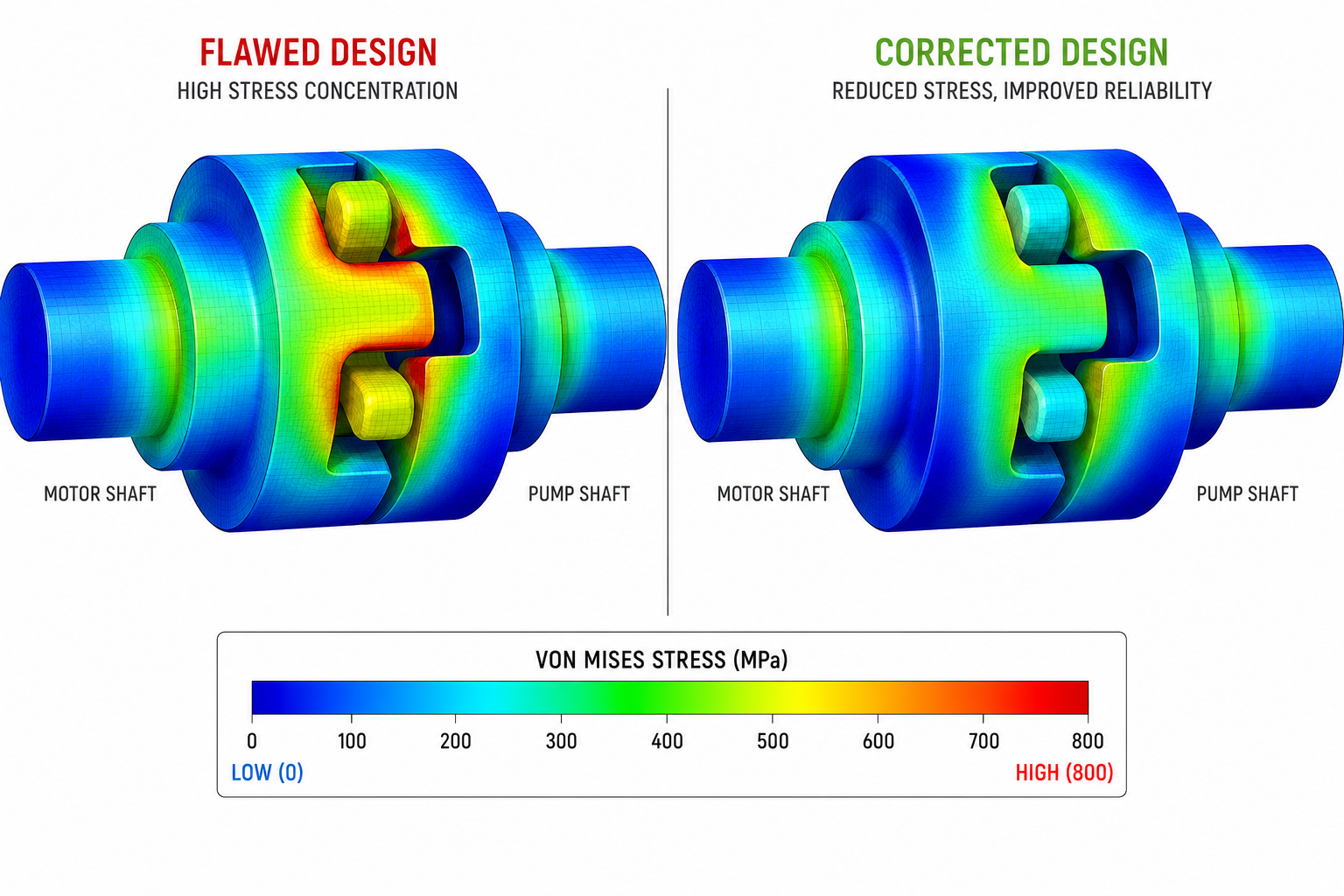
Why a broken coupling is almost always a symptom of misalignment, torsional resonance, or a drivetrain that was never sized for what it actually sees
Developmech | Rotating Equipment & Drivetrain Analysis
Here’s a story every maintenance engineer knows. A coupling shreds. You replace it. Four months later, it shreds again. You buy a better one a stronger element, a higher torque rating and it lasts six months instead of four.
At no point does anyone ask the obvious question: why is the cheapest part in the drivetrain the only one that keeps dying?
Because it’s the messenger. A coupling sits between two machines and absorbs whatever the drivetrain does to it misalignment, torque spikes, torsional oscillation. It is deliberately the most compliant, most replaceable link in the chain, which means it usually fails first. Replacing it without asking what killed it isn’t maintenance. It’s a subscription.
Here are the six things a failing coupling is usually trying to tell you.
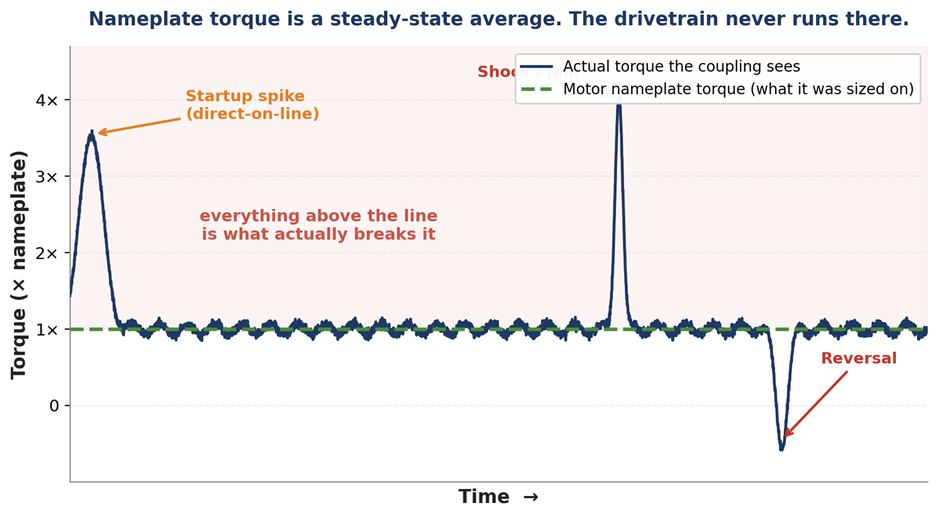
Motor nameplate torque is an average. Startup spikes, shock loads, and reversals are what the coupling actually sees.
Motor nameplate torque is a steady-state rating. The drivetrain never sees steady state. Direct-on-line starting can spike torque to several times nominal; a jammed conveyor, a slug of liquid, a reversing load, or a VFD transient can spike it further. Size the coupling to the nameplate number and you’ve sized it for a load the machine never actually applies.
The cost. The coupling fails early and repeatedly or, far worse, it doesn’t fail, and the shock passes straight through into the gearbox or shaft, which cost fifty times more.
The fix. Size against the real duty cycle, not the nameplate. Apply the appropriate service factor for the driver and the driven machine, and account for starting torque, shock and reversing loads, and the number of starts per hour.
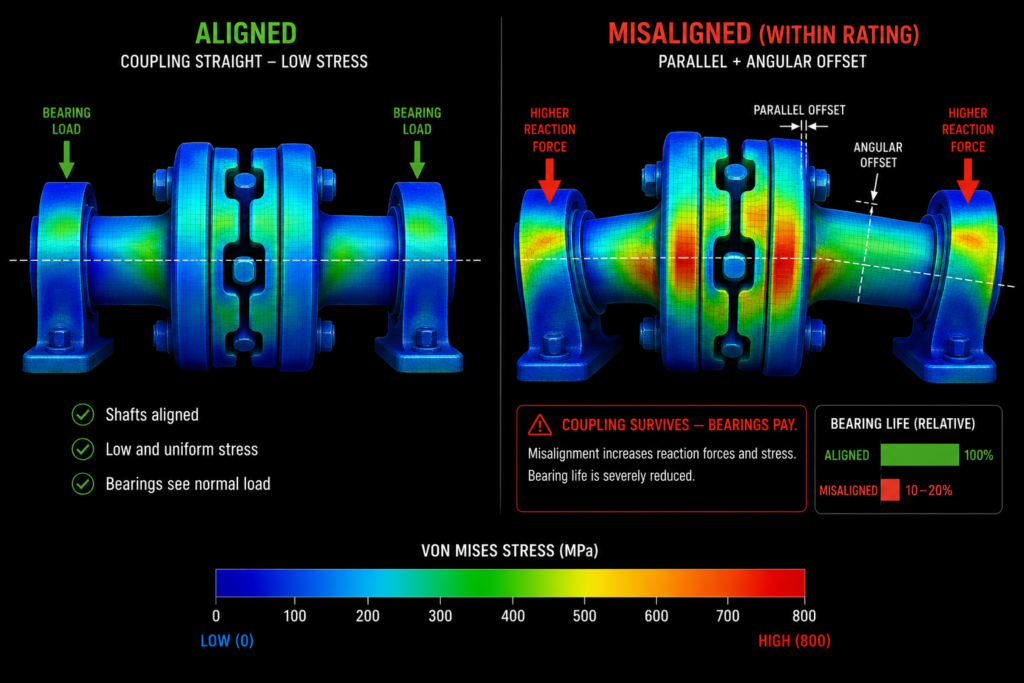
A flexible coupling accommodates misalignment; it doesn’t erase it the reaction forces go straight into the bearings and seals.
This is the single most misunderstood idea in drivetrain design. A flexible coupling tolerates a specified, usually small, amount of parallel and angular misalignment but tolerating misalignment is not the same as removing its loads. Every degree of residual misalignment generates cyclic reaction forces, and those forces are reacted by the bearings and seals on either side of it.
The cost. Here’s the trap: the coupling is not what fails. The bearings do and bearing life falls off a cliff, because life varies with load to roughly the third power (or more). Teams replace bearings and seals for years without ever suspecting the alignment.
The fix. Treat the coupling’s misalignment rating as a safety margin, not a design allowance. Align properly (laser alignment, not a straight edge), and design the mounting so alignment can actually be achieved and held stiff baseplates, machined mounting faces, adjustable feet.
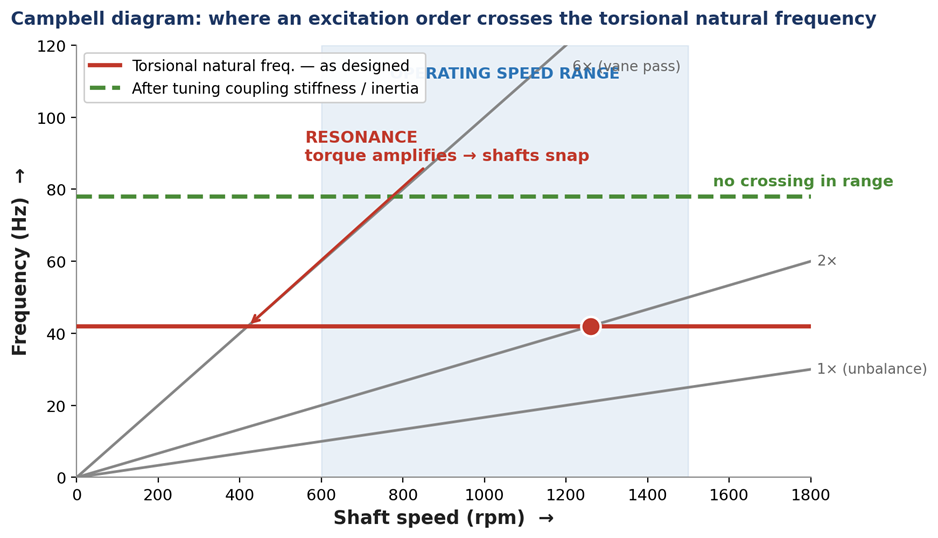
Coupling stiffness plus system inertias sets the torsional natural frequency. Where an excitation order crosses it inside the operating range, torque amplifies.
This is the one that breaks shafts. The coupling’s torsional stiffness, together with the inertias of the motor and driven machine, sets the drivetrain’s torsional natural frequency. If any excitation order motor pole passing, VFD harmonics, pump vane or compressor blade passing, engine firing order crosses that frequency in the operating range, torque amplifies dramatically. And torsional vibration is nearly invisible: it does not show up on a routine lateral vibration survey, so it can run undetected until something snaps.
The cost. Snapped shafts, sheared keys, gear-tooth damage, and coupling failures with no obvious cause the classic “we don’t understand why this keeps breaking” failure.The fix. Run a torsional vibration analysis, especially on variable-speed and reciprocating drives. The coupling is your main tuning knob: its torsional stiffness and inertia can shift the natural frequency out of the operating range, and an elastomeric element can add damping to survive an unavoidable crossing
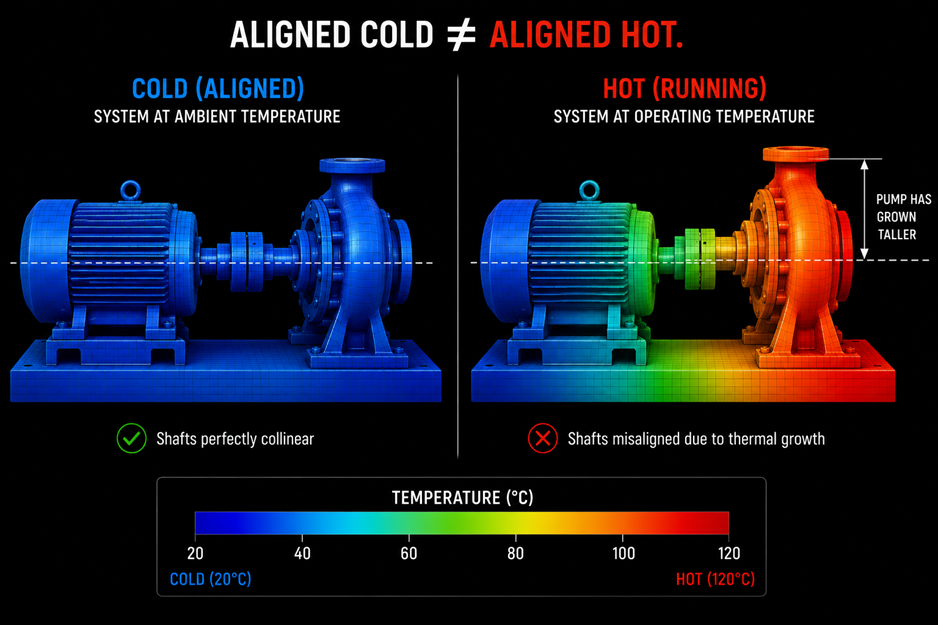
Machines are aligned cold and run hot thermal growth moves the shafts, so a perfect cold alignment can be a bad running one.
Alignment is set with the machine cold and stationary. It then runs hot. Pumps, compressors, turbines, and their drivers grow as they heat, and they don’t all grow by the same amount or in the same direction. A drivetrain that is perfectly aligned on the shop floor can be meaningfully misaligned at operating temperature which drops you straight back into mistake #2.
The cost. Chronic bearing and seal failures that appear only in service and never in commissioning the hardest kind of fault to trace, because everything checks out when it’s cold.
The fix. Calculate the thermal growth of both machines and set deliberate cold offsets so the drivetrain aligns hot, not cold. Where growth is large or uncertain, verify alignment at operating temperature.
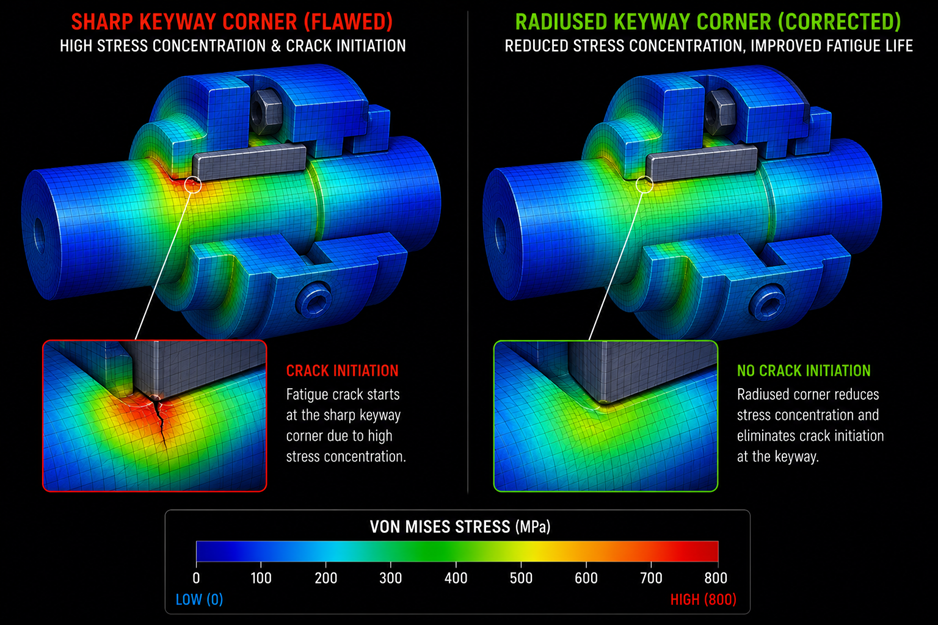
The coupling transmits torque through the shaft keyway a sharp-cornered stress riser under cyclic torque. Radiusing the corner spreads the load.
The coupling doesn’t transmit torque by magic; it transmits it through a key sitting in a keyway machined into the shaft. That keyway is a sharp-cornered stress concentration cut into a shaft carrying cyclic torque and if any of the previous mistakes are amplifying that torque, the keyway is where the shaft will crack.
The cost. A snapped shaft, which usually takes the bearings, seals, and often the driven machine with it. The coupling gets replaced; the root cause is machined into the shaft.
The fix. Radius the keyway corners a sharp keyway corner is a fatigue crack waiting to happen and check torsional fatigue at the stress riser, not just nominal shaft stress. For high-cycle or high-torque duty, consider keyless connections: shrink fits, taper locks, or hydraulic bushings that spread the load instead of concentrating it.
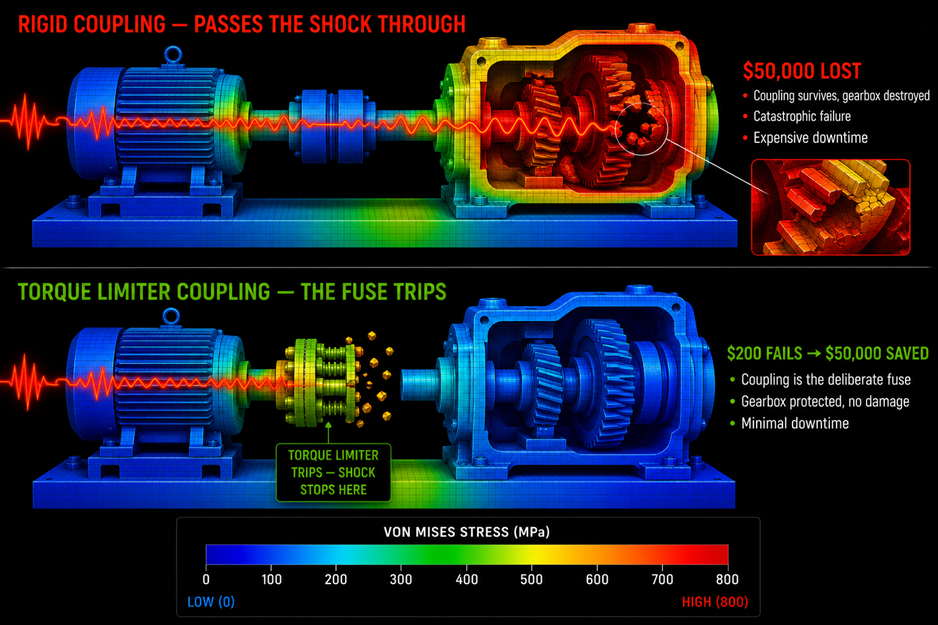
A rigid coupling passes the shock straight into the gearbox; a torque limiter is a deliberate fuse that fails first and cheaply.
Every coupling makes an implicit decision about what happens on an overload, and most engineers never make it consciously. A rigid coupling passes everything through to whatever is downstream. An elastomeric coupling absorbs shock and degrades gradually, giving you warning. A shear-pin coupling or torque limiter is a deliberate fuse: it is designed to fail first and cheaply, protecting the gearbox behind it.
The cost. A $200 coupling that dutifully transmits a jam straight into a $50,000 gearbox or, in the other direction, a fuse that trips on a normal startup and shuts down production.
The fix. Decide the failure mode on purpose. If there is expensive machinery downstream and a credible jam or shock scenario, specify a torque limiter and set it between the real peak duty torque and the damage threshold of what you’re protecting.
A coupling is the cheapest, most visible, most-replaced component in the drivetrain which is precisely why it takes the blame for failures it didn’t cause. It is designed to be the compliant link, so it reports every problem in the system by breaking. Swap it without asking what killed it and you haven’t fixed anything; you’ve just scheduled the next failure. The next time a coupling comes apart, the useful question isn’t which coupling to buy. It’s what the drivetrain was doing to it.
At Developmech, we analyze drivetrains as systems torsional and modal behavior, shaft and keyway fatigue, real duty-cycle sizing, and alignment that holds at operating temperature. If a component in your drivetrain keeps failing and nobody can say why, we’re glad to take a look.
