Address
Malik Saleem Plaza, New City, Wah
Pakistan
WhatsApp: +92 327 5100047
Email: info@developmech.com
Work Hours
Monday to Friday: 3PM - 11AM
Weekend: 10AM - 5PM
Address
Malik Saleem Plaza, New City, Wah
Pakistan
WhatsApp: +92 327 5100047
Email: info@developmech.com
Work Hours
Monday to Friday: 3PM - 11AM
Weekend: 10AM - 5PM

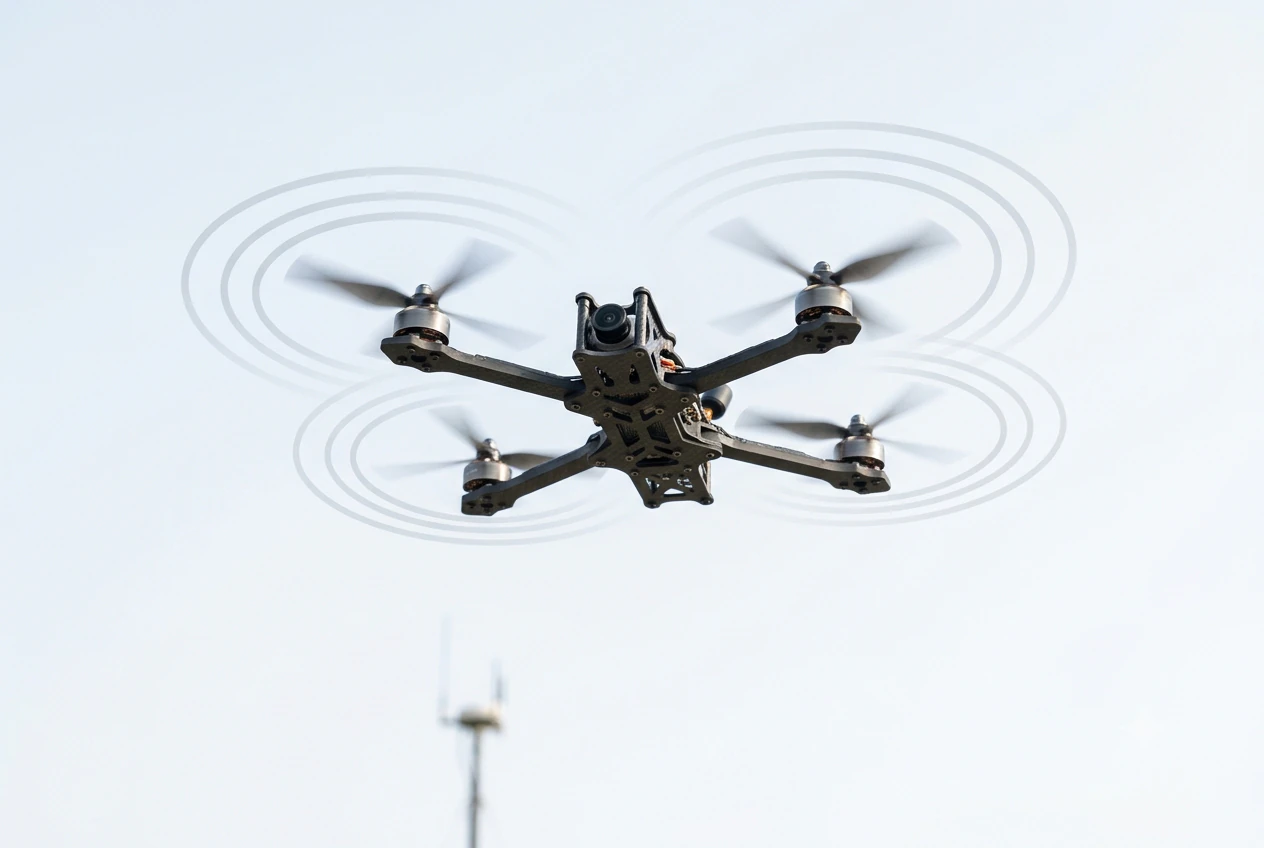
Developmech | Structural, Fatigue, Flow, Thermal and Acoustic Engineering Analysis

Most discussions about counter-drone detection focus heavily on sensors and software. Specifically, operators debate which radar, radio scanner, or AI classifier to buy. However, this framing overlooks a crucial engineering reality: a drone chooses what it emits, and a hostile drone will emit as little as possible.
For example, an autonomous drone can fly an entire mission without any radio control signal. It navigates using preloaded waypoints instead. Alternatively, a drone can trail a thin fiber-optic cable. In this case, it communicates with its operator while emitting zero radio frequencies. In addition, operators can encrypt links or spoof identity signals to blend into friendly traffic. As a result, every signal that standard detection systems look for remains completely optional to the drone.
However, one single physical trait remains unchangeable. While in flight, a drone cannot stop spinning its rotors. Therefore, rotor motion serves as the true foundation of counter-drone detection. Reading this physical signature is an engineering mechanics problem before it becomes a software task.

Left, a silent or fiber linked drone that the radio scanner never sees. Right, the rotor signature that is present either way.
Passive radio frequency (RF) detection is usually the first layer of defense. It listens for control, telemetry, and video links across common frequency bands. As a result, RF scanners can easily find standard commercial drones and pinpoint the operator’s location
However, advanced threats can easily bypass RF scanners. An autonomous drone on preloaded waypoints emits no radio signals. Similarly, a fiber-optic drone leaves no RF footprint to track. Furthermore, encrypted or non-standard protocols will not appear in standard RF signal libraries. Therefore, your primary defense layer becomes blind to deliberate threats.
To solve this gap, counter-drone detection must focus on physical presence. Specifically, systems must detect the physical motion of the turning rotor, which the aircraft cannot turn off.

Left, the emissions a drone can silence at will. Right, the single signature that remains while it flies.
Why focus on the rotor? Because it is the only reliable flight signature. An operator can easily switch off the radio link, video downlink, and remote ID beacon. In addition, satellite navigation receivers emit no external signals.
Consequently, detection strategies that rely solely on radio signals inherit an off-switch. Countermeasures like jamming or RF spoofing target emitted signals. However, against a radio-silent drone, these electronic countermeasures achieve nothing because no signal exists to jam.
Therefore, effective detection must anchor itself to physical motion. A rotor spinning at thousands of revolutions per minute creates an unavoidable physical signature. This mechanical reality persists whether the radio is active, encrypted, or disconnected. As a result, rotor-based detection remains effective against all electronic countermeasures.

Left, a bird and a drone as the same near clutter blip. Right, the blade modulation that tells them apart.
Radar provides long-range surveillance for perimeter security. However, a small drone has a radar cross-section similar to a small bird. Furthermore, a hovering drone creates almost no bulk Doppler shift. As a result, standard primary radar often discards small drones as background clutter.
Without rotor analysis, radar systems face two major failure modes. They either miss incoming drones completely or trigger constant false alarms for birds. Consequently, security teams lose trust in the system.
Fortunately, micro-Doppler radar solves this problem by analyzing the spinning blades. High-speed blade rotation creates a distinct modulation pattern on the radar return. Because bird wings cannot imitate this rapid modulation, micro-Doppler radar cleanly separates drones from birds at ranges of several kilometers.
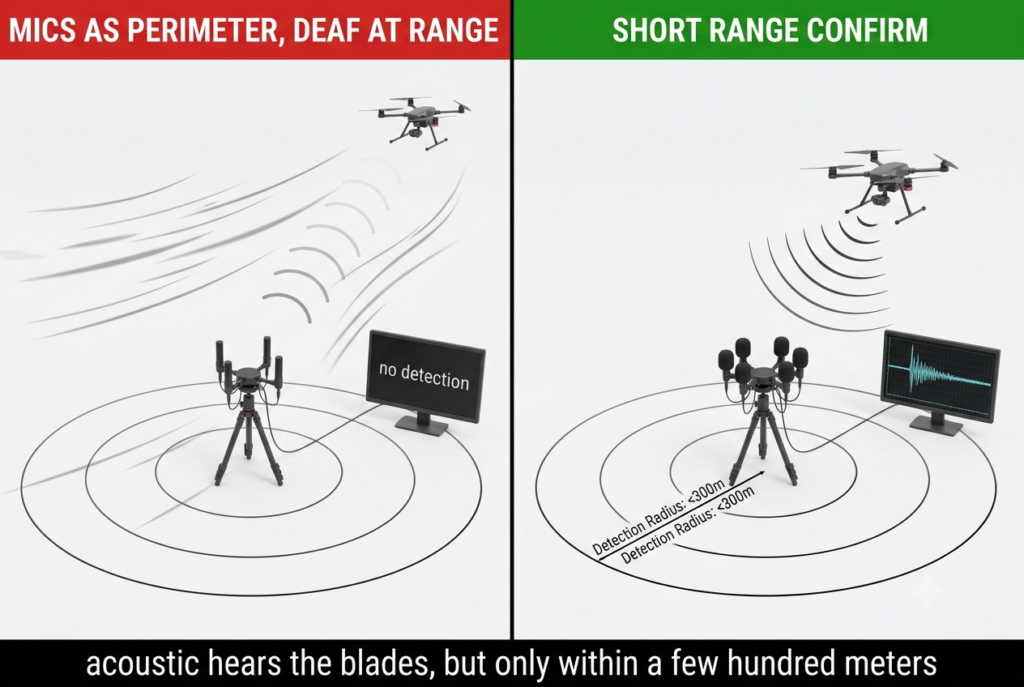
Left, microphones trusted as a perimeter and deaf at distance. Right, the same array used as a short range confirm.
Microphones can also detect rotor motion by listening for the blade pass frequency. Acoustic sensors are low-cost, passive, and do not require direct line-of-sight. Therefore, engineers often consider using microphone arrays as perimeter detectors.
However, sound waves attenuate quickly in open air. In practice, acoustic detection range is limited to a few hundred meters. Additionally, ambient noise, wind turbulence, and temperature shifts significantly reduce this range. If you deploy acoustic sensors for long-range defense, the system will fail on windy days.
Therefore, acoustic arrays should serve as short-range confirmation sensors. Furthermore, proper aeroacoustic design is essential. Engineers must fit windscreens on microphones and apply flow shielding to minimize self-generated wind noise.

Left, a thin signature model that alarms on birds. Right, a signature modeled from the real blade mechanics.
Both radar and acoustic sensors rely on accurate signature models. A rotor signature is not a random signal. Instead, it is governed by physical blade mechanics, including blade count, tip speed, blade length, and aeroelastic flexing.
Software classifiers trained on incomplete or artificial data cause frequent false alarms. Specifically, a weak classifier may flag birds as threats or miss unusual drone designs. Adding complex AI code cannot fix a classifier that lacks underlying physical data.
To solve this issue, engineers must model signature data directly from rotor mechanics. By incorporating rotordynamics and blade aerodynamics into the signature library, the classifier gains a physics-based foundation. As a result, the system accurately distinguishes drones from birds.
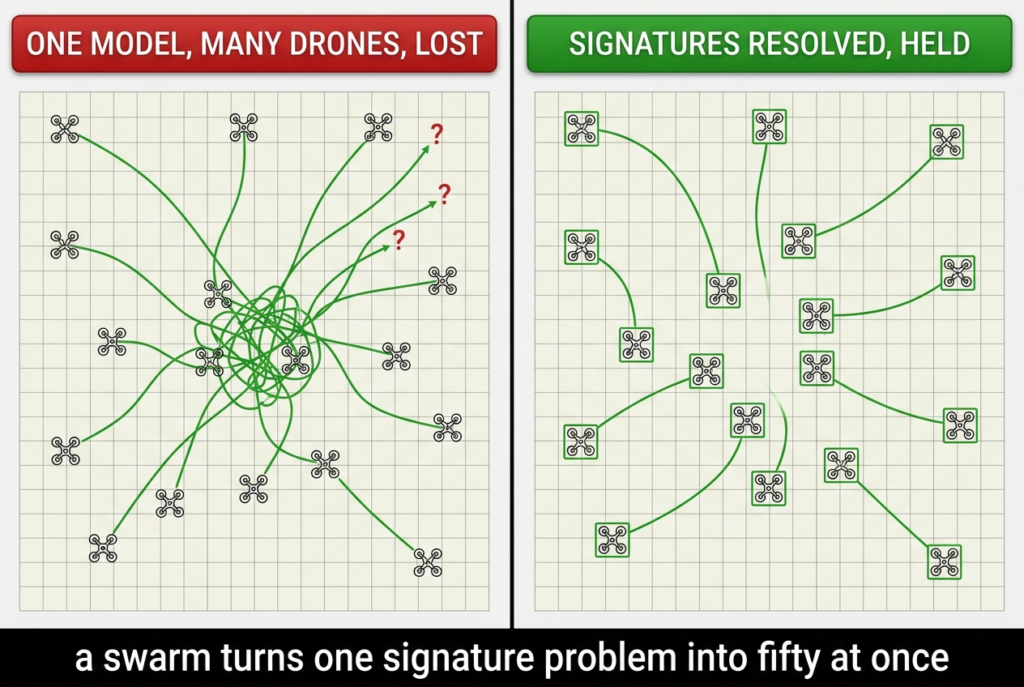
Left, overlapping returns that merge into one confused track. Right, rotor signatures resolved and held separately.
Modern defense systems must handle drone swarms rather than single targets. In a swarm attack, multiple drones approach simultaneously while maneuvering aggressively.
When multiple drones fly close together, their rotor signatures overlap. Consequently, radar tracks blur, merge, and drop targets. Similarly, acoustic sensors struggle to separate individual sound sources in a dense swarm.
Therefore, tracking software must process distinct micro-Doppler features for each individual aircraft. High-fidelity physical models allow algorithms to resolve overlapping signals and maintain stable tracking boxes on every drone in the swarm.
Step back and the whole field reduces to one invariant. A drone can silence its radio, drop its video, disable its identity and navigate without emitting anything, but while it flies it cannot stop turning its rotor. Every reliable way to detect it, at range with radar or up close with sound, is really a way of reading that rotor, and the thing that separates it from a bird is the physics of the blade, not a line of code. That is why detection is a modeling problem wearing a software costume. The radar and the scanner are real and necessary, but they are only as good as the signature they are told to look for, and that signature comes from rotordynamics, aeroelasticity and aeroacoustics. The sensor sees. The physics is what decides whether what it sees is a threat or a bird.
If you are specifying or building drone detection, the sharper question is not which sensor to buy, it is how well anyone has modeled the one signature the drone cannot hide. Against an autonomous or fiber controlled drone over your site, what are you actually detecting?
