Address
Malik Saleem Plaza, New City, Wah
Pakistan
WhatsApp: +92 327 5100047
Email: info@developmech.com
Work Hours
Monday to Friday: 3PM - 11AM
Weekend: 10AM - 5PM
Address
Malik Saleem Plaza, New City, Wah
Pakistan
WhatsApp: +92 327 5100047
Email: info@developmech.com
Work Hours
Monday to Friday: 3PM - 11AM
Weekend: 10AM - 5PM

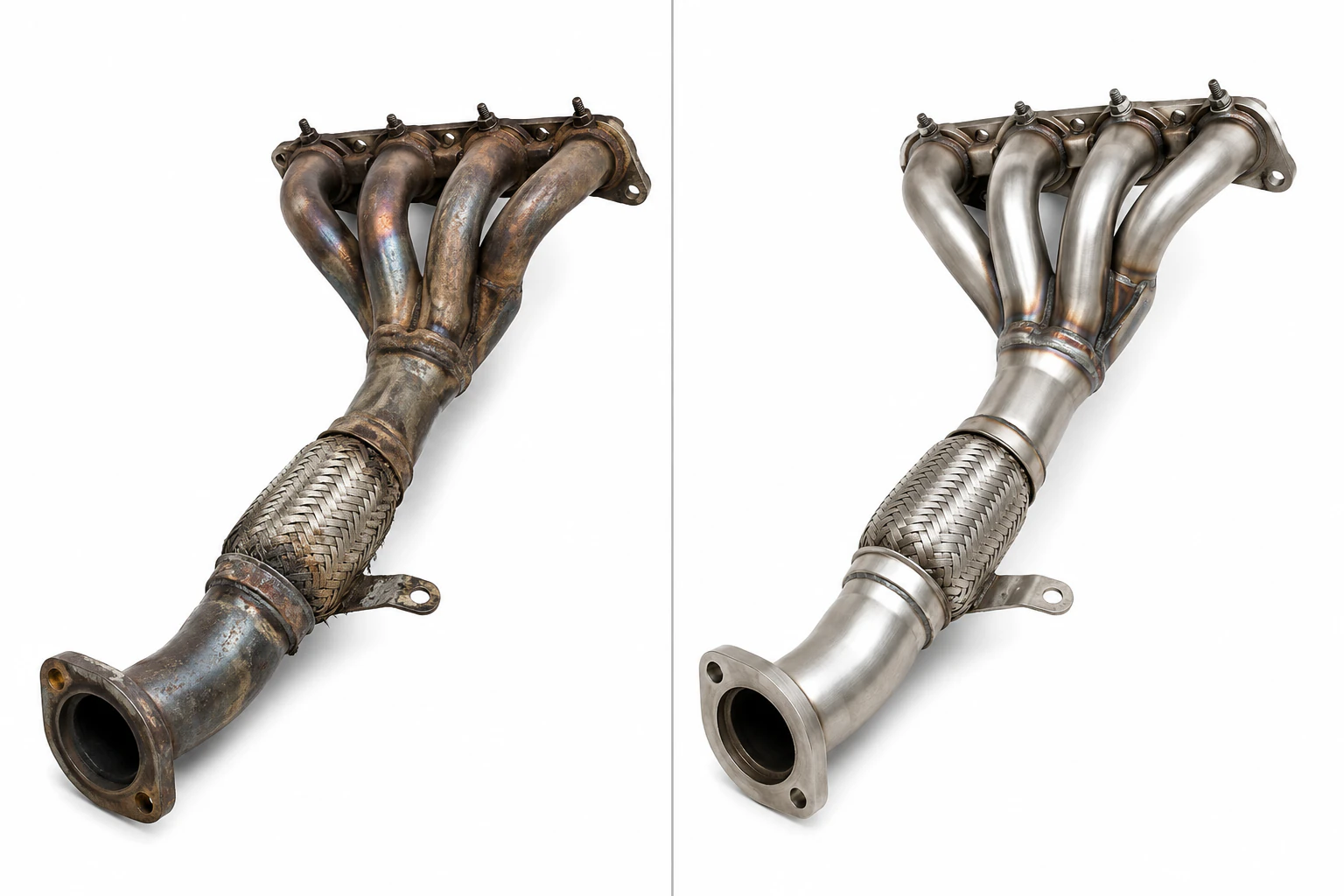
An exhaust system is a thermal fatigue and acoustic structure that heat cycles, resonates, and corrodes, and it cracks at the flex and the welds long before it simply rusts away
Developmech | Thermal, Fatigue & Acoustic Analysis
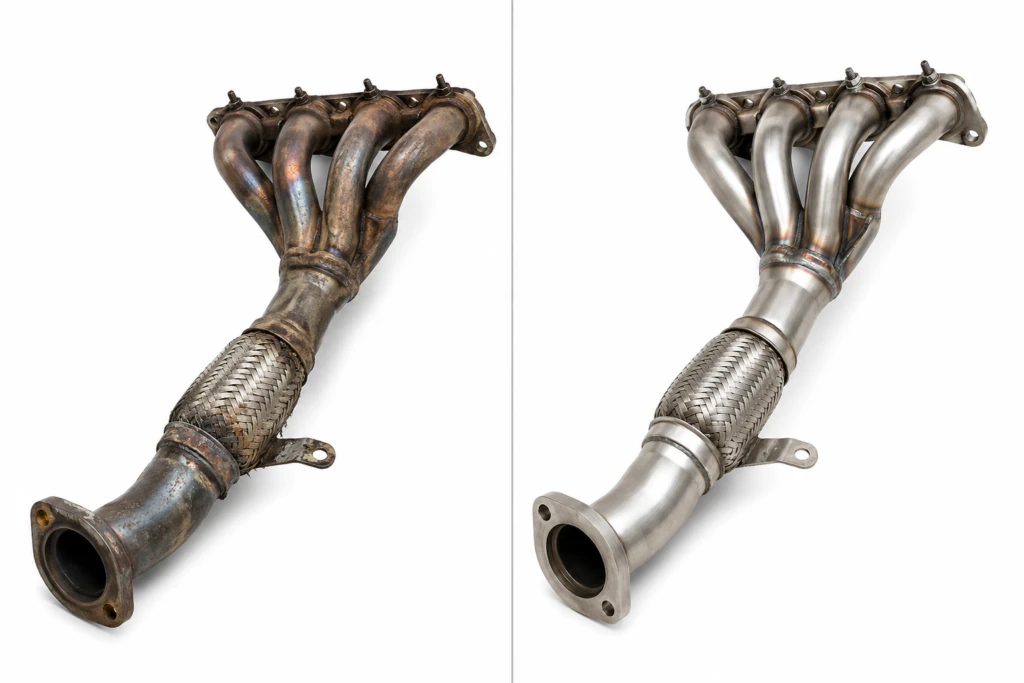
An exhaust is the part everyone assumes just rusts out, slowly going orange underneath the car until a hole appears and it drones. Rust is real, but it rarely kills an exhaust. Long before the metal thins, the system cracks, at the flex joint, at the welds, at the manifold, driven by two things that have nothing to do with corrosion: heat cycling and vibration. An exhaust is a thermal fatigue component and an acoustic instrument that happens to live in a wet, salty environment.
Every drive, the exhaust swings from ambient to several hundred degrees and back, growing and shrinking by centimeters over its length, while hanging off an engine that shakes it at every firing stroke. Constrain that growth, or let a resonance line up with the engine, and it cracks from fatigue, hot or cold, in a matter of thousands of cycles. The rust, when it comes, is the slow part.
Here are the six ways an exhaust system fails, and why heat and sound get there first.

Every drive cycles the exhaust from ambient to several hundred degrees. Constrained, that expansion becomes strain, and the strain crazes and cracks the metal on a countable number of heat cycles.
An exhaust spends its life heating and cooling. Start the engine and the pipe goes from ambient to several hundred degrees in minutes, park it and it cools back, thousands of times over the life of the car. Steel expands as it heats, so every cycle tries to grow the exhaust and then shrink it, and wherever that growth is held back the expansion becomes mechanical strain in the metal. High enough and repeated enough, that strain is a low cycle thermal fatigue load, and it cracks the exhaust where the strain concentrates, at the manifold, the flex, and the welds. It has a countable thermal fatigue life, usually shorter than the time it would take to rust through.
The cost. Thermal fatigue cracks at the hottest, most constrained parts of the system, appearing long before corrosion would, on a car that looks structurally fine underneath.
The fix. Design for the thermal cycle. Let the system expand rather than fight it, keep the hot sections free to grow, choose materials and thicknesses for the temperature and the strain, and check the fatigue life against the real heat cycles, not just the peak temperature.
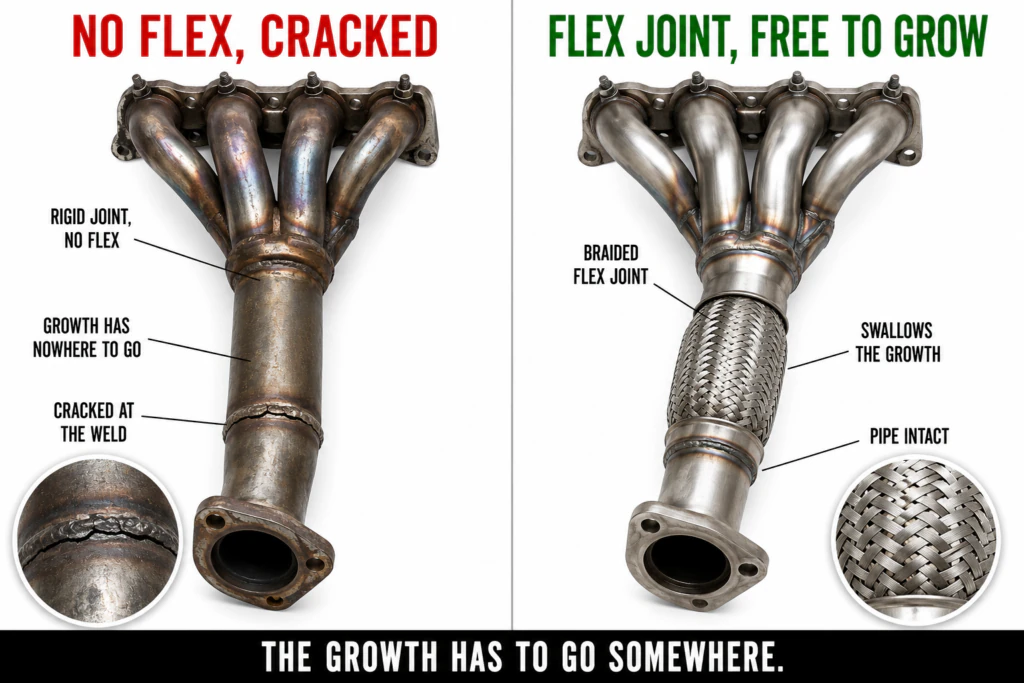
A hot exhaust grows by a couple of centimeters over its length. The flex joint is the part designed to swallow that growth, and without it the expansion cracks the nearest weld.
A full exhaust can grow by a couple of centimeters between cold and hot, and that movement has to be absorbed somewhere. That is the job of the flex joint, the braided bellows near the front of the system, which flexes and stretches to take up the thermal growth and the engine rocking without passing it into the rigid pipe. Leave it out, undersize it, or let it seize with corrosion, and the growth loads the nearest rigid joint or weld until that cracks instead. The flex is a sacrificial expansion element, and when it fails the failures move downstream into parts never meant to move.
The cost. Cracked pipes, flanges, and welds near the front of the system when a missing, undersized, or seized flex joint forces the thermal growth into rigid metal.
The fix. Size and place the flex joint for the real movement. Put it where the growth and the engine rocking are greatest, size it for the axial, lateral, and angular motion it has to absorb, protect it from the corrosion that seizes it, and check that the rest of the system is genuinely free to move once it is fitted.
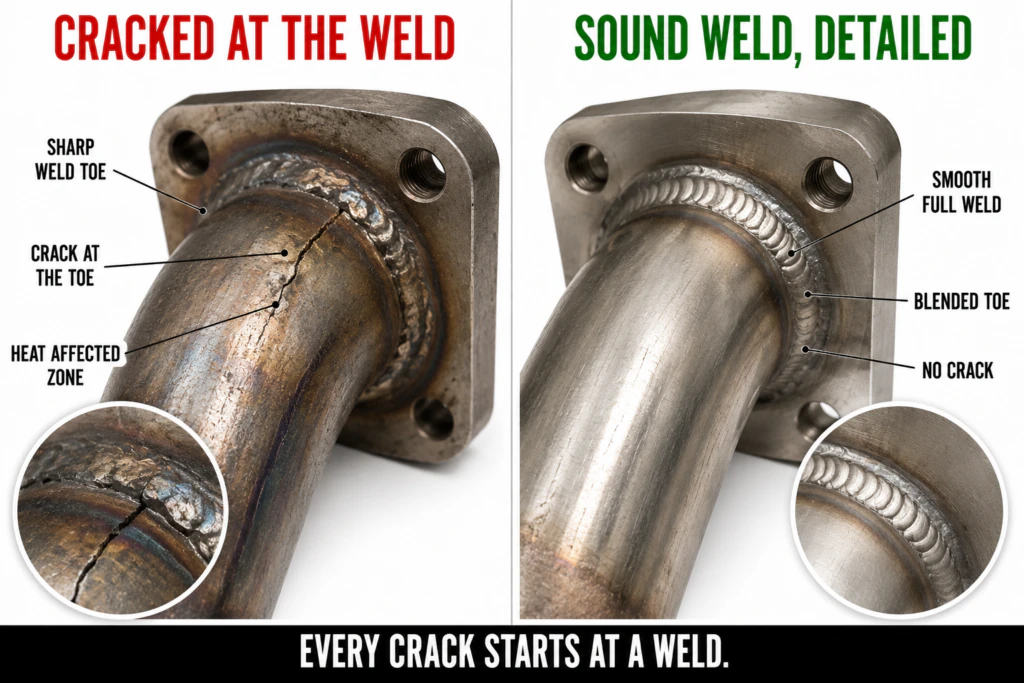
The exhaust is a welded assembly, and the weld toes and heat affected zones are where the thermal and vibration stress concentrates. That is where the cracks start, every time.
An exhaust is a welded structure from end to end, manifold to pipe, pipe to flange, pipe to silencer, and those welds are the weak points. Each weld toe is a sharp notch sitting on a heat affected zone of altered, often harder and less tough metal, so it concentrates both the thermal strain and the vibration stress. The two find the welds first, and a crack opens at a weld toe or runs around a joint, usually at the hot front or wherever the pipe is stiffly restrained. The pipe itself is rarely where it lets go, it is the joints holding the pipe together.
The cost. Cracks that open at weld toes and heat affected zones, at the manifold joints and flanges especially, leaking exhaust and growing under every heat cycle and every vibration cycle.
The fix. Detail the welds for fatigue. Use full, smooth welds with good profiles at the highly stressed joints, avoid sharp toes and starts and stops in high stress areas, relieve the stress where the pipe is stiffly restrained, and treat the manifold and flange welds as the fatigue critical details they are.
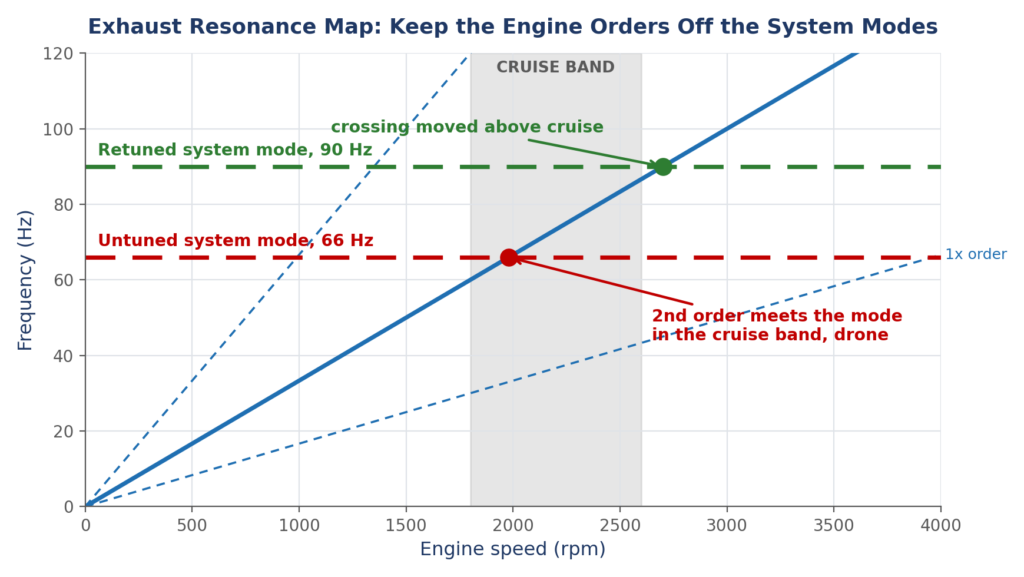
The silencer tunes the sound, but the whole system has natural frequencies. Let an engine order line up with one and you get drone, boom, and a vibration that fatigues the system
An exhaust is tuned to make the engine acceptable to listen to, its silencer and pipe lengths chosen to cancel and absorb the noise. But the same system, hung as a long flexible assembly, has its own natural frequencies, and the engine excites it with pulses at multiples of its speed, the engine orders. When an order crosses a system natural frequency in the driving range, the exhaust resonates, and that shows up as a drone or boom you hear at a particular speed and as a vibration that fatigues the welds and hangers. The acoustic problem and the fatigue problem are the same resonance, felt two ways.
The cost. Drone and boom at the speeds where an engine order meets a system mode, and resonant vibration that fatigues welds, hangers, and the flex far faster than the heat cycling alone would.
The fix. Map the resonances. Build the order diagram against the system natural frequencies across the driving range, move the modes or the hanger positions so the crossings fall outside the range people actually cruise at, add tuned mass or damping where a crossing cannot be avoided, and treat the noise and the fatigue as one problem.
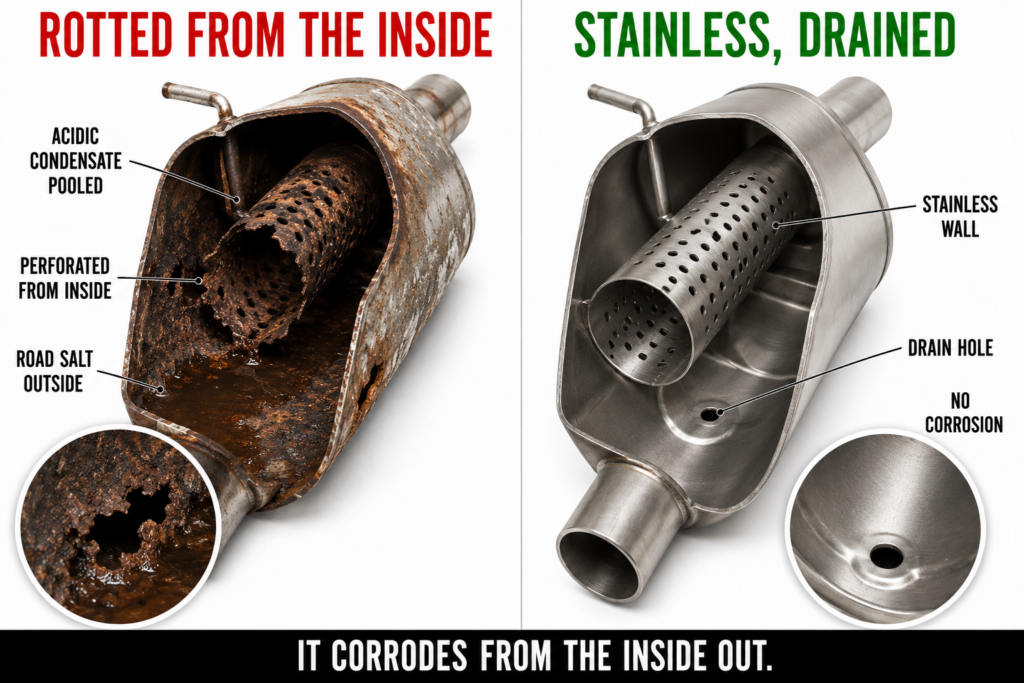
The cold end of the exhaust fills with acidic condensate that never fully dries, so the silencer rots from the inside out, while road salt attacks it from the outside.
When corrosion does matter, it usually works from the inside. Combustion produces water, and on a short drive the cold end of the exhaust, the rear silencer, never gets hot enough to boil it off, so acidic condensate collects and sits there, corroding the silencer from the inside out. From the outside, road salt and water attack the same cold end, and the two meet in the middle of a thin steel wall. That is why the rear silencer rots first and why the failure is a perforated silencer rather than a cracked pipe. Material and drainage, not just wall thickness, decide how long it lasts.
The cost. A silencer that perforates from the inside out and an exhaust that leaks and drones, worst on cars that do short cold trips where the condensate never dries.
The fix. Design the cold end for corrosion. Use stainless or aluminized steel where the condensate collects, drain the silencer so water cannot pool, keep the cold sections short enough to dry out, and match the material to the duty rather than assuming the same steel works hot and cold.

The exhaust is a long, heavy assembly hung between a vibrating engine and the body. The rubber hangers isolate it and set its natural frequencies, and a poor layout fatigues the pipe.
The exhaust is a long, heavy, cantilevered assembly joined at one end to a shaking engine and along its length to the body by rubber hangers. Those hangers carry the weight, isolate the vibration, and set where the system natural frequencies fall. Too few hangers, hangers in the wrong places, or the wrong rubber, and the exhaust sags, swings, and resonates, feeding vibration into the pipe and the cabin. The relative motion between the engine end and the body drives fatigue at every joint, and a broken hanger quickly overloads the next one and cracks the pipe between them.
The cost. Cracked pipes and broken hangers from an assembly that is poorly isolated or badly supported, plus vibration and noise carried into the cabin through the hangers.
The fix. Design the mounting as a system. Place the hangers to support the weight and to put the natural frequencies where the engine will not excite them, choose isolators that decouple the engine motion, allow the front of the system to move with the engine while the rest stays put, and check the fatigue at the joints against the real motion.
An exhaust is not a set of pipes waiting to rust, it is a hot, welded, resonating structure hung off a vibrating engine, and it almost always cracks before it corrodes. It heat cycles until the constrained metal fatigues, it grows and needs a flex joint to swallow the movement, it cracks at the welds where the stress concentrates, it resonates when an engine order meets one of its modes, and it rots from the inside where the condensate collects. Rust is the slow, visible failure everyone expects. The heat and the sound get there first, at the flex and the welds, on cars that still look solid underneath. Design the exhaust for the temperature swing, the movement, and the resonance, and the rust becomes the thing that finally, eventually, retires it.
At Developmech, we do the engineering behind the exhaust: thermal fatigue of the hot end, flex and expansion joint design, weld and joint fatigue, exhaust acoustics and resonance, and the hanger and isolation layout that keeps the system quiet and intact. If you build exhaust or hot gas systems that have to survive their own heat and vibration, we are glad to take a look.
