Address
Malik Saleem Plaza, New City, Wah
Pakistan
WhatsApp: +92 327 5100047
Email: info@developmech.com
Work Hours
Monday to Friday: 3PM - 11AM
Weekend: 10AM - 5PM
Address
Malik Saleem Plaza, New City, Wah
Pakistan
WhatsApp: +92 327 5100047
Email: info@developmech.com
Work Hours
Monday to Friday: 3PM - 11AM
Weekend: 10AM - 5PM

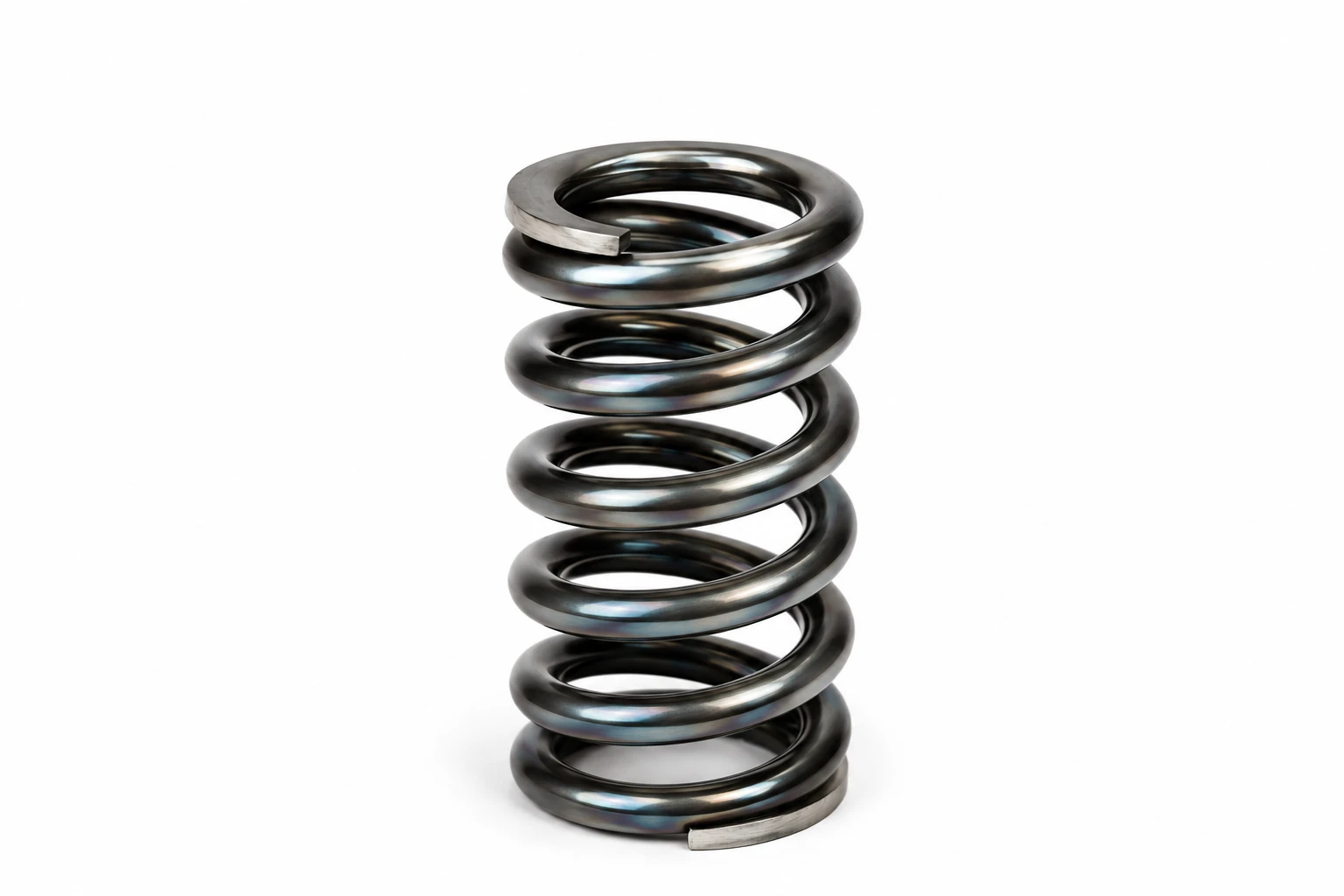
A spring is a torsion bar wound in a circle, and it fails by fatigue, surge, relaxation, buckling, and coil clash, most of them nothing to do with the load it was sized for
Developmech | Fatigue, Vibration & Durability Analysis
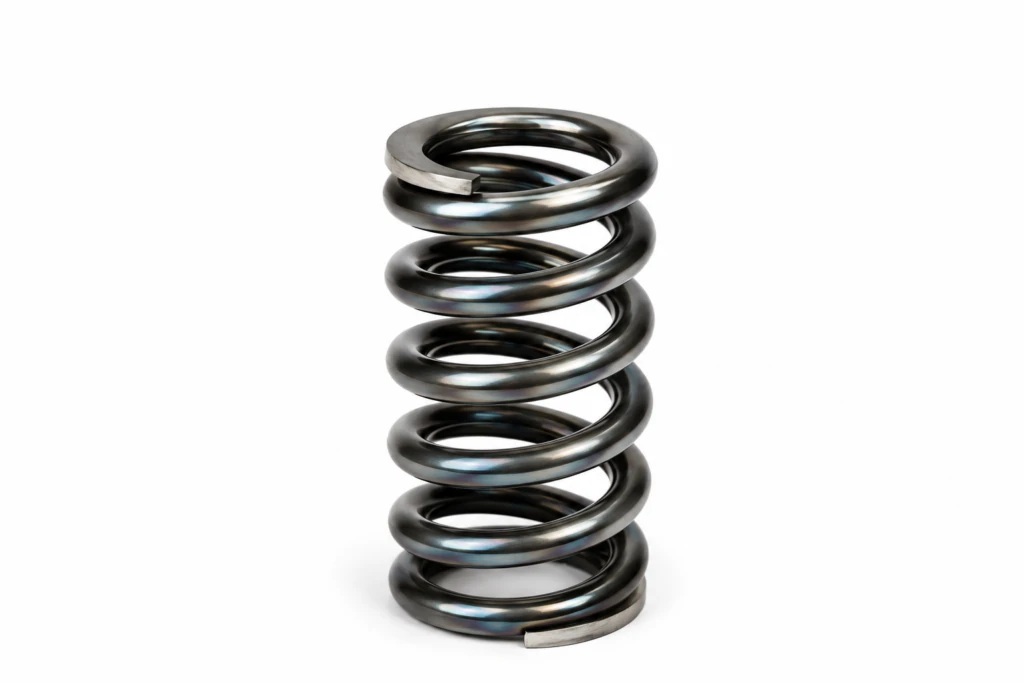
A spring looks like the one component you cannot get wrong. You pick a rate, check that the stress at maximum load is below yield, and move on. It never yields, so it never fails, or so the calculation says. Springs fail constantly, and almost never because they yielded. They fail because a spring is not really a coil, it is a torsion bar wound into a circle, storing energy by twisting its wire, with a set of failure modes the static load check never touches.
It fatigues at the surface of its wire, resonates and surges when something shakes it at its natural frequency, relaxes and quietly loses its load, buckles sideways if it is too slender, and hammers itself to death if allowed to close solid. None of those show up when you compare the peak stress to yield. This one is deliberately not a story about cracks, it is six different ways the same simple part fails.
Here are the six, and why the static load check misses every one.

A spring stores energy by twisting its wire, so the shear stress peaks at the wire surface. That is where fatigue cracks start, and shot peening the surface is what buys the life.
A helical spring does not bend, it twists. Push on its ends and every part of the wire sees a torsional shear stress, and because that shear peaks at the surface of the wire, the surface is where it works hardest and where it fails. Under a cycling load that surface accumulates fatigue damage like any other cyclically loaded part, and a crack starts there, usually at a tiny flaw, an inclusion, or a forming mark, and grows until the coil breaks. This is the one classic fatigue failure in the list, and the reason valve springs are shot peened is to put the surface in compression and push that life out.
The cost. A spring that breaks a coil from surface fatigue, with no warning and no visible deformation first, on a part whose static stress was comfortably below yield.
The fix. Design and finish the surface for fatigue. Keep the shear stress amplitude below the fatigue strength for the life required, shot peen to put the surface in residual compression, control the finish and the material cleanliness, and check against a fatigue curve, not the yield strength.

A spring is a distributed mass on a distributed stiffness, so it has its own natural frequency. Excite it near that frequency and the coils resonate, or surge, wildly amplifying the load.
A spring is not a massless connection, it has mass distributed along a stiffness, so like any such system it has natural frequencies of its own. Drive it at or near one of them and the coils resonate among themselves, a phenomenon called surge, where waves of compression run up and down the spring and the coils move far more than the ends do. In a valve train this is deadly: the cam delivers its motion as a set of harmonics, and if one lines up with the spring natural frequency the spring surges, loses contact with the cam, and the valve floats. The load in the surging spring can multiply, which is why a spring can fail at high speed while passing every static and low speed test.
The cost. Valve float and lost control at speed, coils hammering each other, and dynamic loads far above the design load, appearing only once the excitation reaches the surge frequency.
The fix. Keep the excitation away from the surge frequency. Design the natural frequency to be many times the highest forcing frequency and its low harmonics, use variable pitch or conical designs that spread the surge frequency, add a damper where needed, and check the dynamics across the speed range, not just the static load.

A spring that is held compressed, especially when hot, slowly loses free length and load. It has not cracked and has not yielded on the gauge, but it no longer does its job.
A spring can fail without a single crack, simply by ceasing to push as hard as it should. Hold it compressed and over time, especially at temperature, it relaxes, its free length shortens, and the load it delivers at a given height drops. This is set, or relaxation, a slow, permanent loss driven by creep in the material under sustained stress. A valve spring that has relaxed no longer seats the valve firmly, a suspension spring that has set sits lower and softer, and none of it involves fracture. The spring looks intact and still measures as a spring, it has just quietly stopped delivering the force it was fitted to deliver.
The cost. Lost preload and ride height, valves that no longer seat, mechanisms gone soft and out of specification, from a spring that never cracked and never obviously yielded.
The fix. Design against relaxation. Keep the sustained stress below where the material creeps at its operating temperature, choose a material and treatment rated for the heat, preset the spring so the early relaxation is taken out before assembly, and verify the load retention over time and temperature, not just when new.
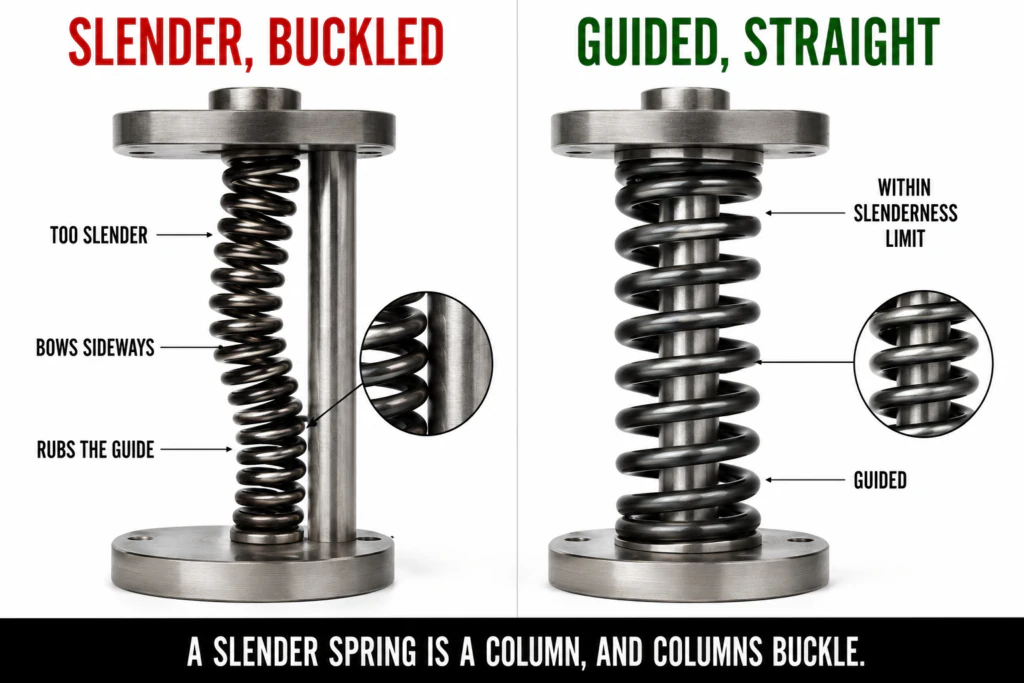
A compression spring that is too long and thin is a column, and columns buckle. Past a slenderness limit it bows sideways instead of shortening, and loads the guide and itself unevenly.
A compression spring is a column, and a slender enough column does not compress straight, it buckles. Once the free length is large compared with the coil diameter and the spring is compressed past a certain fraction of it, it becomes unstable and bows sideways, exactly like an over long strut. Now the load is no longer along its axis, the spring rubs on its guide or bore, the stress goes uneven around the coils, and the whole thing works nothing like the straight compression the design assumed. It is a stability failure, not a strength one, and checking the axial stress never catches it.
The cost. A spring that bows sideways under load, rubbing and wearing on its guide, loading itself and its housing off axis, and delivering a rate and life nothing like the design intended.
The fix. Design for stability. Keep the slenderness and compression within the limits where the spring stays straight, guide it over a rod or in a bore where the duty demands, use a squarer, stiffer geometry where buckling threatens, and check the buckling limit alongside the stress.
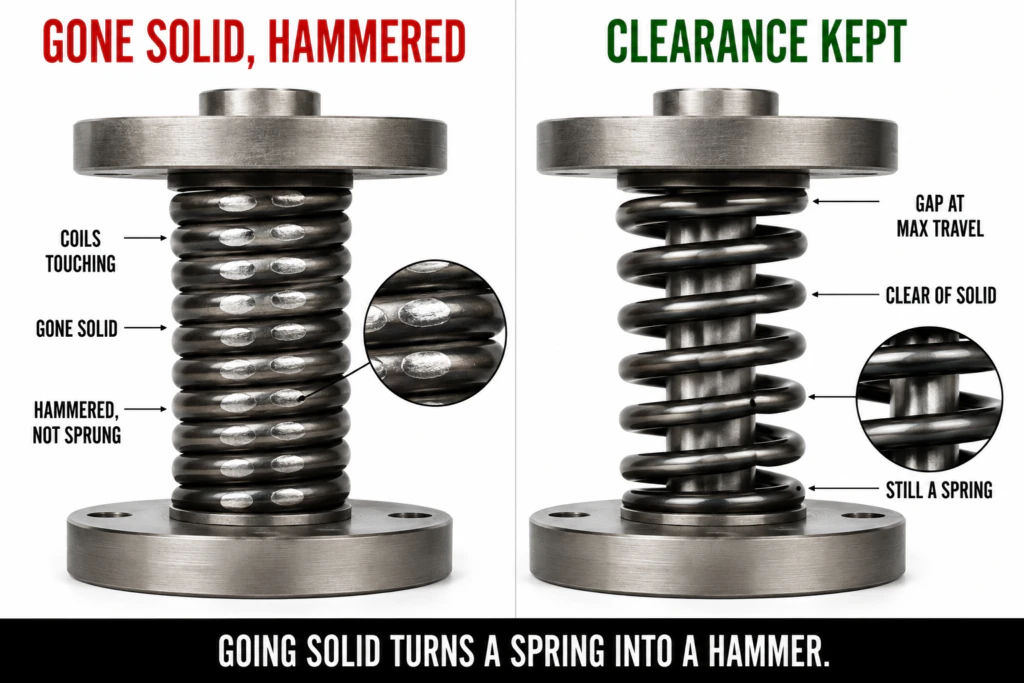
Compress a spring too far and the coils touch and it goes solid, a sudden metal to metal stop. The spring stops acting like a spring and starts acting like a hammer.
Every compression spring has a solid height, the length at which all the coils touch and it can shorten no more. Drive it there and it stops behaving like a spring at all, it becomes a solid metal spacer, and the smooth build up of force turns into a sudden, violent metal to metal stop. Coils clash, the shock loads spike far above anything the rate would suggest, and the impact hammers the coils and the seats. In a valve train, coil clash from surge or over travel destroys springs, and in any mechanism a spring allowed to close solid is being asked to be a stop, a job it is bad at and does not survive for long.
The cost. Shock loads and impact damage when the coils clash or the spring goes solid, battered coils and seats, and a spring destroyed by being used as a stop rather than a spring.
The fix. Keep clear of solid. Leave enough clearance that the spring never reaches solid height in service, including under the worst over travel and any surge, keep the working range within the safe part of the travel, and add a positive stop elsewhere so the spring never takes the final blow.
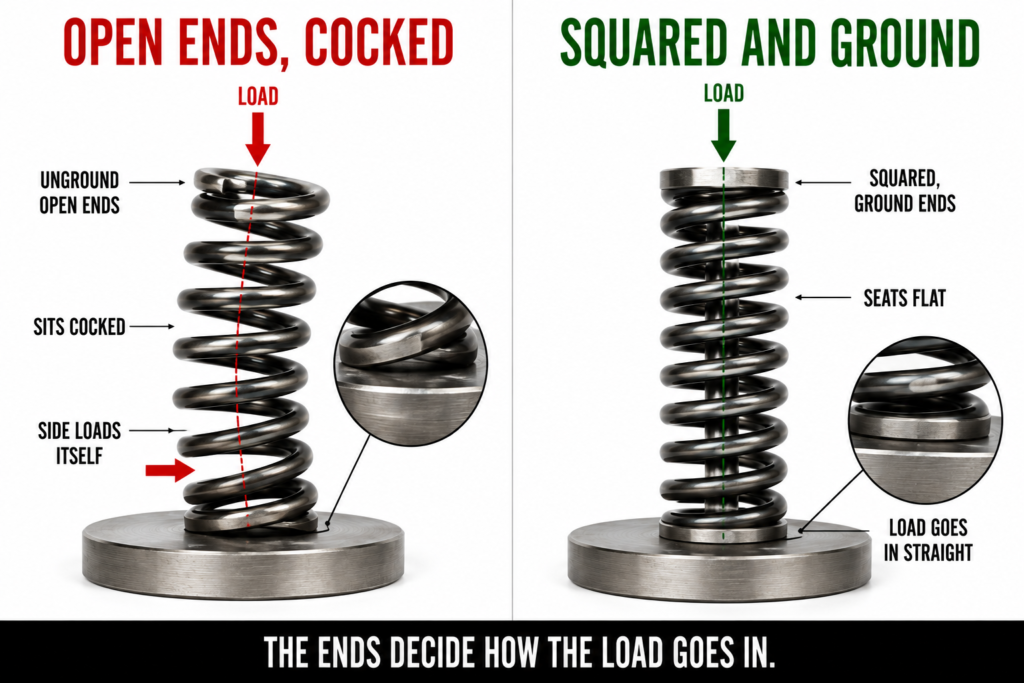
How the ends are formed and seated decides whether the load goes in straight. Ends that are not squared, ground, and seated flat make the spring cock over and load itself sideways.
A spring can be perfect along its length and still fail because of how it meets the world at its ends. The end coils, and the seats they sit on, decide whether the load goes in straight down the axis or off to one side. Ends that are not squared and ground, or seats that are not flat and square, let the spring sit cocked, so as it compresses it pushes sideways as well as axially, bending itself, rubbing its guide, and concentrating stress on one side of the coils. It then fails on that overloaded side, or wears where it should not, all because the load was fed in crooked. The ends are not a detail, they are how the force gets into the spring.
The cost. A spring that sits cocked and side loads itself, wearing its guide and overloading one side of its coils, failing on that side from a fault that lives entirely in the ends and the seats.
The fix. Detail the ends and the seats. Square and grind the ends where the duty needs the load introduced straight, provide flat, perpendicular seats, guide the spring so it cannot cock, and check the squareness and seating, not just the spring in isolation.
A spring is the part everyone trusts to the simplest possible check, peak stress against yield, and it is the part with the most ways to fail that the check never sees. It fatigues at its wire surface, surges when an excitation finds its natural frequency, relaxes and loses its load without cracking, buckles sideways if it is too slender, hammers itself apart if allowed to go solid, and side loads itself if its ends are wrong. Only one of those is a crack. The rest are resonance, creep, instability, impact, and geometry, and every one can retire a spring whose static stress was never near yield. Design a spring for how it actually behaves, twisting, resonating, relaxing, and moving, and it lasts. Design it to a single stress check, and it finds one of the other five ways out.
At Developmech, we do the engineering behind springs: surface fatigue and shot peen life, surge and dynamic response in valve trains and beyond, relaxation and load retention, buckling and stability, and the coil clash, clearance, and end detailing that decide whether a spring survives its duty. If you design with springs that have to work at speed, at temperature, and for the long haul, we are glad to take a look.
