Address
Malik Saleem Plaza, New City, Wah
Pakistan
WhatsApp: +92 327 5100047
Email: info@developmech.com
Work Hours
Monday to Friday: 3PM - 11AM
Weekend: 10AM - 5PM
Address
Malik Saleem Plaza, New City, Wah
Pakistan
WhatsApp: +92 327 5100047
Email: info@developmech.com
Work Hours
Monday to Friday: 3PM - 11AM
Weekend: 10AM - 5PM

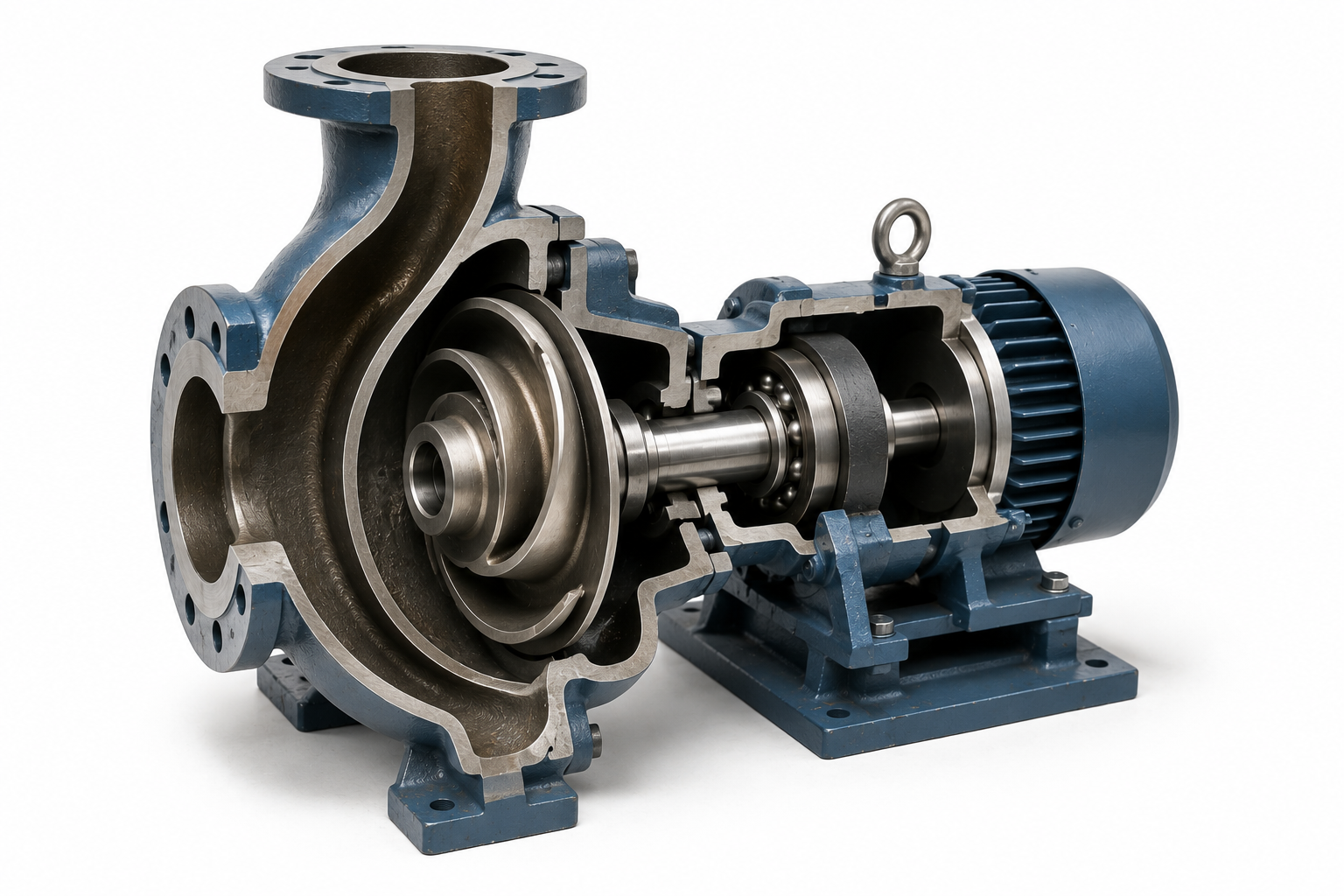
A centrifugal pump is a fluid machine that cavitates, tears at its own vanes, cooks its seal, and loads its bearings, and only one of the ways it dies is ordinary wear
Developmech | Flow, Structural & Reliability Analysis
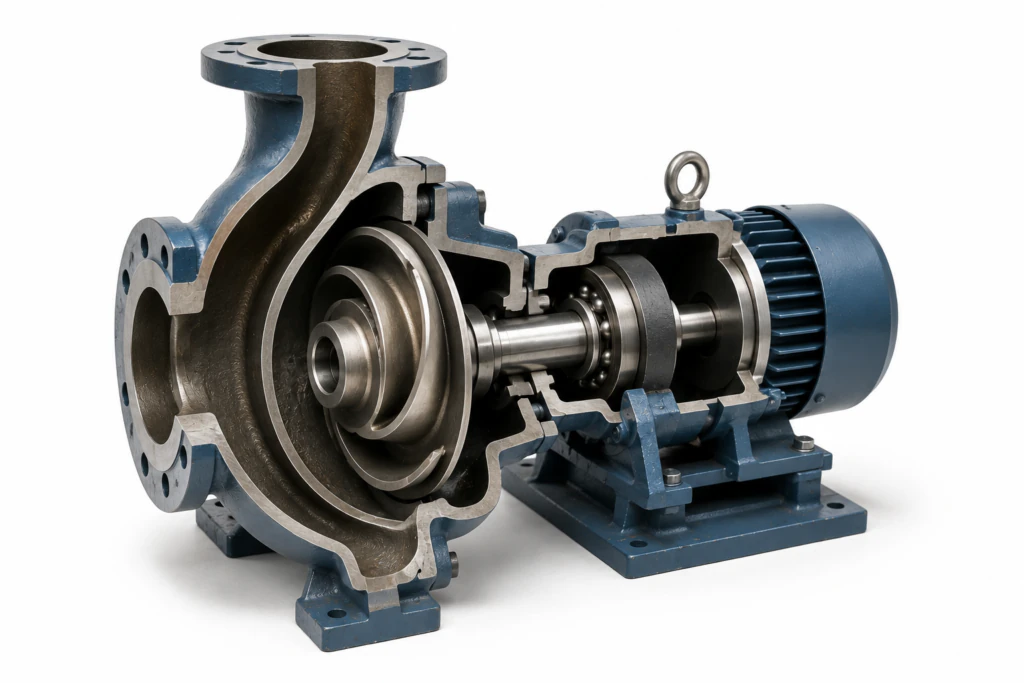
A centrifugal pump looks indestructible, a metal casing with a metal wheel inside, moving water. Yet pumps are among the most commonly failed machines in any plant, and they rarely fail from anything as simple as wearing out. A pump is a fluid machine, destroyed by what the fluid does inside it: bubbles that implode and sandblast the metal, flow that tears at the vanes off the design point, a seal cooked by heat, and bearings shaken by loads that should not be there.
The most quietly destructive of these has a name that sounds harmless, cavitation. When the pressure at the impeller inlet falls too low, the water boils at room temperature into tiny vapor bubbles, and a fraction of a second later they collapse, violently, each implosion firing a microscopic jet of water at the metal. Millions of them pit and erode the impeller as surely as a sandblaster, and the number that governs it, the NPSH, is one most pump problems come back to.
Here are the six ways a centrifugal pump fails, and why only one of them is a crack.
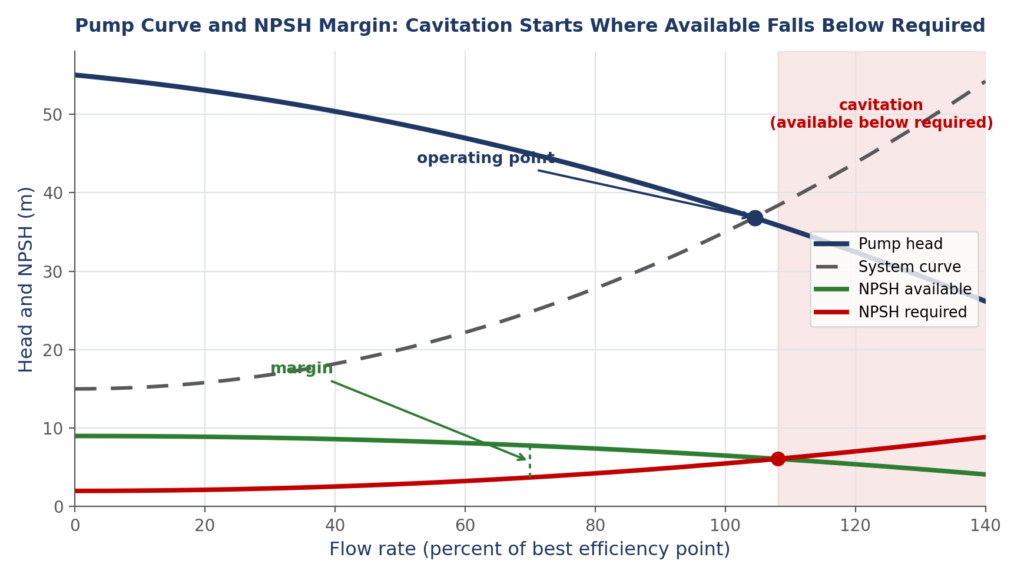
When the available NPSH falls below what the pump requires, the water flashes to vapor at the inlet and the bubbles implode on the impeller. The margin between the two curves is the whole game.
Cavitation is the signature pump failure, and it comes down to one balance. Every pump requires a certain suction pressure to keep the liquid from boiling as it enters the impeller, its required NPSH, and the installation provides one, the available NPSH. When the available falls below the required, the liquid flashes to vapor at the lowest pressure point, and those bubbles collapse the instant they reach higher pressure deeper in. Each collapse is a tiny, ferocious implosion, a microjet of water striking the metal at enormous local pressure, and millions of them pit the impeller, eat the vanes, and hollow out the metal, while the pump loses head, rattles as if full of gravel, and vibrates. It is erosion, not wear, driven entirely by a pressure margin.
The cost. An impeller eroded and pitted from the inside, lost head and flow, noise and vibration, a pump slowly hollowed out by its own fluid, all from too little suction margin.
The fix. Protect the NPSH margin. Keep the available NPSH comfortably above the required across the operating range, lower the suction losses, raise the liquid level or lower the pump, and check the margin at the real duty, not just the rated point. Cavitation is a design condition, not bad luck.
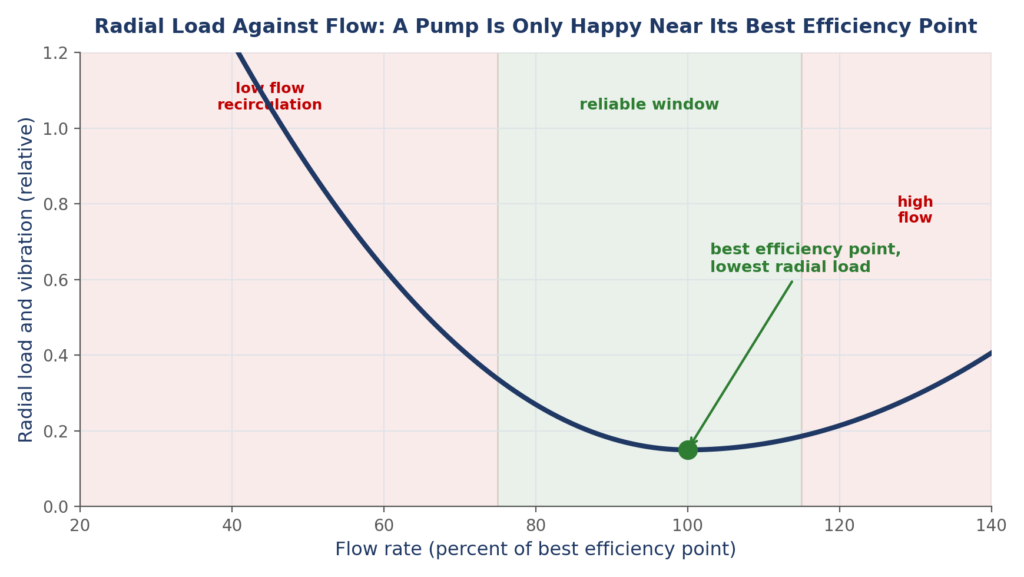
A pump is balanced only near its best efficiency point. Push it to low or high flow and the flow inside separates and recirculates, the radial thrust climbs, and the whole rotor is loaded and shaken.
A centrifugal pump is hydraulically balanced only near one flow, its best efficiency point. Run it well below that, throttled down or dead heading toward no flow, and the liquid stops following the vanes cleanly, separating and recirculating, hammering the vanes with unsteady loads and driving the pressure up unevenly. That uneven pressure becomes a radial thrust that pushes the shaft sideways, climbing steeply as the flow leaves the best point, loading the bearings and seal and bending the shaft. A pump forced far from its design flow is not just inefficient, it tears at its own internals.
The cost. High radial thrust and recirculation away from the best point, a shaft pushed sideways, and bearings and seals carrying loads and vibration they were never sized for.
The fix. Keep the pump near its best point. Select it so the real duty sits close to the best efficiency point, avoid running throttled hard down or near shutoff, use a minimum flow bypass where low flow is unavoidable, and match the pump to the system rather than throttle a mismatched one.
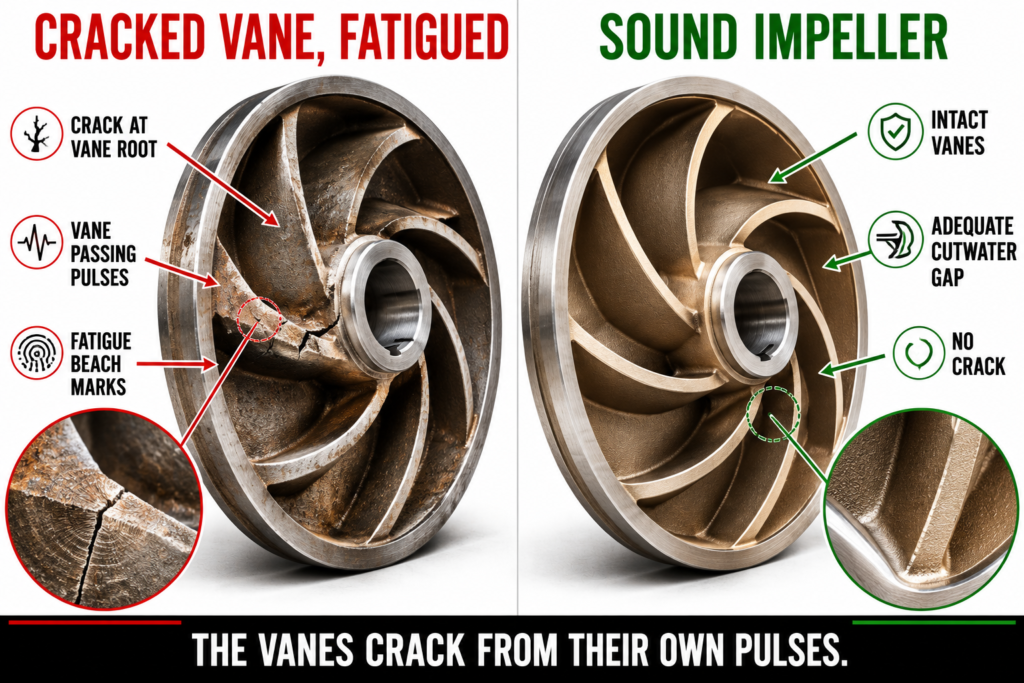
Every time a vane passes the cutwater it fires a pressure pulse. Strong pulses, or a vane passing frequency that hits a natural frequency, crack the vanes and shrouds by fatigue.
The impeller is a rotating structure that beats against the fluid every revolution. Each time a vane sweeps past the casing tongue, the cutwater, it fires a sharp pressure pulse, so the impeller feels those pulses at its vane passing frequency. Run the pump with too little gap to the cutwater, or land that frequency on a natural frequency of the impeller or shaft, and the pulses drive real cyclic stress into the vanes and shrouds. This is the one classic fatigue failure in the pump, a crack that starts where the vane meets the shroud and grows until a piece of the impeller lets go. It is the pump beating itself apart at a frequency set by its own geometry and speed.
The cost. Fatigue cracks in the impeller vanes and shrouds from vane passing pulses, worst with a tight cutwater gap or a resonance, ending in a lost piece of impeller.
The fix. Design the impeller for its own pulses. Keep an adequate gap between the vane tips and the cutwater, keep the vane passing frequency and its harmonics clear of the impeller and shaft natural frequencies, and check the pulsation and fatigue, not just the steady stress.
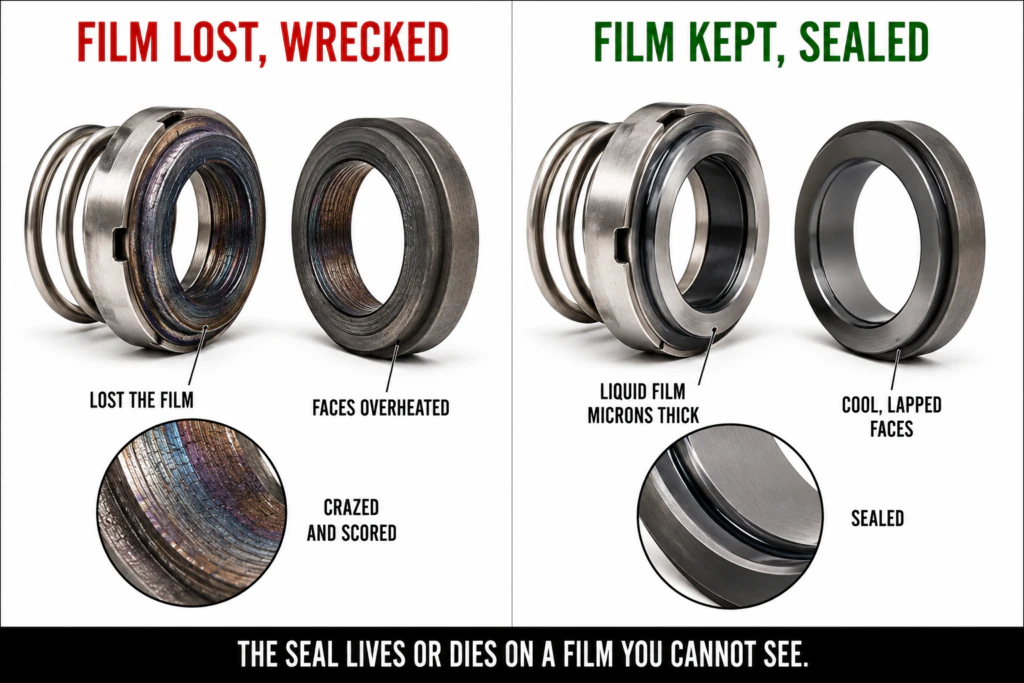
The mechanical seal runs two flat faces together on a film of liquid microns thick. Lose the film, even for a moment, and the faces overheat, craze, and wear, and the pump leaks.
Most pumps do not fail at the impeller or the bearings, they fail at the seal. A mechanical seal keeps the liquid in by running two extremely flat faces together, one rotating, one still, on a film of liquid only microns thick. That film lubricates and cools the faces, and anything that breaks it destroys the seal, whether running dry, cavitation and air at the seal, a dead headed pump, or solids in the liquid. Lose the film and the faces touch, heat instantly, craze and wear, and the seal leaks. It is the single most common reason a pump is pulled from service, a tribology problem living on a film you cannot see.
The cost. A wrecked seal from a lost fluid film, faces overheated, crazed, and worn, a leaking pump, the most common single cause of pumps being pulled from service.
The fix. Protect the seal film. Keep the seal flushed and cooled, never run the pump dry or dead headed, keep air and cavitation away from the seal chamber, and select the seal and its support system for the liquid and duty, treating the seal environment as a design item.
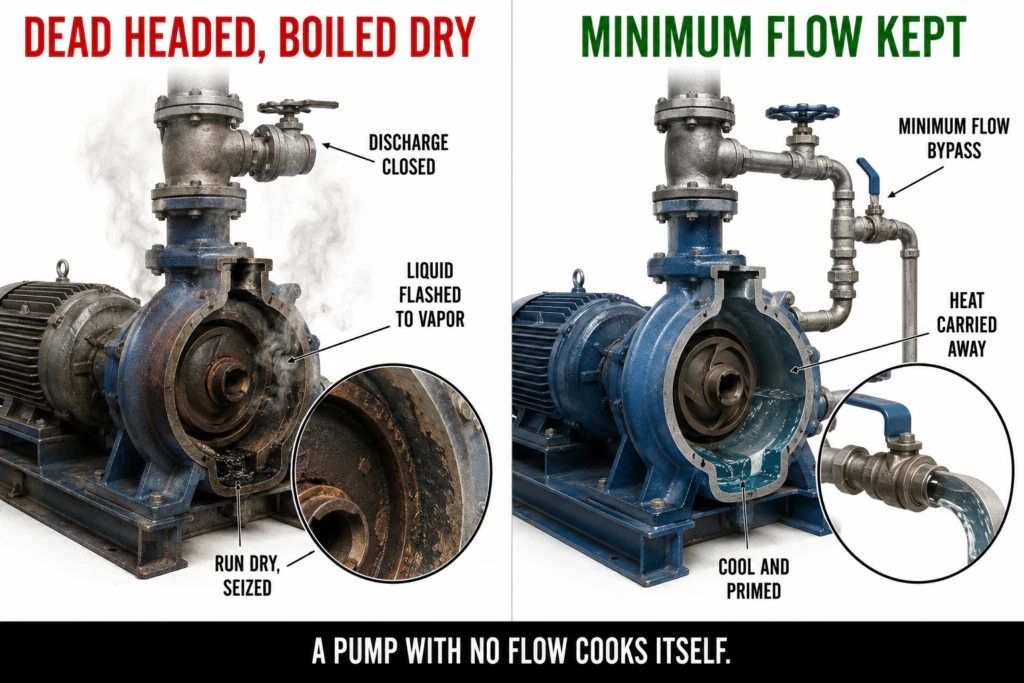
A pump moving no flow has nowhere to send the power it draws, so the liquid inside heats and flashes to vapor. A few minutes dead headed can boil a pump dry and seize it.
A pump needs to move flow to survive, because the power it draws has to go somewhere. Close the discharge, or run against a blocked line, and the pump keeps drawing power, but with no flow leaving, that power turns into heat in the small trapped volume of liquid. In minutes it can boil, flash to vapor, and leave the pump running dry, and a dry pump has no cooling for its seal and no lubrication of the faces, so it overheats, seizes, and destroys the seal and sometimes the impeller. Running at or near zero flow is one of the fastest ways to wreck a pump, which is why pumps that must run blocked in need a minimum flow path.
The cost. A pump heated to boiling and run dry when dead headed or starved, a seized, vapor bound pump, and a seal and impeller cooked by the heat with nowhere to go.
The fix. Guarantee a minimum flow. Never run against a closed discharge, fit a minimum flow bypass where dead heading is possible, protect against dry running and loss of prime, and size the minimum flow for the heat the pump puts in, not just the hydraulics.
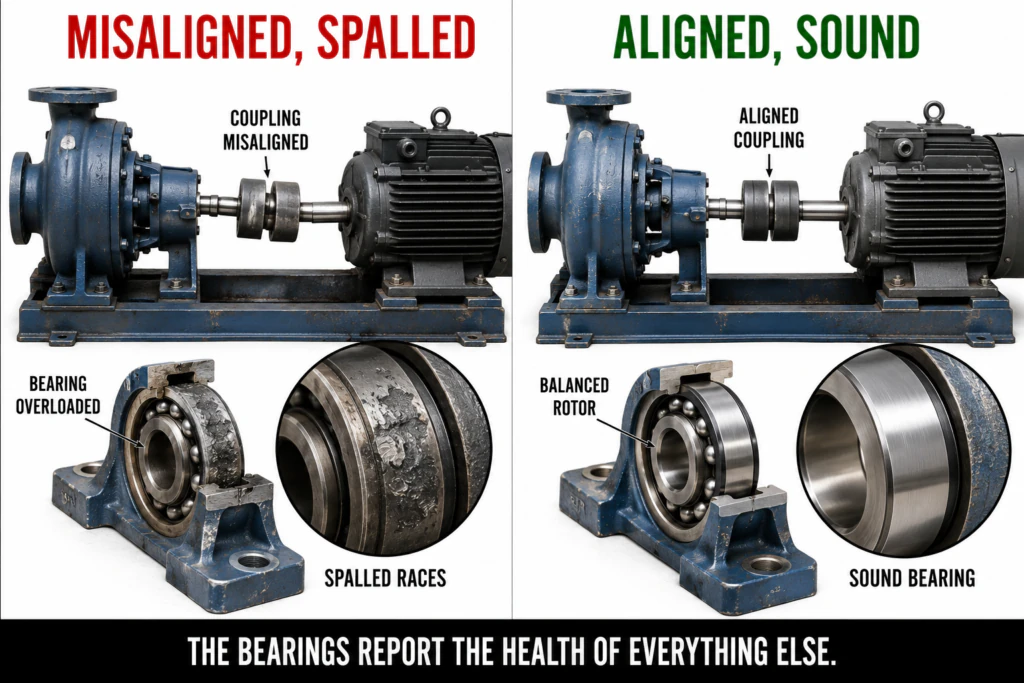
The bearings hold the shaft against every load the pump makes, and misalignment and unbalance shorten their life sharply. A pump that vibrates is usually a pump whose bearings are on their way out.
Everything the pump does mechanically ends up in the bearings: the radial thrust from the flow, the axial thrust from the impeller, the unbalance of the rotor, and any misalignment with the driver. The bearings carry all of it, and bearing life falls steeply with load and is wrecked by vibration and contamination. A pump coupled even slightly out of line runs its bearings under a cyclic load they should not see, and an unbalanced or bent rotor shakes them apart, so the bearings spall, roughen, and fail, usually the first visible sign that something upstream, alignment, balance, or flow, is wrong. The bearings report the health of everything else.
The cost. Spalled, noisy, overheated bearings from misalignment, unbalance, or excess thrust, failing early and taking the pump down, often the first symptom of a deeper problem.
The fix. Look after the rotating assembly. Align the pump and driver properly, balance the rotor, keep the bearings clean, cool, and lubricated, and treat rising vibration as the early warning it is, tracing it to the flow, the alignment, or the balance before the bearing fails.
A centrifugal pump is a fluid machine wrapped around a rotating structure, and almost everything that kills it comes from the fluid or the loads the fluid makes, not from simple wear. It is sandblasted by cavitation when the suction margin is too small, tears at its vanes when it runs far from its best point, cracks its impeller at its own vane passing frequency, cooks its seal when the film is lost, boils itself dry when dead headed, and spalls its bearings when misaligned. Only one of those six is a crack. The rest are erosion, hydraulic overload, a lost sealing film, boiling, and spalled bearings, and every one can destroy a pump that is metallurgically sound. Give a pump the suction margin, the flow near its best point, and the alignment and cooling it needs, and it runs for decades. Starve it of any, and it finds one of the six ways to destroy itself from the inside.
At Developmech, we do the engineering behind pumps: cavitation and NPSH analysis, CFD of the impeller and casing flow, operating point and radial thrust, impeller and vane fatigue, and the seal, minimum flow, and alignment choices that keep a pump alive. If you build or run pumps that have to survive their own fluid, we are glad to take a look.
