Address
Malik Saleem Plaza, New City, Wah
Pakistan
WhatsApp: +92 327 5100047
Email: info@developmech.com
Work Hours
Monday to Friday: 3PM - 11AM
Weekend: 10AM - 5PM
Address
Malik Saleem Plaza, New City, Wah
Pakistan
WhatsApp: +92 327 5100047
Email: info@developmech.com
Work Hours
Monday to Friday: 3PM - 11AM
Weekend: 10AM - 5PM

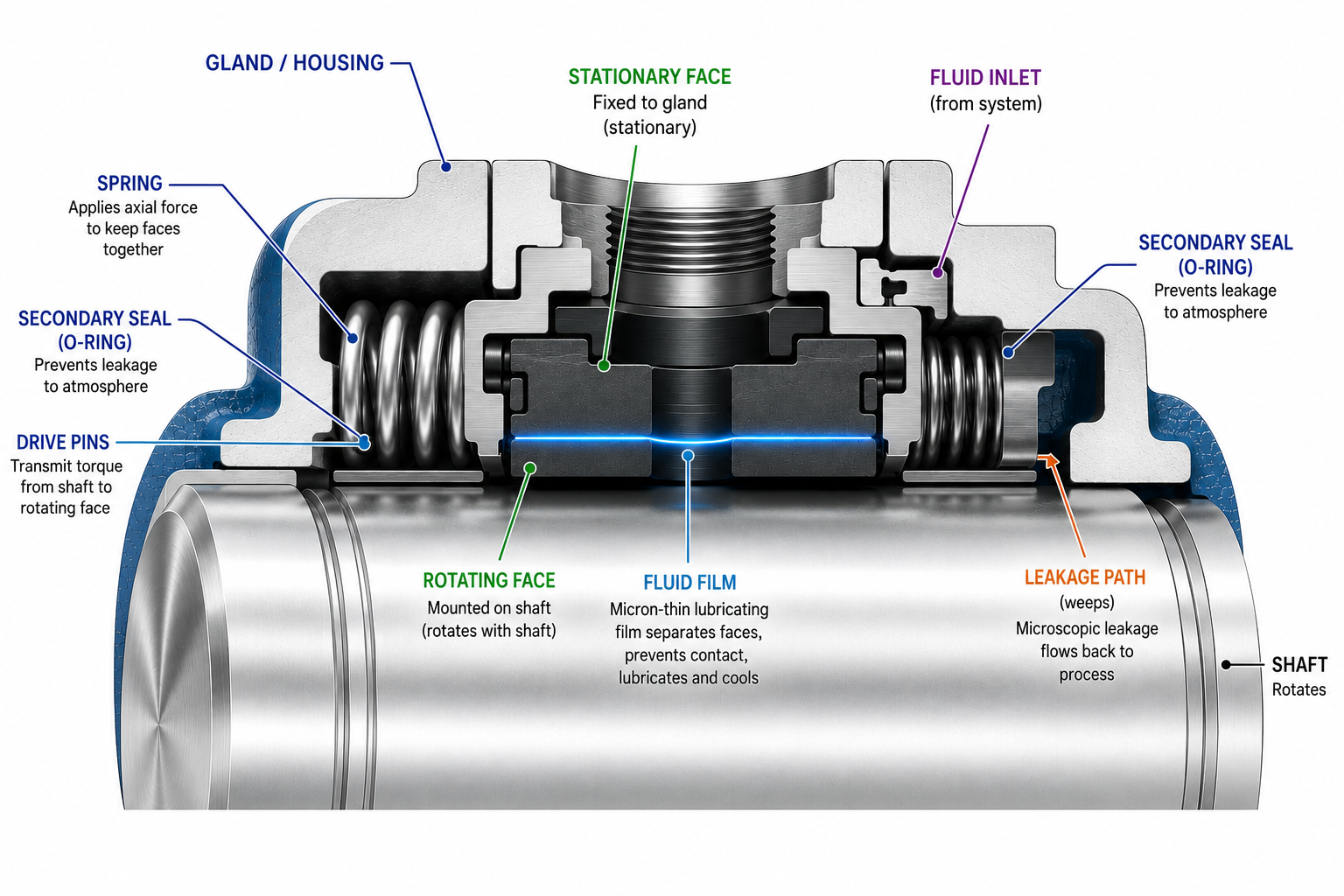
Every seal failure is a story about the equipment around it, and reading it right is the difference between a real fix and leaking again
Developmech | Rotating Equipment & Reliability
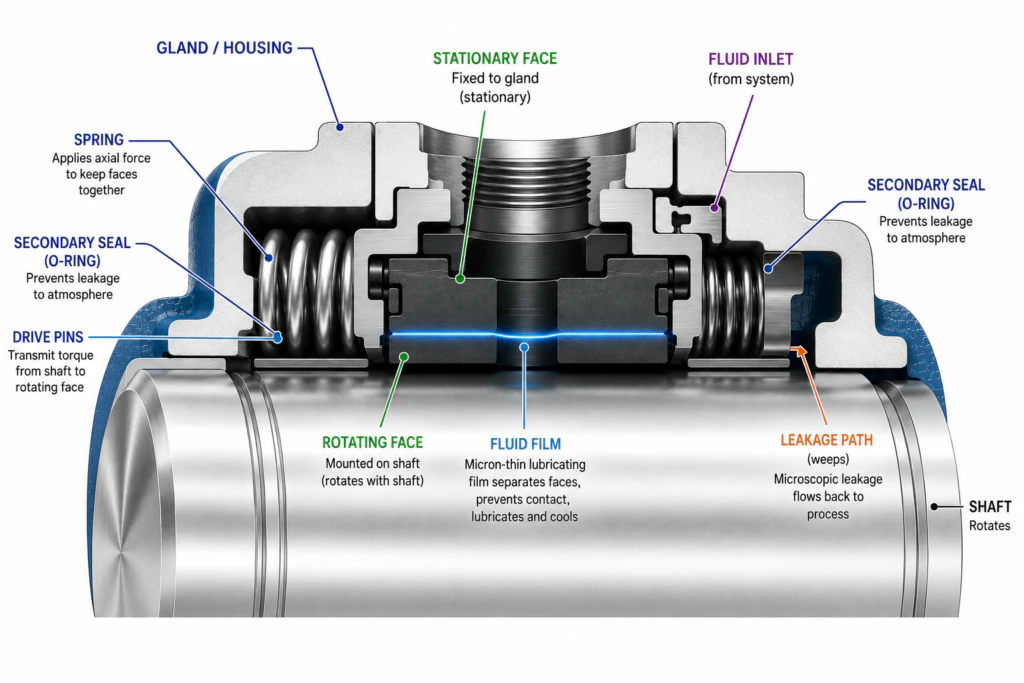
A mechanical seal is a deceptively simple idea: two ultra flat rings, one spinning with the shaft and one held stationary, pressed together so tightly that almost nothing gets past, yet separated by a film of liquid so thin it can be measured in microns. That film is the whole game. It is what keeps the faces from touching, and the entire art of sealing is keeping it exactly the right thickness.
This is why a mechanical seal almost never simply “wears out.” When one fails, that fluid film was destroyed, and the film was destroyed by something happening in the pump, the shaft, the piping, or the process around it. The seal is where the failure shows up. It is rarely where the failure began.
Replace the seal without reading what killed it and you get the most frustrating outcome in rotating equipment: a brand new seal that leaks again in days. Here are the five things a failed seal is usually telling you.
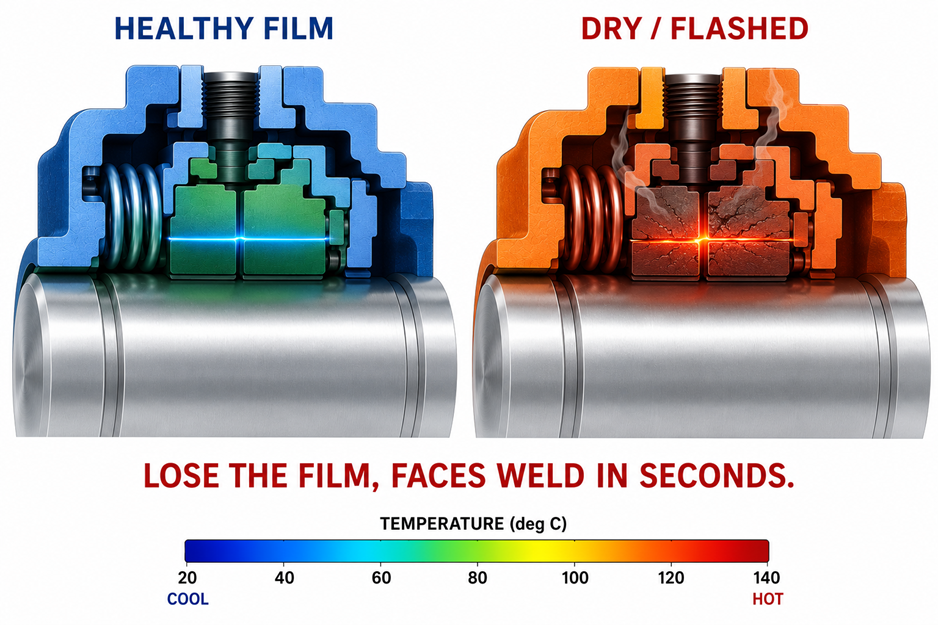
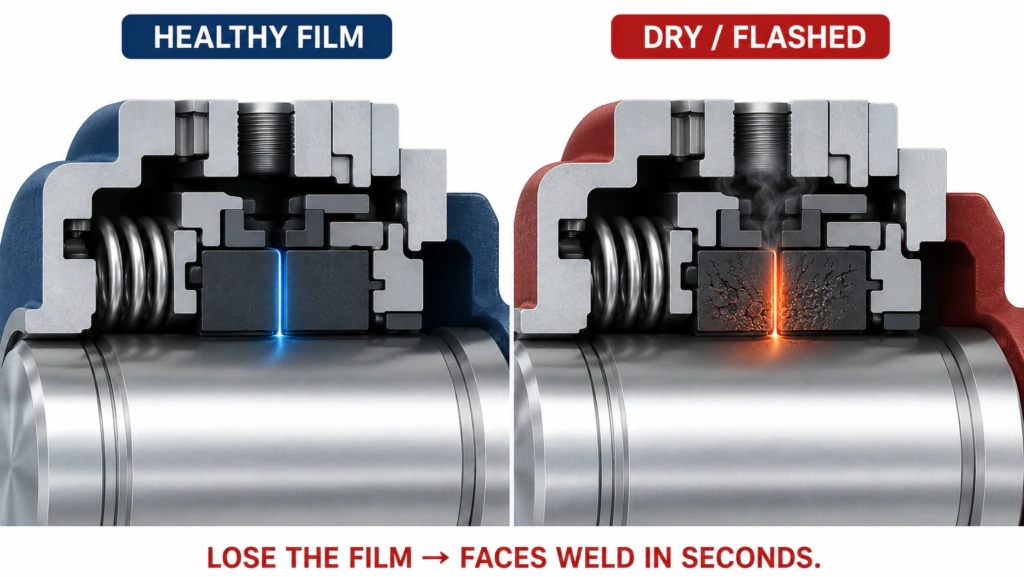
The seal runs on a micron thin liquid film. Lose it (dry running, flashing, air) and the faces contact, overheat, and destroy themselves in seconds.
The faces are meant to ride on a continuous film of the fluid being sealed. Remove that film, by running the pump dry, letting it cavitate, sealing a liquid that flashes to vapor across the faces, or trapping air on startup, and the faces make hard contact. At sliding speeds of tens of metres per second, dry contact generates enormous heat almost instantly: the faces score, heat check, blister, and can effectively weld together.
The cost. Catastrophic, sudden failure, often within seconds of a dry running event, usually with a burned, cracked face that gets misread as “the seal was defective.”
The fix. Protect the film. Ensure the seal chamber stays flooded and vented, add flush or quench plans (API piping plans) where the duty needs them, and never let the pump run dry or deadheaded. If the fluid flashes, control seal chamber pressure and temperature to keep it liquid across the faces.
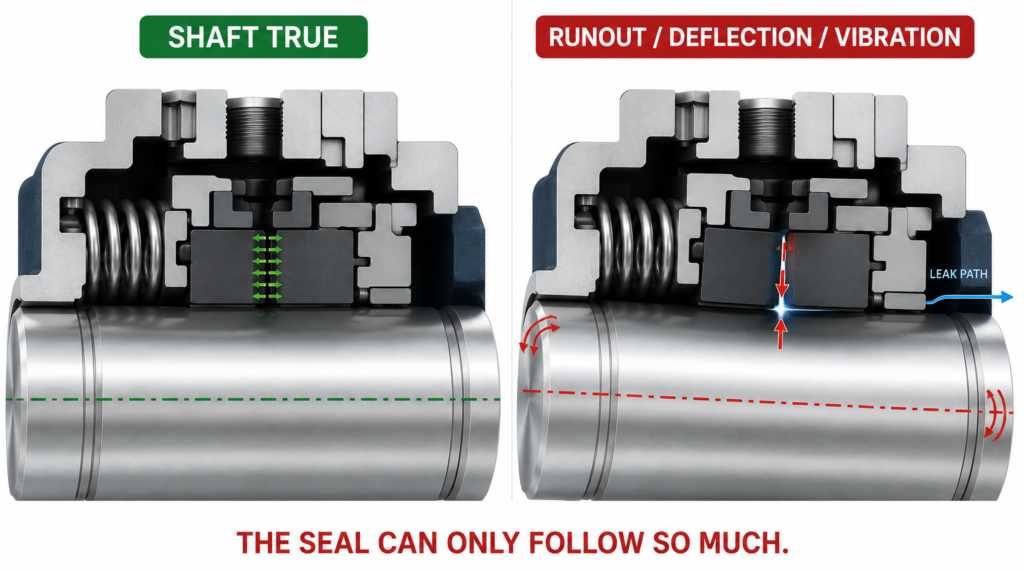
The stationary face has to follow the rotating one. Excess runout, deflection, or vibration opens the faces every revolution and pumps fluid straight out.
A seal keeps the faces together by letting the flexibly mounted face track tiny movements of the rotating one. That only works if the movements stay tiny. Bent shafts, worn bearings, misalignment, an unbalanced rotor, or operating a pump far off its best efficiency point all make the shaft run out, deflect, and vibrate more than the seal was designed to follow. The faces open and close every revolution, and each opening leaks.
The cost. Chronic weeping, rapid face wear, fretting on the shaft or sleeve, and short seal life: the failure that keeps coming back no matter how good the replacement seal is.
The fix. Fix the shaft, not the seal. Check runout, bearing condition, and alignment; balance the rotor; and keep the pump operating near its best efficiency point where hydraulic loads are lowest. The seal can only tolerate the motion the rest of the machine allows.
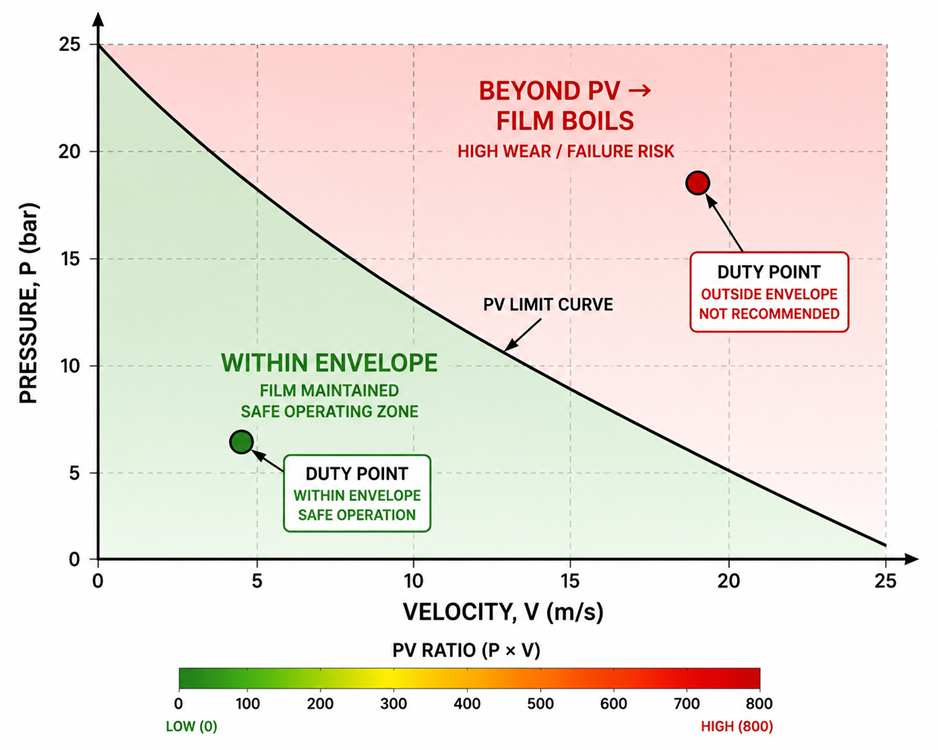
Every face material pair has a pressure and velocity (PV) limit. Push past it and the film boils away: the same faces that last for years fail in weeks.
Seal faces are rated by a PV limit, the product of the pressure holding them together and the sliding velocity between them, which together set how much heat is generated at the interface. Run a given face pair beyond its PV limit, higher pressure, higher speed, or a poor lubricity fluid, and the film can no longer carry the heat away. It thins, boils, and breaks down. The identical seal that runs for years in one service fails in weeks in another, and it looks like bad luck.
The cost. Repeated “unexplained” short life on a seal that is, in fact, being asked to do something outside its envelope for the materials chosen.
The fix. Match the face materials to the actual PV and the fluid. Carbon against silicon carbide, silicon carbide against silicon carbide, hard coatings: each has a different envelope. For high PV or poor lubricity duty, size the balance ratio, choose the right face pair, and consider a flush that cools and lubricates the interface.
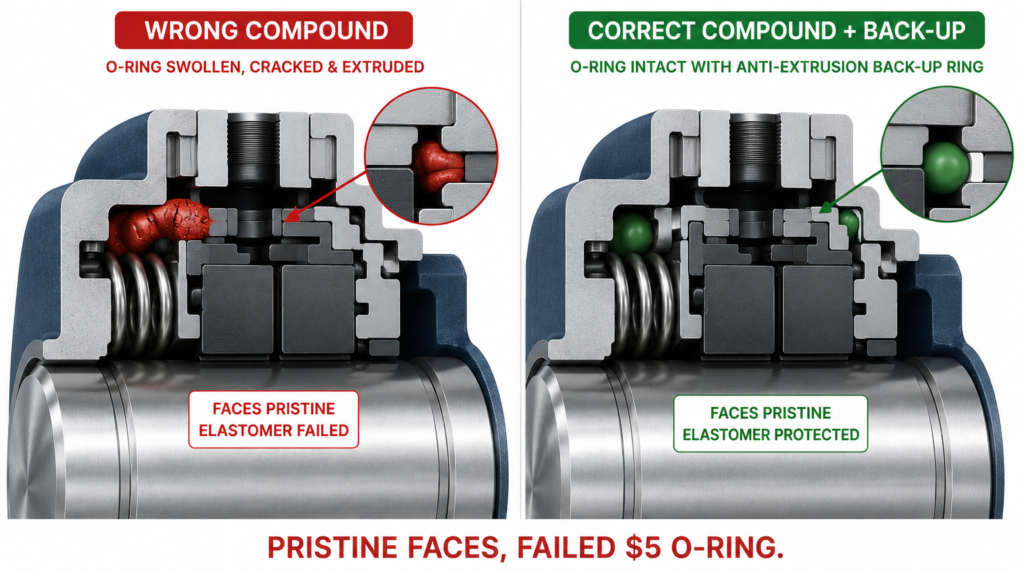
The faces get the attention, but the elastomer rings fail first, attacked by the chemistry, swollen, embrittled, or extruded by heat and pressure.
The precision faces get all the attention, but the humble elastomer rings and secondary seals are where a lot of failures actually start. An elastomer that is wrong for the chemistry swells, hardens, cracks, or dissolves; one run beyond its temperature rating takes a compression set and stops sealing; one under too much pressure without a backup extrudes through the gap. When the secondary seal quits, the primary faces can be perfect and the seal still leaks.
The cost. Leaks that make no sense: pristine faces, a failed seal, and a maintenance team chasing the wrong component while the real culprit is a $5 elastomer ring in the wrong compound.
The fix. Specify elastomers for the full chemistry and temperature range, not just the nominal fluid, including CIP and SIP cycles, cleaning agents, and upset conditions. Verify chemical compatibility and temperature limits, and where pressure is high, add a backup ring to prevent extrusion.
Seal faces are flat to a few light bands. A little heat or clamping distortion cones them, and a coned face cannot hold a film.
A seal face is lapped flat to within a few wavelengths of light, a fraction of a micron. That flatness is what lets a continuous, uniform film form. It also means almost nothing is needed to ruin it. Frictional heat at the faces, a hot process fluid, or clamping and thermal gradients in the gland can distort a face by more than its flatness tolerance, coning it slightly convex or concave. A face that is no longer flat cannot maintain a uniform film, and the leak follows.
The cost. Persistent low level leakage and short life that no amount of relapping fixes, because the distortion happens under running heat and load, not on the bench.
The fix. Manage the heat and the mounting. Provide adequate face cooling and flush, choose face materials with high thermal conductivity and low distortion, and design the gland and clamping so thermal gradients do not warp the faces in service. Flatness has to survive operating temperature, not just inspection.
A mechanical seal is an exquisitely sensitive instrument for measuring everything wrong with the machine it is bolted to. Dry running, shaft motion, excess PV, the wrong elastomer, thermal distortion: the seal reports all of it the same way, by leaking. That is why swapping seals until one “sticks” is a losing game, because the new seal inherits the exact conditions that killed the last one. The failed face is evidence. Read it, find what destroyed the film, fix that, and the next seal lasts for years instead of days.
At Developmech, we treat seal failures as system problems: shaft and rotor dynamics, seal chamber conditions, face and elastomer selection, and the thermal and structural behavior of the gland. If a seal keeps failing and replacing it is not solving it, we are glad to take a look.
