Address
Malik Saleem Plaza, New City, Wah
Pakistan
WhatsApp: +92 327 5100047
Email: info@developmech.com
Work Hours
Monday to Friday: 3PM - 11AM
Weekend: 10AM - 5PM
Address
Malik Saleem Plaza, New City, Wah
Pakistan
WhatsApp: +92 327 5100047
Email: info@developmech.com
Work Hours
Monday to Friday: 3PM - 11AM
Weekend: 10AM - 5PM

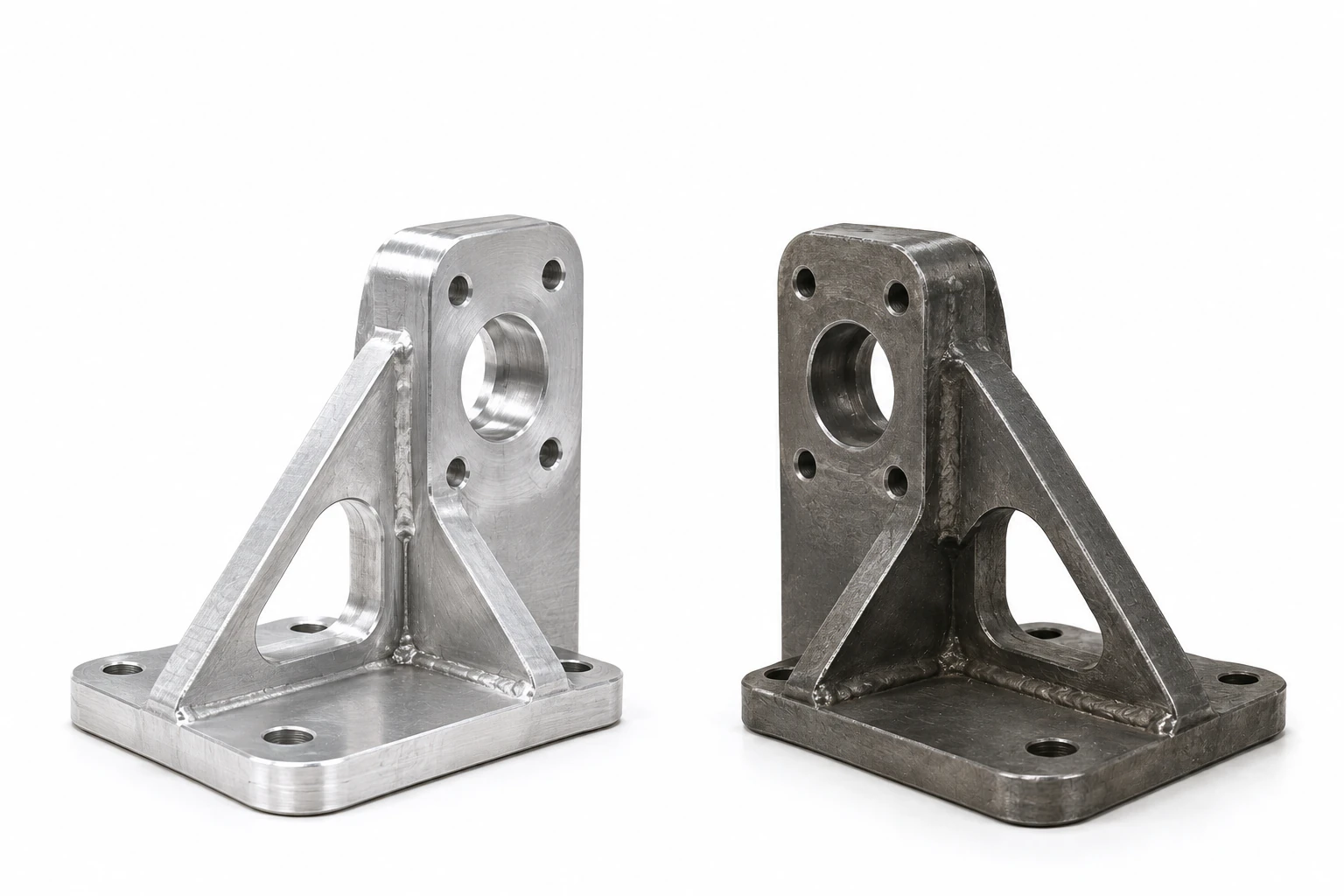
The difference that matters between aluminium and steel is not weight, it is that steel has a stress it can survive forever and aluminium does not, plus five more that decide which to use
Developmech | Fatigue, Materials & Structural Analysis
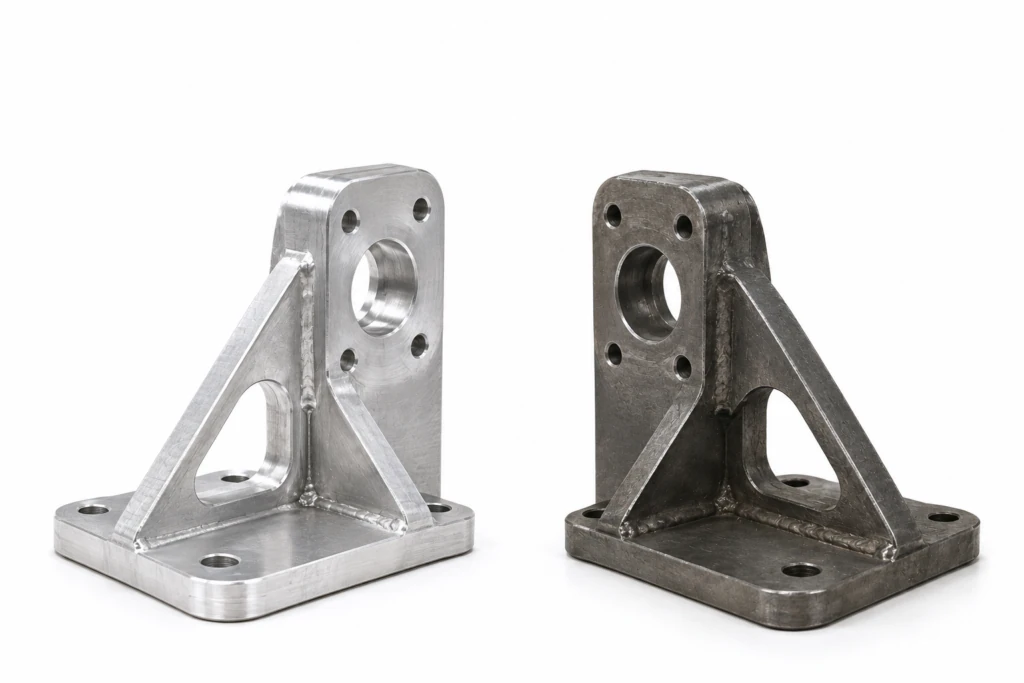
The first thing anyone says about aluminium is that it is light. It is, at about a third the density of steel, and for anything that has to move or fly that matters enormously. But weight is the least interesting difference between the two metals, and designing an aluminium part as if it were a lighter steel one is how aluminium parts fail. The two behave differently in almost every way that decides whether a part survives, and the most important difference has nothing to do with weight.
Steel has a fatigue limit. Below a certain cyclic stress, a steel part can be loaded and unloaded forever and never crack, because its fatigue curve flattens into a floor. Aluminium has no such floor. Its curve keeps sloping down without end, so there is no stress low enough to load an aluminium part forever, only stresses that take longer to crack it. Every aluminium part is on a countdown, and the only question is how many cycles are on the clock.
Here are the six differences between aluminium and steel that actually decide a design, starting with the one that catches people out.

Steel’s fatigue curve flattens into an endurance limit, a stress it survives forever. Aluminium’s keeps falling with no floor, so any cyclic stress cracks it eventually. This is the difference that catches people out.
The most important difference between the two metals is what happens under cyclic load. Steel has a fatigue limit, a stress below which its curve goes flat and it endures essentially unlimited cycles without cracking. Design a steel part below that line and fatigue stops being the failure mode. Aluminium has no fatigue limit at all. Its curve slopes downward without end, so no matter how low the cyclic stress, the part eventually cracks if it is cycled long enough, it just takes more cycles. An aluminium part designed as if it had a steel style endurance limit is designed to a line that does not exist.
The cost. An aluminium part that cracks from fatigue at a stress that would last a steel part forever, because it was designed to an endurance limit aluminium does not have.
The fix. Design aluminium to a finite life. Set the required number of cycles, read the stress off the real aluminium fatigue curve at that life with margin, and accept that the part has a life, or drop the stress far enough that fatigue is not the limit. Never borrow a steel endurance limit for aluminium.
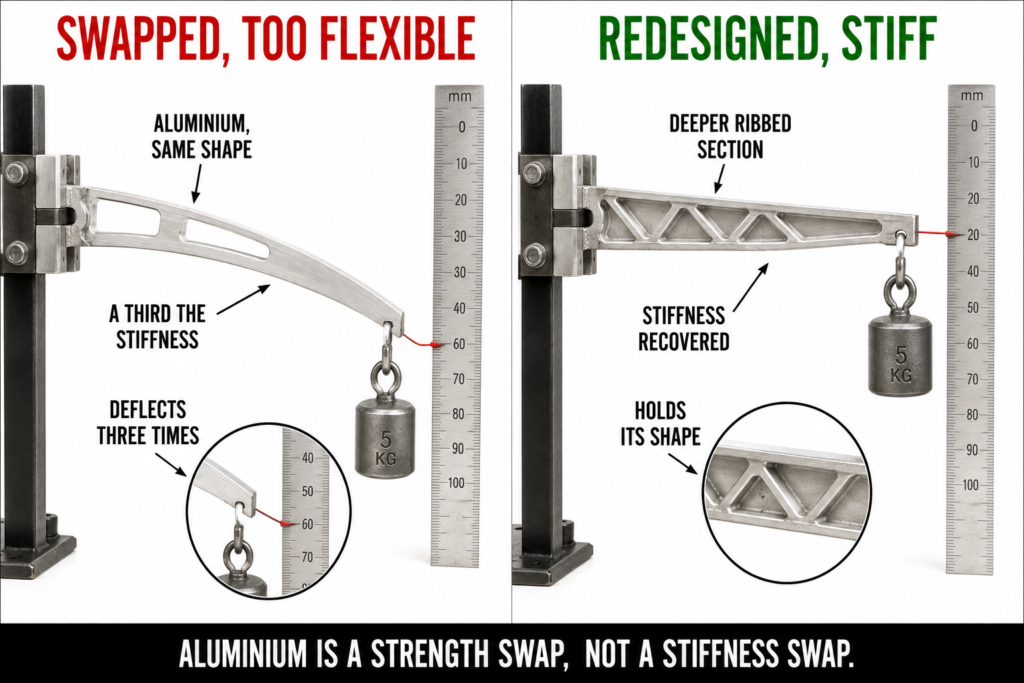
Aluminium is about a third as stiff as steel, so the same shape deflects three times as much. You often cannot just swap the metal, you have to redesign the section for stiffness.
Aluminium is about a third as stiff as steel, its elastic modulus roughly a third, and that catches people who think of strength and forget stiffness. Remake a steel part in aluminium in the same shape, and even if it is strong enough it deflects about three times as much under the same load, because deflection depends on stiffness, not strength. Wherever deflection matters, a bracket that must stay put, a panel that must not flex, a structure that must hold a tolerance, you cannot simply swap the metal. You have to redesign the section, deeper or ribbed, to get the stiffness back, and that eats into the weight saving. Aluminium is a strength substitution, not a stiffness one.
The cost. An aluminium part strong enough but far too flexible, deflecting three times as much as the steel it replaced, losing tolerance or feeling flimsy, when only the strength was checked.
The fix. Design aluminium for stiffness, not just strength. Check the deflection as well as the stress, resize the section, deeper, ribbed, or thicker, to recover the stiffness the modulus gives away, and count the added material against the weight saving so the swap is judged on the stiff design.
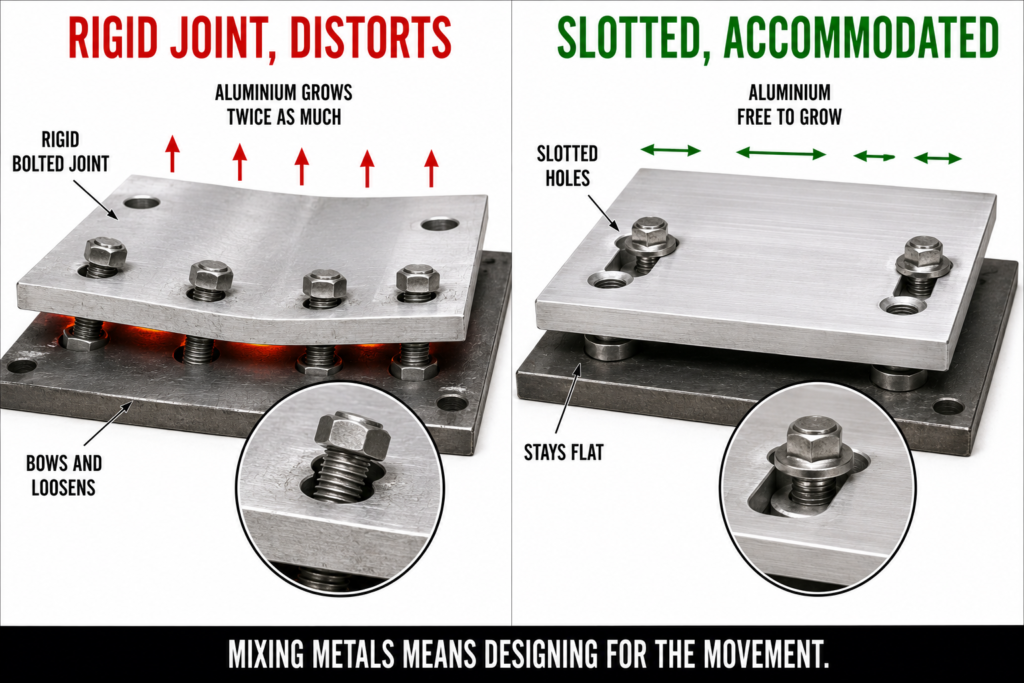
Aluminium expands about twice as much as steel for the same temperature rise. Join the two rigidly and every heat cycle drives a thermal stress and a movement into the joint.
Aluminium expands and contracts about twice as much as steel. On its own that just means an aluminium part grows more when it gets hot, which has to be allowed for. The trouble comes when the two are joined, because now every temperature change makes the aluminium try to grow or shrink twice as far as the steel it is bolted to, and the joint has to absorb the difference. Bolt an aluminium part rigidly to a steel one and every heat cycle drives a thermal stress into the fasteners and the metal around them, loosening bolts, distorting the assembly, and fatiguing the joint, with no external load at all. Mixing the two metals means designing the joint for the movement between them.
The cost. Loosened fasteners, distortion, and thermal fatigue at aluminium to steel joints from the expansion mismatch, appearing over temperature cycles with no external load involved.
The fix. Design the joint for the expansion mismatch. Let the aluminium grow relative to the steel with slotted holes, flexible mounts, or expansion joints, keep long rigid runs of mixed metal short, and check the thermal stress and movement over the real temperature range, not just the mechanical load.
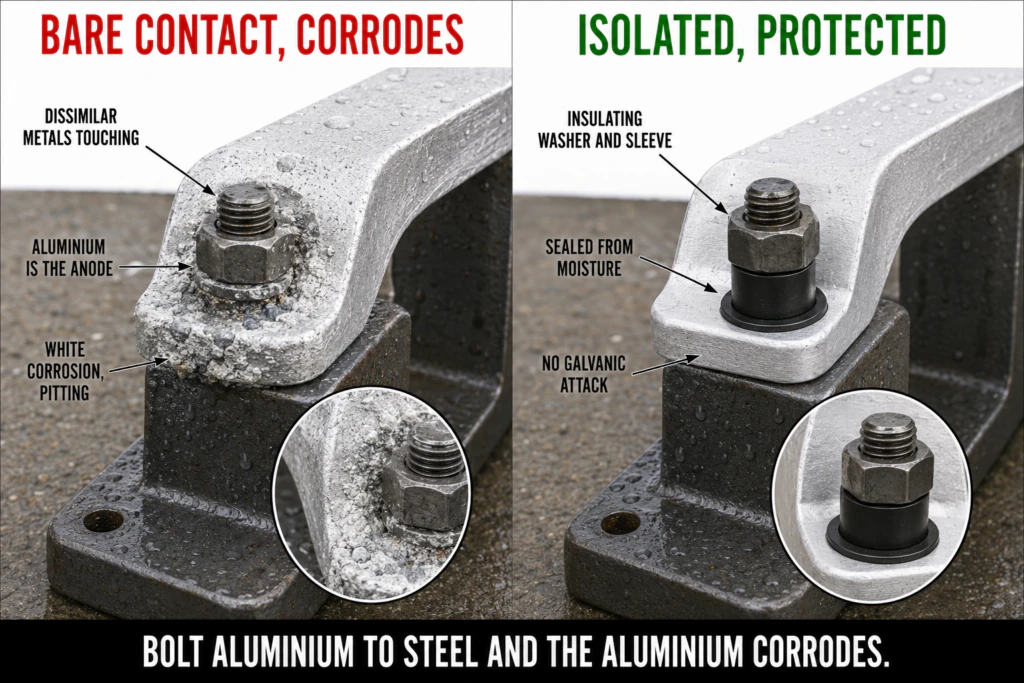
Aluminium and steel in contact with any moisture form a galvanic cell, and the aluminium is the one that corrodes. The more noble steel is protected at the aluminium’s expense.
Put aluminium and steel in contact with any moisture present and you have built a battery. The two sit at different places on the galvanic scale, and connected in a wet environment the less noble metal, the aluminium, becomes the anode and corrodes preferentially, while the steel is protected. The aluminium around the joint pits, swells with white corrosion product, and eats away, often fastest where the joint needs to stay tight. It is not general weathering, it is galvanic attack driven by the contact itself, and a stainless fastener in an aluminium part, or an aluminium panel on a steel frame, corrodes at the interface unless the two are kept apart.
The cost. Galvanic corrosion of the aluminium at every wet contact with steel, pitting and swelling at the joint, and a connection corroding exactly where it must stay sound.
The fix. Break the galvanic couple. Isolate aluminium from steel with coatings, gaskets, or insulating washers and sleeves, keep the joint dry or sealed, choose fasteners and finishes compatible with aluminium, and design so water cannot sit in the contact and complete the cell.
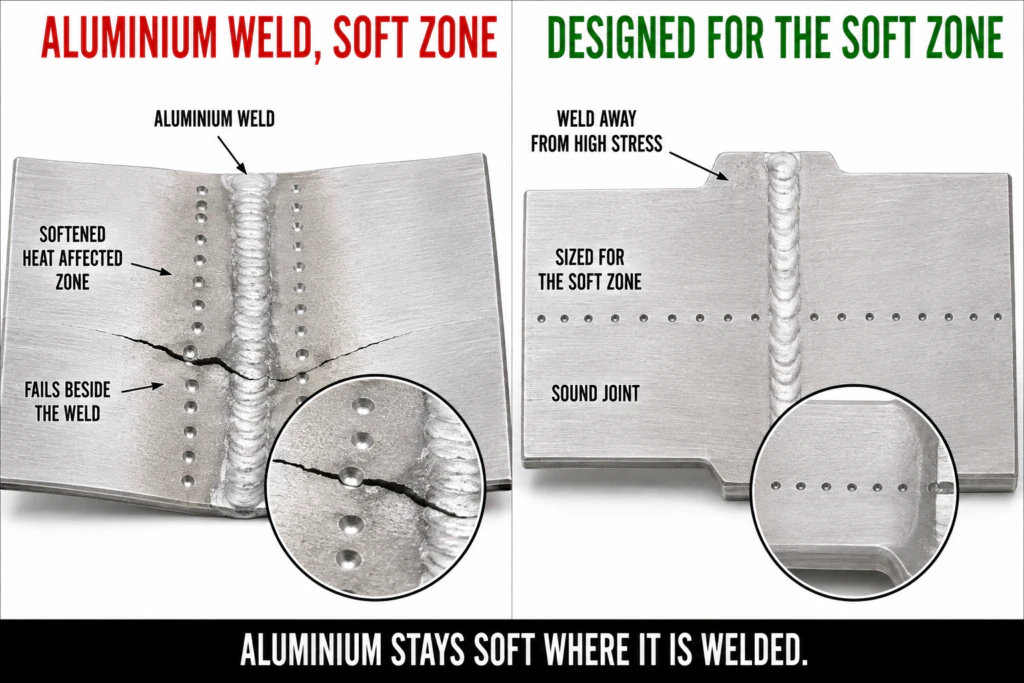
Welding aluminium softens the metal around the weld, and unlike many steels it does not come back with the weld. The heat affected zone can be the weakest part of the whole part.
Welding treats the two metals very differently. Much of aluminium’s strength comes from a temper, a heat treatment or work hardening that the welding heat undoes, so the heat affected zone beside an aluminium weld is left soft, sometimes far weaker than the parent metal, and it does not recover as it cools. That soft band becomes the weakest part of the structure, right beside the weld where the stress is often highest. Steel has its own weld problems, a hardened, sometimes brittle heat affected zone, but they are different problems, and an aluminium weld that looks identical to a steel one can hide a soft zone that governs the part’s strength.
The cost. A soft, weakened heat affected zone beside every aluminium weld that does not recover, becoming the weakest part of the structure right where the stress is highest.
The fix. Design aluminium welds around the soft zone. Choose alloys and tempers for how they behave after welding, place welds away from the highest stresses, size the joint for the softened heat affected zone rather than the parent metal, and heat treat again where the design demands full strength back.
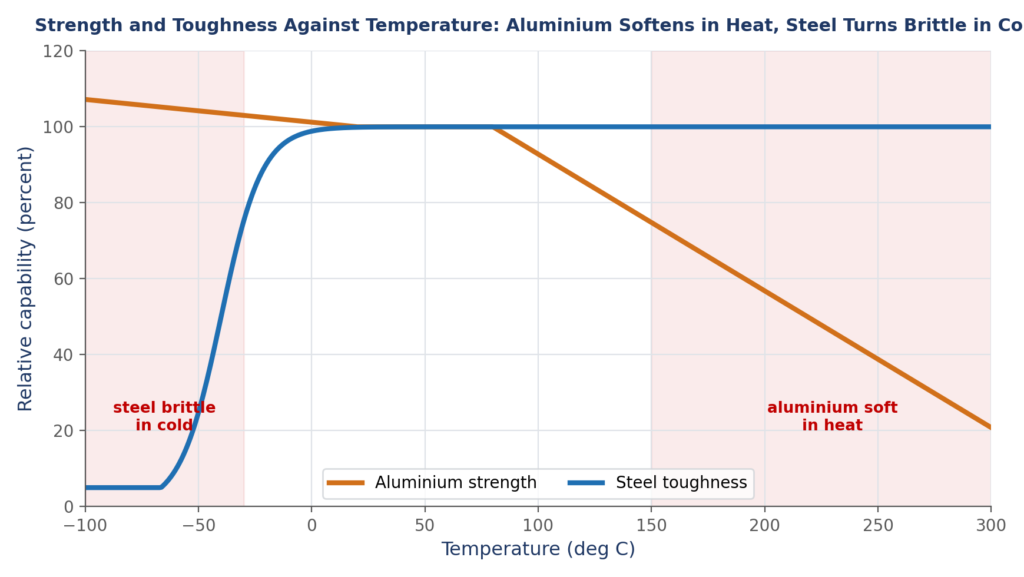
Each metal has its temperature weakness. Aluminium loses strength as it warms, well before it glows, while steel can turn brittle as it cools below its transition temperature.
The two metals fail at opposite ends of the temperature scale. Aluminium loses strength at surprisingly modest temperatures, softening steadily as it warms, so a part that is fine at room temperature can be well down on strength at a temperature that barely bothers steel, long before anything glows. Steel holds its strength through heat far better, but it has the opposite weakness, many steels turn brittle as they get cold, losing their toughness below a ductile to brittle transition and liable to snap without warning. So aluminium is wrong where it will run hot, and the wrong steel is dangerous where it will run cold, and neither weakness shows up in a room temperature test.
The cost. Aluminium parts quietly losing strength in the heat, and the wrong steel snapping brittle in the cold, each failing at a temperature extreme that a room temperature test never revealed.
The fix. Choose the metal for its temperature. Derate aluminium for its service temperature and avoid it where it runs hot enough to soften, specify steels with a low enough transition temperature for cold service, and test the properties at the real operating temperature, hot and cold, not just at room.
Aluminium and steel are not the same material at different weights, they are two different metals that both happen to be structural, and weight is the least of what separates them. Steel can be loaded forever below its fatigue limit and aluminium cannot, aluminium is a third as stiff, it expands twice as much, it corrodes when you bolt it to steel, it stays soft where it is welded, and it loses strength in heat while steel loses toughness in cold. Only the first is really about fatigue, the rest are stiffness, expansion, corrosion, welding, and temperature, and every one can decide the part. Choose between them on the difference that matters for the job, and design the aluminium as aluminium, not as light steel. Pick aluminium because it is light and treat it like steel, and it finds one of these six ways to remind you that it is not.
At Developmech, we do the engineering behind the material choice: fatigue life in both metals, stiffness and deflection driven design, thermal expansion and mixed metal joints, galvanic corrosion, weld and heat affected zone strength, and the temperature limits that decide aluminium or steel. If you are choosing between aluminium and steel for a part that has to last, we are glad to take a look.
