Address
Malik Saleem Plaza, New City, Wah
Pakistan
WhatsApp: +92 327 5100047
Email: info@developmech.com
Work Hours
Monday to Friday: 3PM - 11AM
Weekend: 10AM - 5PM
Address
Malik Saleem Plaza, New City, Wah
Pakistan
WhatsApp: +92 327 5100047
Email: info@developmech.com
Work Hours
Monday to Friday: 3PM - 11AM
Weekend: 10AM - 5PM

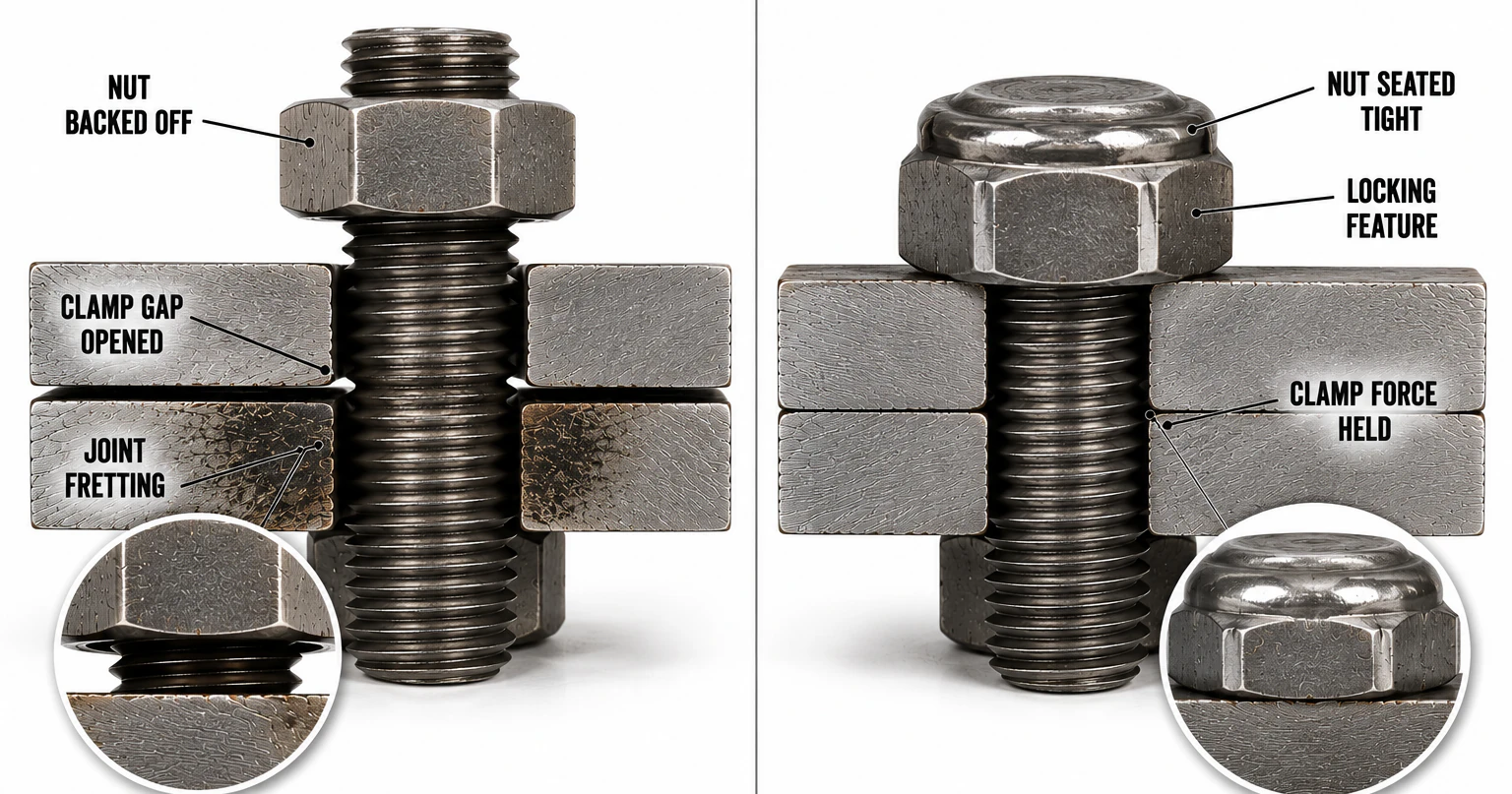
A bolt does not hold a joint together, its preload does, and almost every bolt failure is a preload that was wrong, lost, or never measured
Developmech | Structural, Fatigue & Bolted Joint Analysis
A list of bolt failures reads like a catalogue of villains: overload, fatigue, shear, loosening, embrittlement, corrosion. It makes the bolt look fragile, as if it were forever finding new ways to break. It is not. Almost every one of those failures is the same failure wearing a different mask, and the thing behind the mask is preload. A bolt does not hold a joint together by being strong. It holds the joint together by being stretched, and the clamping force that stretch produces is what actually does the work.
Tighten a bolt and you are not locking two parts together, you are stretching a very stiff spring and using its pull to clamp the joint. Get that clamp force right and the bolt barely feels the loads that would destroy a loose one. Get it wrong, too little, too much, or lost over time, and the grade stamped on the head stops mattering, because the joint was never really relying on the bolt’s raw strength in the first place.
Here are the six ways bolted joints fail, and the one number underneath all of them.
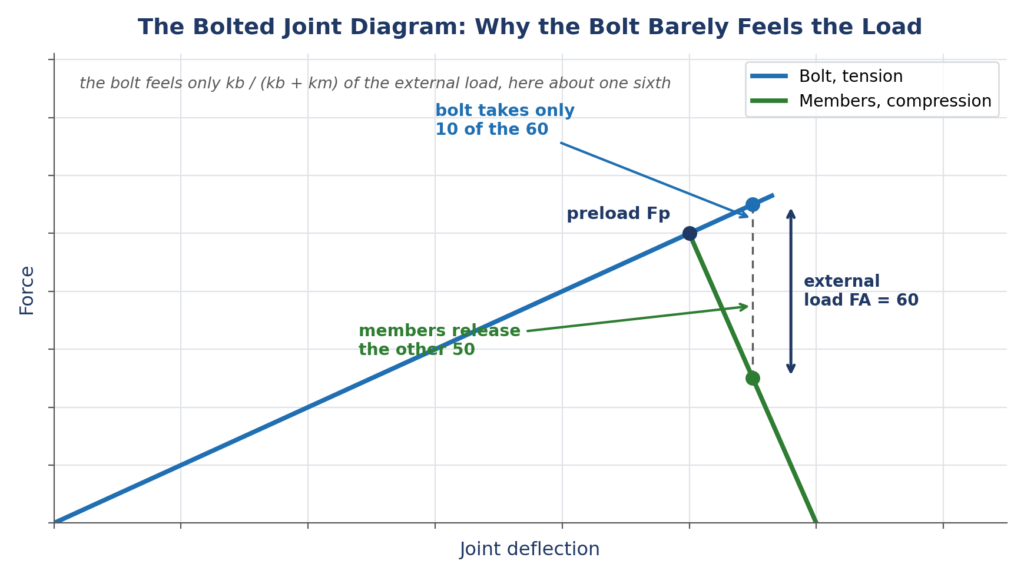
Tightening stretches the bolt and compresses the members, so the joint is two springs in opposition. That stored clamping force, the preload, is what carries the joint.
Tighten a bolt and you stretch it, and it pulls the clamped parts together until its pull balances the push of the squeezed members. The joint is now two springs loaded against each other, the bolt in tension and the members in compression, and the force locked between them is the preload. That preload, not the bolt alone, is what holds the joint. When an external load tries to pull the joint apart, most of it relaxes the compressed members rather than stretching the bolt further, so the bolt sees only a small share. This is the whole reason a bolted joint works, and it is invisible on a torque wrench.
The cost. Joints designed as if the bolt simply had to be strong enough, with no attention to the preload, which then fail in service for reasons that look mysterious but are all preload.
The fix. Design the joint as a spring system. Work out the preload the joint needs, choose the bolt size and grade to deliver and hold it, and set the members, the gasket, and the grip length so the stiffnesses work with you. The preload is the design variable, not an afterthought of tightening.
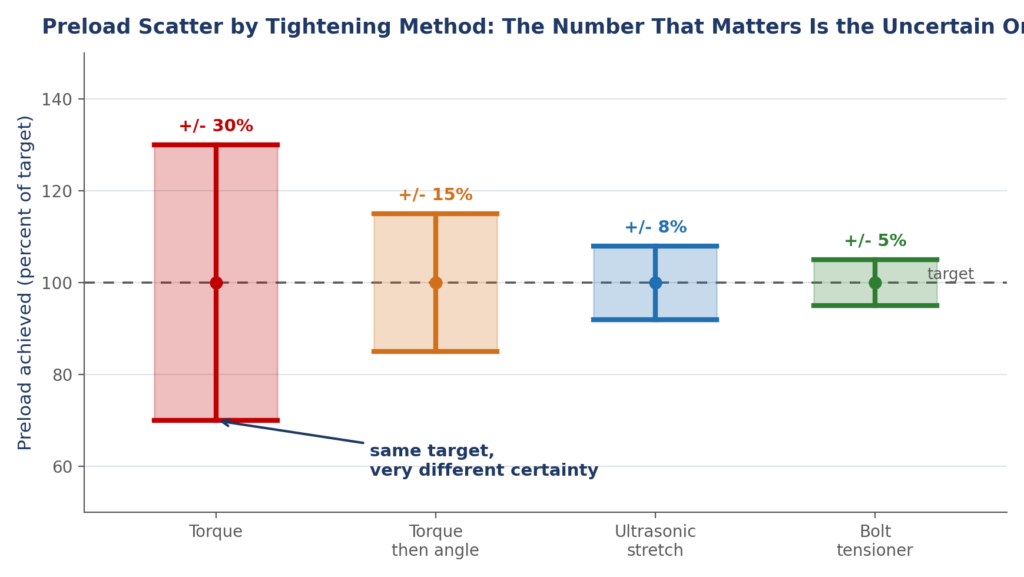
Only about a tenth of the torque becomes clamp force, the rest fights friction, and friction scatters. Torque control leaves the preload uncertain by a third or more.
The number that matters, the preload, is not the number you control on assembly. You control torque, and torque reaches preload only through friction, under the head and in the threads. Only around ten to fifteen percent of the effort ends up as clamp force, and the rest turns against that friction. Worse, friction is not consistent, so the same torque on the same bolts can scatter the preload by thirty percent or more with lubrication, finish, and reuse. You set a precise torque and get an imprecise clamp force, which is why torque alone is the crudest way to do the one thing that keeps the joint alive.
The cost. A row of identical bolts torqued to the same figure carrying very different preloads, some too loose to survive fatigue, some yielded, none of them the value the design assumed.
The fix. Control preload more directly where it matters. Use angle control, bolt stretch measurement, or tension indicating methods on critical joints, specify and control the friction with the right lubrication, and treat torque as the rough method it is. Where torque must be used, design for its scatter rather than pretending it is exact.
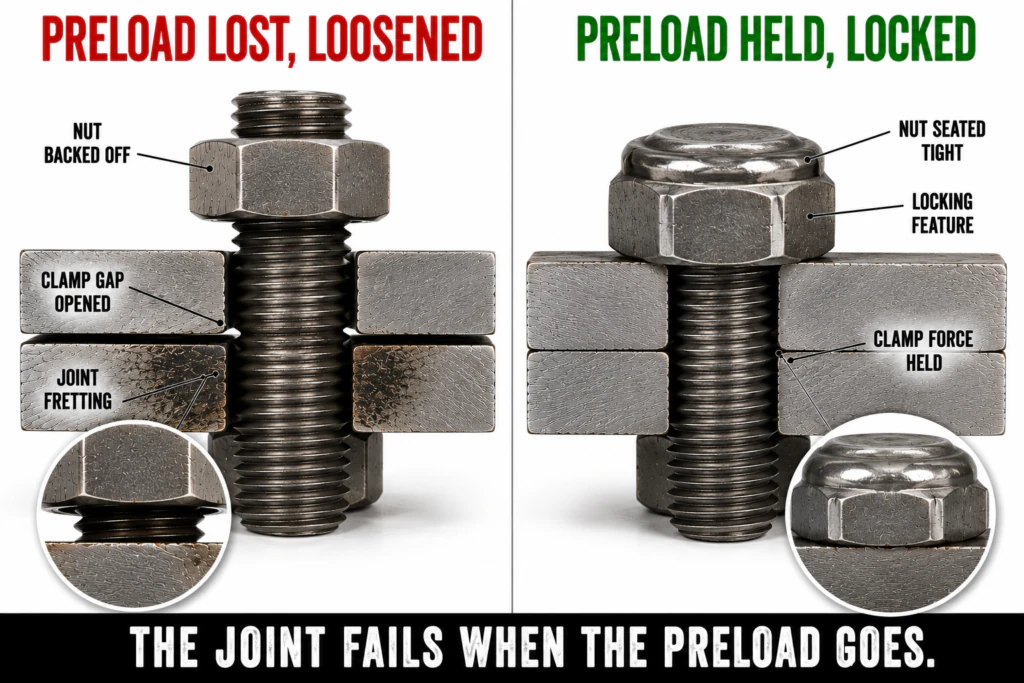
Vibration and embedding quietly bleed preload away. Once the clamp force is gone, every other bolt failure is just waiting to happen.
Preload is not something you set once and forget, because a joint is always trying to give it back. Transverse vibration can walk a nut loose a fraction of a turn at a time until the clamp force is gone. Even without loosening, the surfaces embed, high spots flatten, gaskets and coatings creep, and the bolt relaxes as the grip shortens. Either way the preload bleeds off, and the instant it does the joint stops behaving like a clamped spring system and starts behaving like a loose bolt in a hole, which is where all the dramatic failures begin.
The cost. A joint that was tight at assembly and is loose in service, feeding straight into fatigue, slip, and leakage, often with no visible sign until something breaks.
The fix. Design the preload to survive. Use enough preload and enough grip length that vibration and embedding cannot exhaust it, add locking features or prevailing torque where transverse vibration is real, choose gaskets and coatings that do not creep, and where the joint matters, plan to check and retighten.
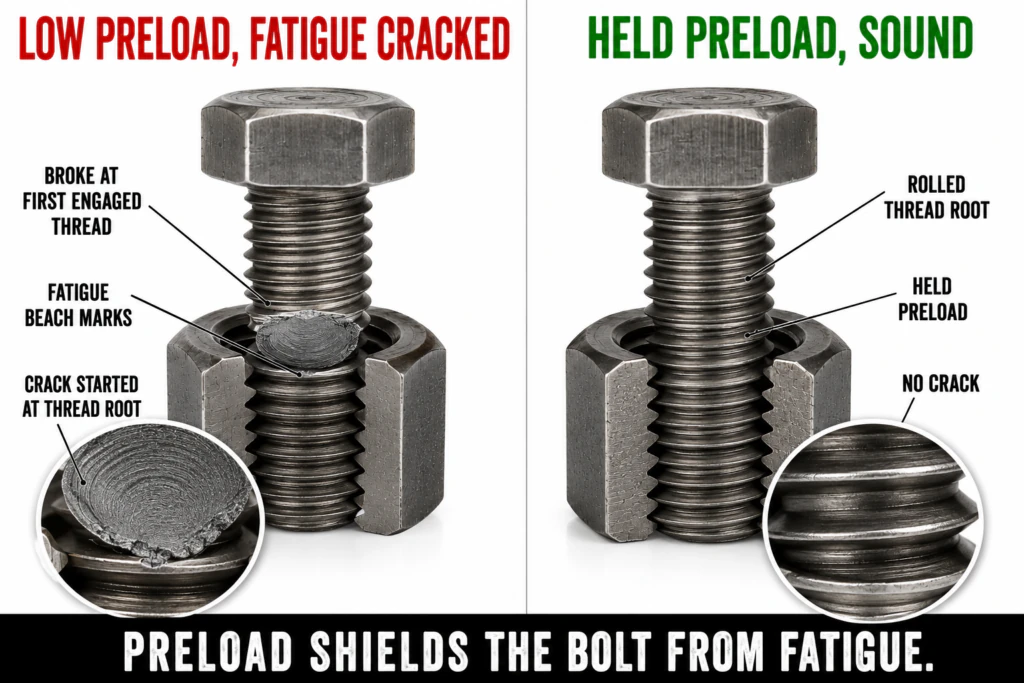
A well preloaded bolt sees only a fraction of the cyclic load. Lose the preload and it sees all of it, and it cracks at the first engaged thread every time.
Fatigue is where lost preload collects its debt. In a properly preloaded joint the bolt sees only a small fraction of any external cyclic load, because the members take most of the swing, so the alternating stress stays low and the bolt lasts. Let the preload fall and that protection disappears, the bolt carries the full cyclic load, and the alternating stress climbs into the range that cracks it. It cracks at the first thread engaged in the nut, where the load crowds into the first turn and the thread root concentrates the stress, leaving beach marks right there. The same bolt, correctly preloaded, would have run indefinitely.
The cost. Fatigue cracks at the first engaged thread on bolts that were strong enough on paper, failing on cyclic loads a correctly preloaded joint would have shrugged off.
The fix. Protect the bolt with preload and geometry. Keep the preload high and stable so the bolt sees little of the cyclic load, use rolled threads rather than cut for a stronger root, ease the load into the nut with a better nut design, and check the bolt fatigue against the real alternating stress, not the average.
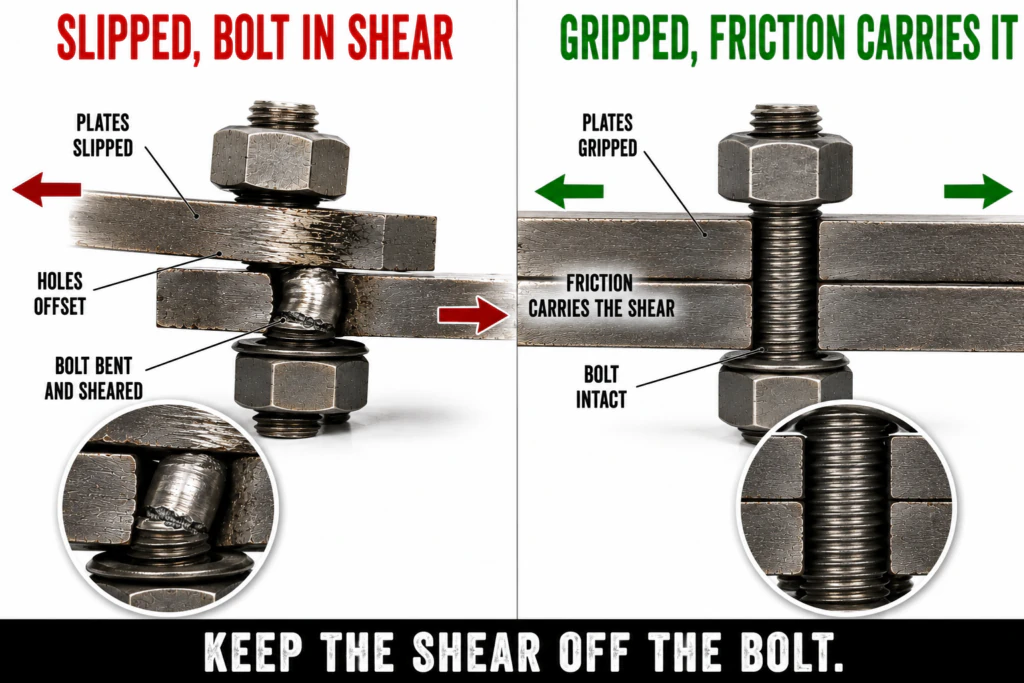
A preloaded joint carries shear by friction between the members. Lose the clamp force and the joint slips, and the bolt is left taking a shear load it was never meant to see.
A bolt is poor at carrying shear directly, and in a well designed joint it does not have to. The preload clamps the members so hard that friction between them carries the shear, and the bolt just supplies the clamping force. Lose the preload and that friction goes with it, the joint slips until the members bear against the bolt shank, and now the bolt carries shear directly, in bearing it was never sized for. Under a steady load it bends or shears, under a cyclic one the slipping joint frets and hammers it until it fails. The failure looks like a weak bolt, but the cause was a joint allowed to slip.
The cost. Sheared or bent bolts and fretted, slipped joints, in connections that were fine until the clamp force that carried the shear was lost.
The fix. Keep the shear off the bolt. Design slip critical joints so preload and friction carry the shear with margin, prepare the faying surfaces for the friction you are counting on, and where the bolt must carry shear in bearing, size and detail it for that duty deliberately rather than by accident.
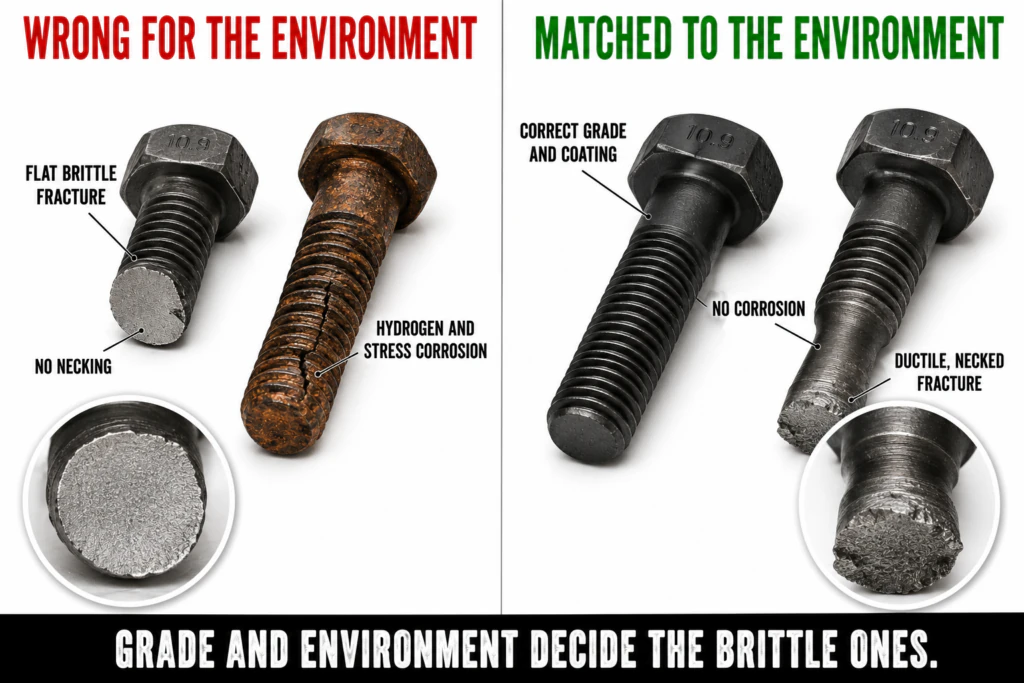
High strength bolts can fail brittle, with no warning, from hydrogen or a corrosive environment. The right grade and coating for the environment is part of the design, not a catalogue choice.
The last group of failures does not wait for a load cycle, it comes from the material and its environment. High strength bolts are the most useful and the least forgiving, because the harder the steel the more easily hydrogen embrittles it. Hydrogen from plating, pickling, or a corrosive environment gathers at the stressed thread root and cracks the bolt slowly and brittlely, hours or weeks after tightening, with a flat bright fracture and no necking to warn you. Stress corrosion and plain corrosion do the same more slowly, under the steady pull of the bolt’s own preload. The stronger the bolt, the more carefully its grade, coating, and environment have to be matched.
The cost. Delayed brittle fractures of high strength bolts, and corroded or stress corrosion cracked bolts, failing without warning under nothing more than their own preload.
The fix. Match the bolt to its environment, not just its load. Choose the grade with embrittlement and corrosion in mind, specify coatings and baking that keep hydrogen out, avoid the hardest grades where hydrogen or corrosion is a real risk, and treat the environment as a design input alongside the force
A bolt is not a small strong thing that holds a joint together, it is a spring that stores a clamping force, and that force is the joint. Overload, fatigue, loosening, slip, and brittle fracture are not six unrelated ways for a bolt to break, they are what happens when the preload is too low, too high, or gone. Tighten the bolt to the right stretch and keep it there, and the grade on the head is almost the least important thing about it. Treat the bolt as something you simply do up tight, and the strongest bolt in the catalogue will still find one of these ways to fail, because the joint was never really about the bolt. It was about the preload.
At Developmech, we do the engineering behind the bolted joint: preload and joint stiffness analysis, bolt fatigue assessment, self loosening and vibration, slip critical and shear connections, and the grade, coating, and tightening method that hold a joint together for life. If you build joints that have to stay tight, we are glad to take a look.
