Address
Malik Saleem Plaza, New City, Wah
Pakistan
WhatsApp: +92 327 5100047
Email: info@developmech.com
Work Hours
Monday to Friday: 3PM - 11AM
Weekend: 10AM - 5PM
Address
Malik Saleem Plaza, New City, Wah
Pakistan
WhatsApp: +92 327 5100047
Email: info@developmech.com
Work Hours
Monday to Friday: 3PM - 11AM
Weekend: 10AM - 5PM

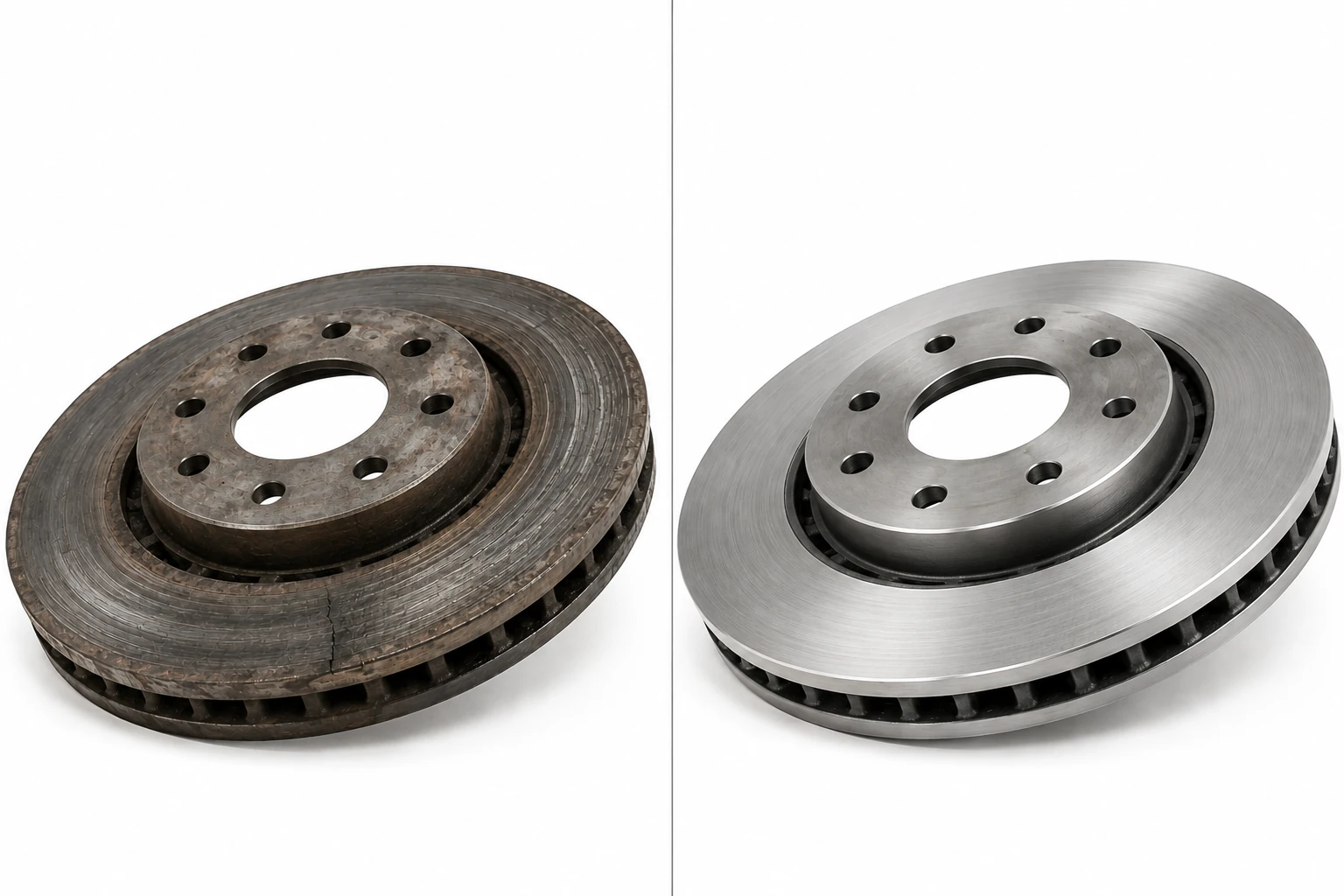
A brake disc is a heat sink and a thermally cycled structure, and it fails by thermal fatigue, distortion, and judder long before the friction surface is worn out
Developmech | Thermal, Structural & Fatigue Analysis
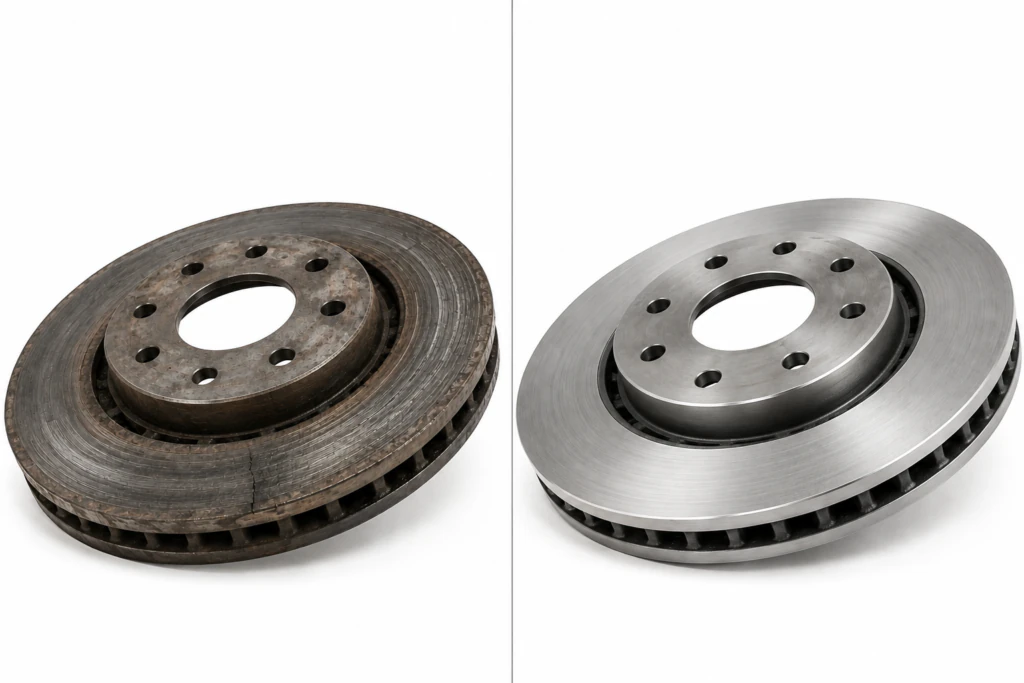
A brake disc looks like a wear part, a metal plate the pads slowly grind away until you replace it. That is not how most discs die. The disc is not really a friction surface, it is a heat sink, and braking is the job of turning the car motion into heat and getting rid of it. A hard stop from highway speed dumps hundreds of kilojoules into the disc in a couple of seconds and drives the surface past 600 degrees, and it is that heat, not the rubbing, that cracks, warps, and shakes the disc apart.
Wear is the slow, boring failure. The interesting ones are thermal: a surface crazed with heat cracks, a disc that cones when hot and is blamed for being warped, a thickness variation that shudders the pedal, and a disc that runs out of capacity to absorb heat and fades. None of these show up as thinning on a wear gauge, and all are decided by how the disc handles heat.
Here are the six ways a brake disc fails from heat, and what each one costs.
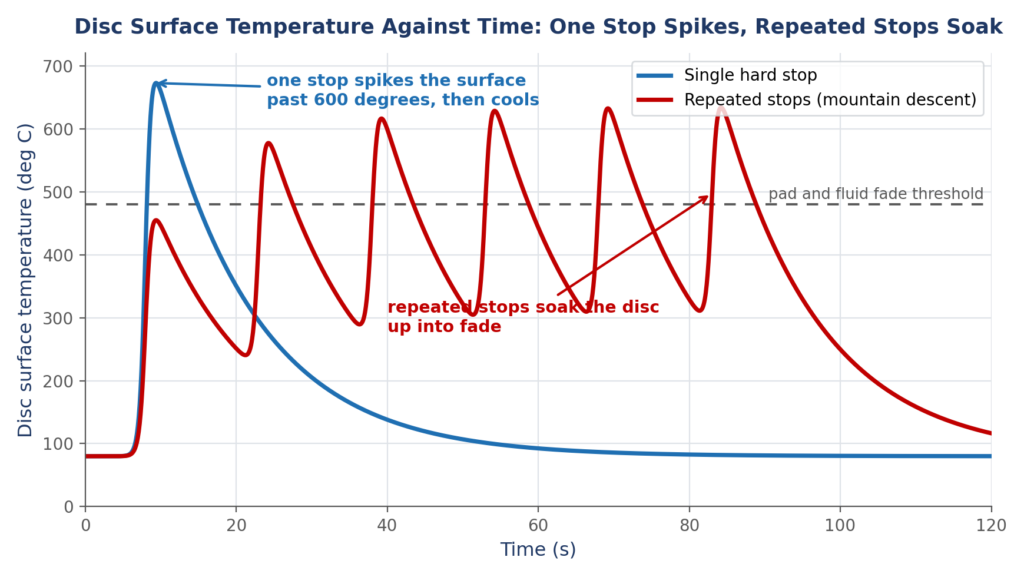
A hard stop drives the disc surface past 600 degrees in seconds, and repeated stops heat soak the whole disc until the pads and fluid overheat and the brakes fade.
A brake turns the kinetic energy of the car into heat, and almost all of it lands in the disc. A single hard stop from highway speed puts hundreds of kilojoules into each front disc in a second or two, faster than it can conduct inward, so the surface spikes past 600 degrees while the core is still cool. Do it once and the disc sheds the heat before the next stop. Do it repeatedly, down a mountain pass or on a track, and the heat soaks through the whole disc and climbs until the pads and fluid reach temperatures where friction drops or the fluid boils, and the brakes fade. The disc is a heat sink with a finite capacity, and fade is that capacity running out.
The cost. Brake fade when the disc, pads, and fluid heat soak past their limits, a soft pedal from boiling fluid, and a car that stops worse the more it is asked to stop.
The fix. Design the disc for the energy, not the geometry. Size the mass and vented cooling for the worst duty cycle, not a single stop, match the pad and fluid to the temperatures the disc will reach, and model the heat soak over a repeated stop sequence so the capacity is proven against the duty, not guessed.
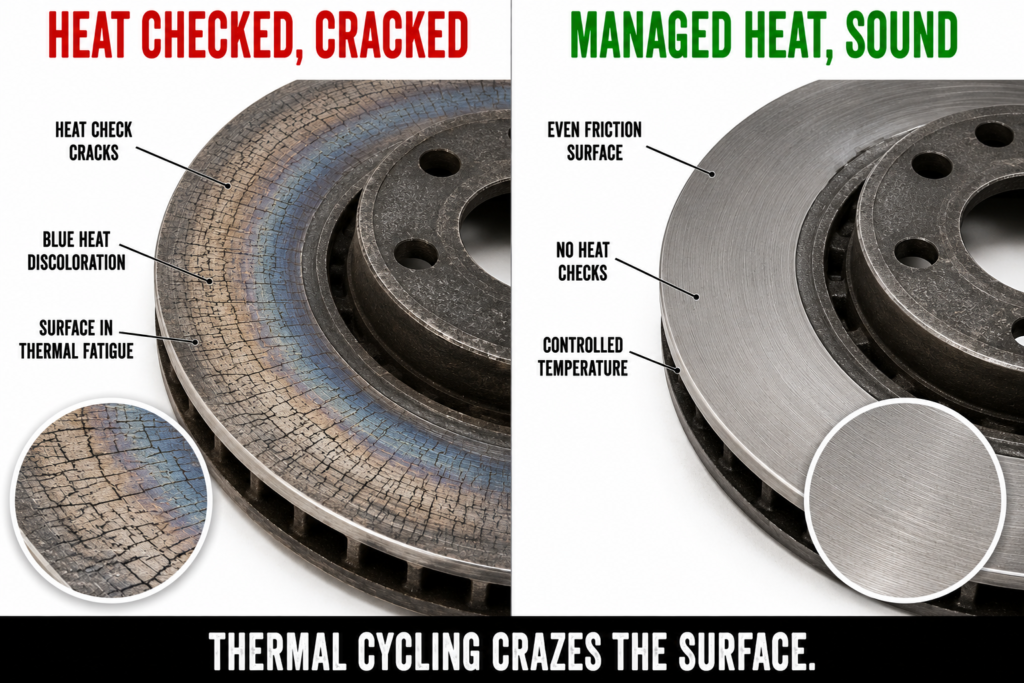
Heated fast, the surface wants to expand but the cold core will not let it, so it yields in compression, then cracks in tension as it cools. The result is a network of heat check cracks.
Every hard stop heats the friction surface far faster than the body behind it, so the surface tries to expand into a disc that will not let it. Held back, it yields in compression, so when the disc cools that surface is left in tension, and after enough cycles the tension opens a fine network of radial cracks across the friction band, called heat checking. It is a low cycle thermal fatigue failure, driven by the temperature swing rather than the load, which is why a disc nowhere near its wear limit can be covered in cracks and ready to fail.
The cost. A friction surface crazed with heat check cracks that grow with every cycle, roughen the braking, and eventually run deep enough to break a piece out of the disc.
The fix. Control the thermal swing and the material. Keep the peak temperature and the gradient down with enough mass and cooling, choose a cast iron grade that resists thermal fatigue, avoid the sudden cooling that makes it worse, and check the surface against a thermal cycle life, not just a wear limit.
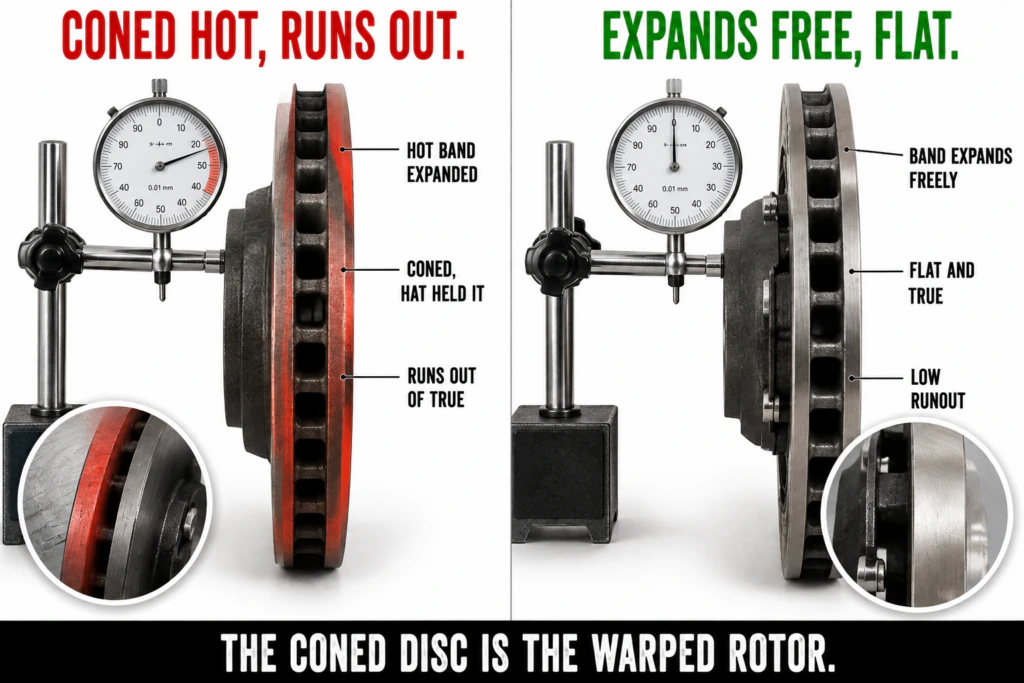
A disc rarely bends. It cones, because the hot friction band wants to grow and the cooler hat holds it, so the disc distorts into a shallow cone and runs out of true while it is hot.
The warped rotor is one of the most misunderstood failures in a car. Discs almost never bend the way the word warped implies. What happens is thermal, the friction band gets hot and wants to grow while the cooler hat holds it back, so the disc distorts into a shallow cone. Hot, it is no longer flat, it runs out of true, and the pads knock against the high spots and pulse the pedal. It often relaxes back close to flat when it cools, which is why the fault comes and goes and gets blamed on a bent disc that measures fine on the bench.
The cost. A disc that cones and runs out of true when hot, a pulsing pedal that appears under heavy braking and vanishes when cool, and uneven pad contact that speeds the other thermal failures.
The fix. Design the disc to expand freely and evenly. Let the band grow relative to the hat, with a floating or relieved hat where the duty is severe, keep the section and cooling symmetric so it heats evenly, and check the coning under a real thermal load, not just the cold flatness.
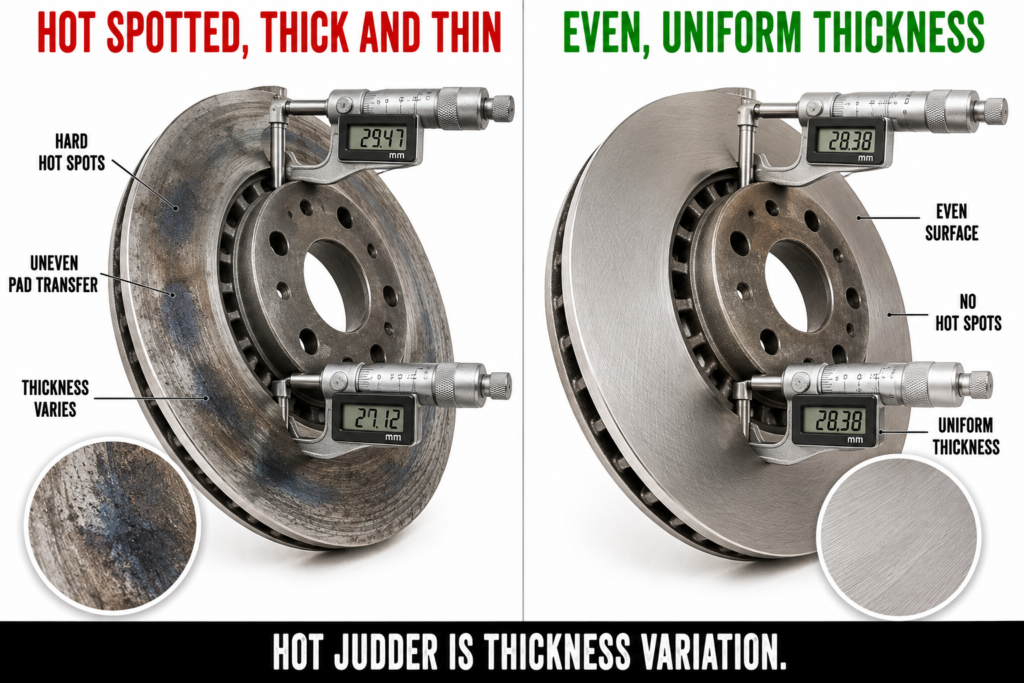
Uneven heating leaves hard hot spots and uneven wear, so the disc ends up thicker in some places than others. That thickness variation turns into a brake torque that rises and falls every revolution.
Judder is the disc telling you its thickness is no longer even. When a disc heats unevenly it develops hot spots, hard raised patches, and with uneven wear and transferred pad material it ends up measurably thicker in some places than others. That thickness variation means the pads squeeze more where the disc is thick and less where it is thin, so the braking torque rises and falls every revolution, and the driver feels a judder through the pedal and steering that gets worse with speed. It is a geometry problem written into the disc by heat.
The cost. A judder through the pedal and steering that grows with the thickness variation, hard to diagnose, and hot spots that are themselves crack starters.
The fix. Keep the disc heating and wearing evenly. Design for uniform heat input and cooling so hot spots do not form, match the pad so it lays down an even transfer film, keep the runout low so the disc does not build thickness variation over time, and specify a thickness variation limit, not just a minimum thickness.
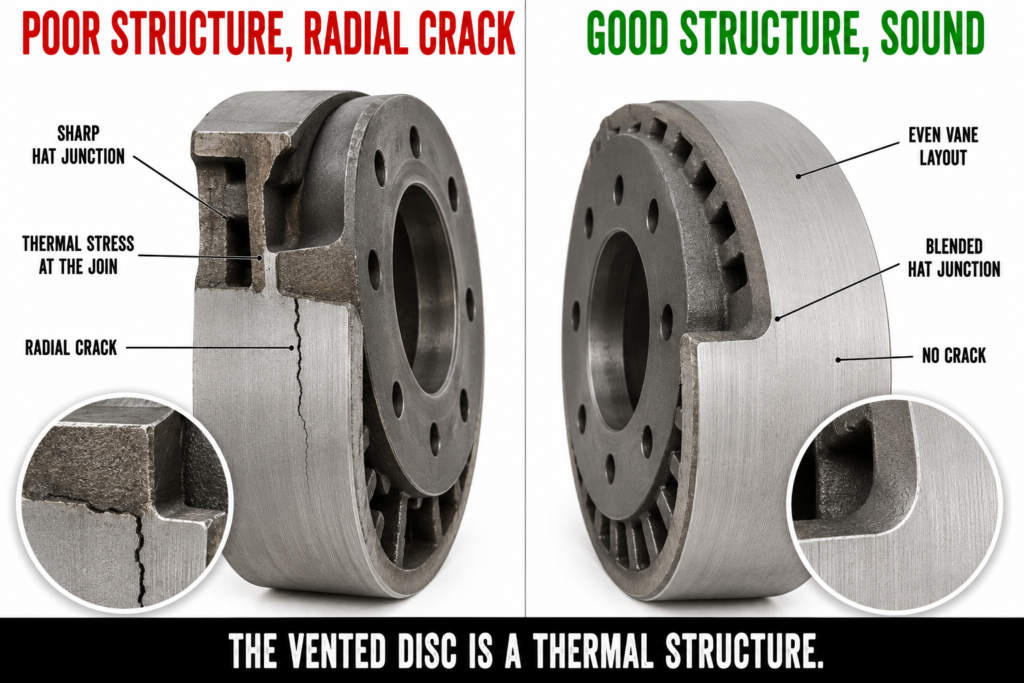
The vanes cool the disc and hold it together. The friction band and the hat expand by different amounts, so the disc carries a real thermal stress, and a poor design cracks between the two.
A vented disc is not a solid plate, it is two friction rings joined by cooling vanes and hung off a hat, all of it a structure carrying thermal load. The vanes pump air and shed heat, but they also tie the two faces together and set how stiff and symmetric the disc is. Because the friction band runs far hotter than the hat, the two expand by different amounts, and that difference is a real thermal stress concentrated where the band meets the hat. A disc with too few vanes, an unbalanced section, or a sharp hat junction cracks there, radially, long before it wears out.
The cost. Radial cracks running out from the vanes or the hat junction, driven by the thermal gradient between the friction band and the hat, that can split the disc rather than merely craze it.
The fix. Design the vented disc as a thermal structure. Use a vane layout that cools evenly and keeps the disc stiff and balanced, blend the band to hat junction to spread the thermal stress, let the band expand relative to the hat, and analyze the thermal stress across the whole disc, not just the surface temperature.
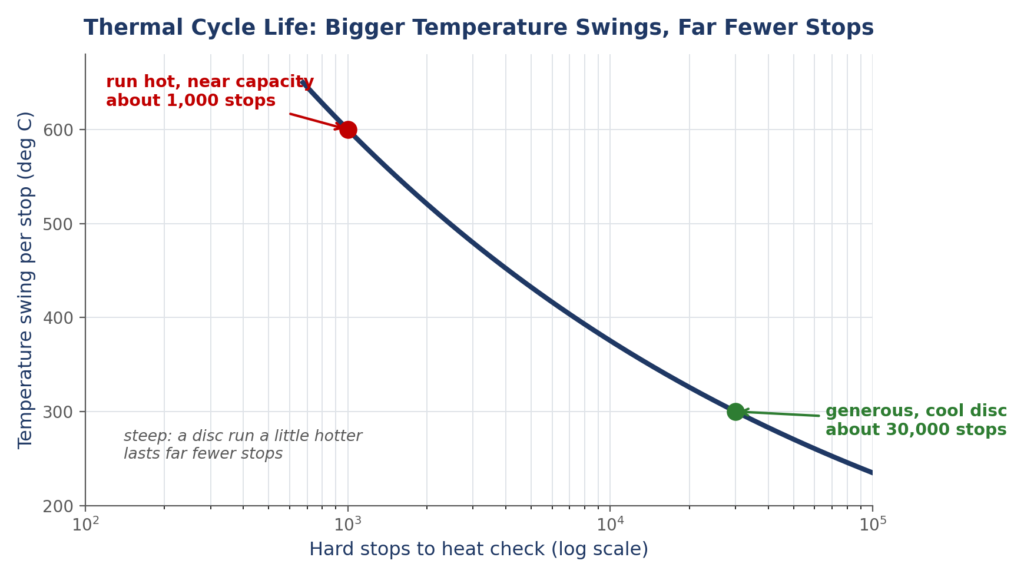
Thermal fatigue follows the size of the temperature swing, and the bigger the swing the fewer the stops before the disc heat checks. A disc has a countable number of hard stops in it.
All of this fits on a curve, because thermal fatigue behaves like any other fatigue, only counted in temperature swings instead of stress cycles. The bigger the swing on each stop, the fewer stops before the disc heat checks, and the relationship is steep, so a disc run a little hotter does not last a little less, it lasts far less. A generous, cool disc might shrug off tens of thousands of hard stops, while the same disc run at the edge of its capacity cracks in a fraction of that. The disc has a countable thermal fatigue life, and every hard stop spends a little of it.
The cost. A disc designed to a wear thickness but governed by its thermal fatigue life, cracking on a number of hard stops nobody counted because only wear was considered.
The fix. Design the disc to a thermal fatigue life, not a wear limit. Set the peak temperature and swing from the real duty cycle, keep them low enough that the heat check life exceeds the service life with margin, choose the material for thermal fatigue, and size the disc for the stops it will actually see.
A brake disc is not a wear part that happens to get hot, it is a heat sink and a thermal structure that happens to have a wear limit, and it almost always fails on the heat. It crazes with heat check cracks, cones and runs out of true while it is hot, builds a thickness variation that shudders the pedal, cracks from the gradient between its band and its hat, and fades when it cannot absorb any more energy. Size it for the energy it has to swallow and the temperature swings it has to survive, and it will wear out quietly the way everyone expects. Size it for its thickness alone, and it will crack, warp, and shake itself apart while there is still plenty of metal left to wear.
At Developmech, we do the thermal and structural engineering behind braking: transient thermal analysis of the disc over real duty cycles, thermal fatigue and heat check life, coning and thickness variation, vented disc structure and thermal stress, and the material and cooling choices that keep a disc alive. If you build brakes that have to survive their own heat, we are glad to take a look.
