Address
Malik Saleem Plaza, New City, Wah
Pakistan
WhatsApp: +92 327 5100047
Email: info@developmech.com
Work Hours
Monday to Friday: 3PM - 11AM
Weekend: 10AM - 5PM
Address
Malik Saleem Plaza, New City, Wah
Pakistan
WhatsApp: +92 327 5100047
Email: info@developmech.com
Work Hours
Monday to Friday: 3PM - 11AM
Weekend: 10AM - 5PM

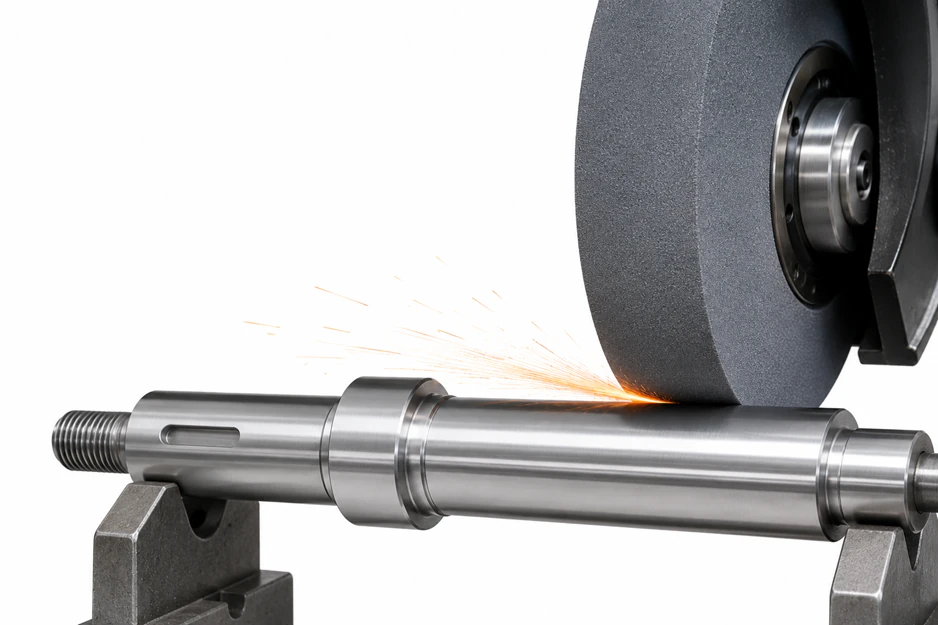
Heat, residual stress, burrs, and burn: how the final operations on a part quietly set its fatigue life, and why the drawing never warned you
Developmech | Manufacturing Support & DFM
By the time a part reaches the saw, the water jet, or the grinding wheel, most people treat it as finished work. The engineering is done, the drawing is signed, and cutting it to size or grinding it to finish feels like a formality. It is not. These final operations are subtractive, thermal, and violent, and they decide as much about how a part performs as any line on the drawing.
The catch is that most of what they do to a part is invisible. A ground surface can look perfect and be metallurgically burned. A cut edge can measure in tolerance and carry a hardened, cracked layer. A part can pass every dimensional check and still have had its fatigue life quietly cut in half before it ever left the shop.
Here are the six ways cutting and grinding turn good parts into failures, and what it costs when nobody is watching for them.
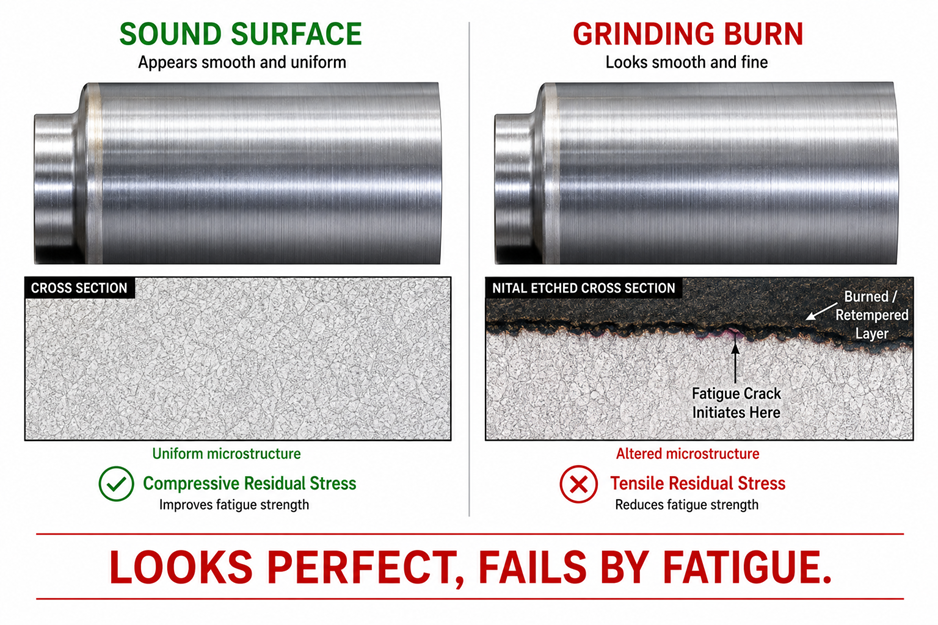
Push a wheel too hard and the surface overheats, retempering the steel and leaving tensile residual stress. The part looks perfect and fails by fatigue.
Grinding looks gentle, but at the wheel contact the surface can reach temperatures high enough to change the metallurgy of the steel in a layer you cannot see. Push the wheel too hard, starve the coolant, or let it glaze, and the surface retempers or even rehardens, and it is left in tensile residual stress. Tensile residual stress at the surface is close to the worst thing you can do to a fatigue loaded part, because it adds directly to the service load exactly where cracks start.
The cost. Parts that pass every dimensional and visual check and then fail by fatigue in service, at loads the drawing said were safe. It is one of the hardest failures to trace, because the evidence is invisible without a nital etch or a Barkhausen check.
The fix. Grind gently. Control wheel selection, dressing, coolant delivery, and feed to keep the surface cool, and where the part is fatigue critical, specify a maximum residual stress or require an etch check. A slower, cooler grind that leaves compressive stress is worth far more than a fast one that burns.
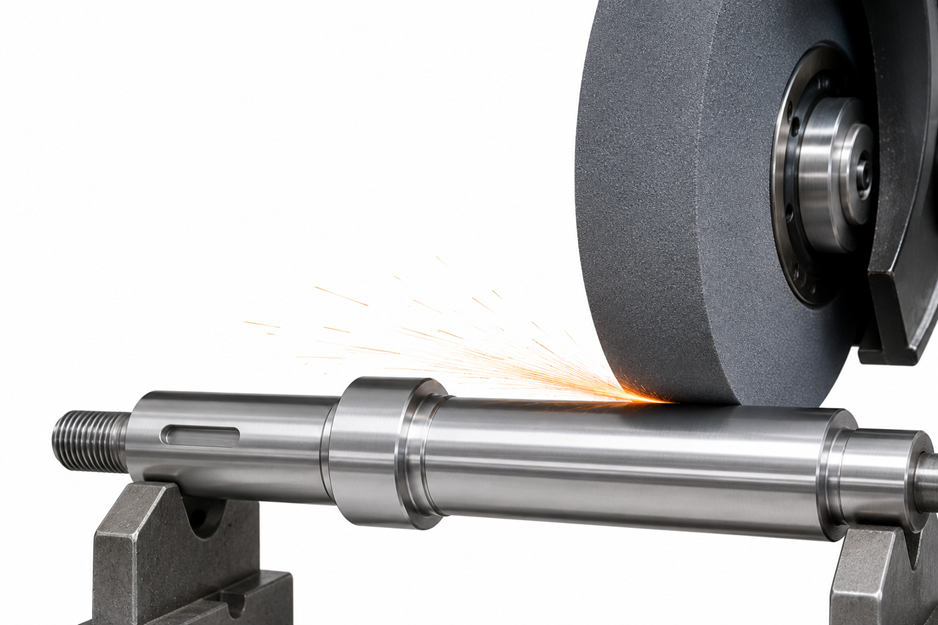
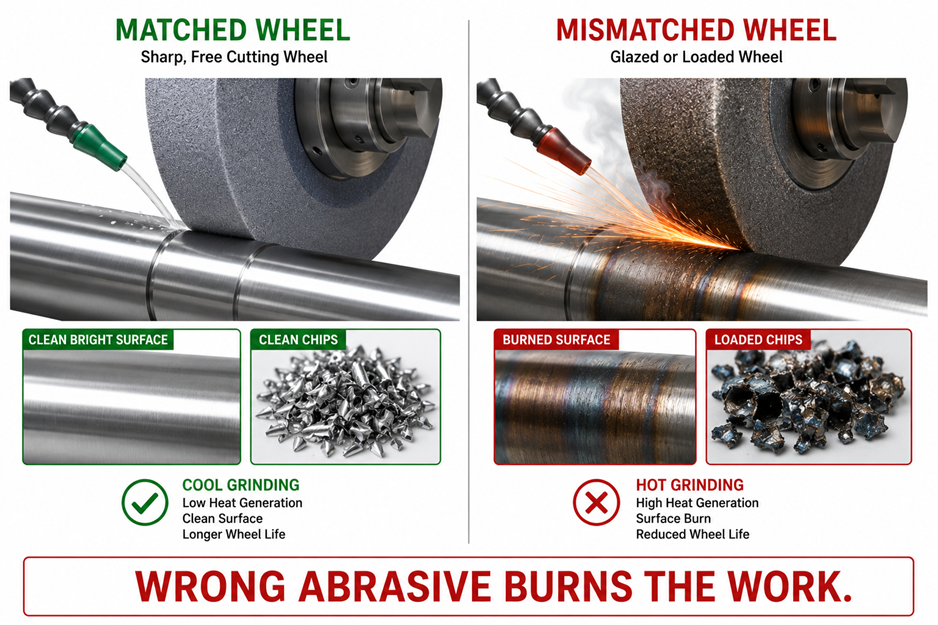
Abrasive, grit, and bond have to match the material. The wrong pairing glazes, loads, burns, and wears out fast.
A cutting blade or grinding wheel is not a generic tool. The abrasive (aluminium oxide, silicon carbide, CBN, diamond), the grit size, and the bond hardness all have to match the material being cut. Run a wheel that is too hard for the material and it glazes and burns; too soft and it wears away in minutes. Cut a hard or gummy material with the wrong blade and you get heat, poor finish, and rapid wear.
The cost. Burned surfaces, poor finish, fast consumable wear, and slow throughput, plus the heat damage from mistake one when the wrong wheel overheats the work.
The fix. Match the abrasive and bond to the material and the operation, not to whatever is on the shelf. Dress and true wheels properly, and choose superabrasives (CBN for hardened steel, diamond for carbide and ceramics) where they pay for themselves in life and cut quality.
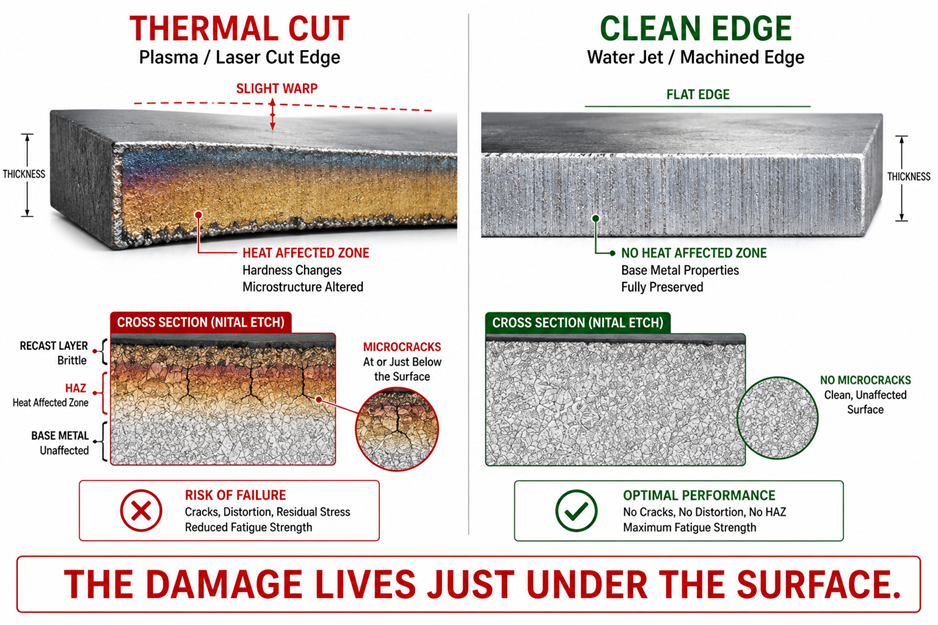
Plasma, laser, and oxy fuel cutting harden and microcrack the edge and warp thin parts. The damage lives just under the surface.
Thermal cutting processes, plasma, laser, and oxy fuel, cut by melting or burning the material, which means they pour heat into the edge. That heat leaves a heat affected zone: a thin layer of altered, often hardened and microcracked material along the cut, plus residual stress that can bow and twist thin parts as they cool. The edge measures fine and machines badly, or cracks under load.
The cost. Hard, brittle edges that crack or wreck the next tool that touches them, warped plates that will not lie flat, and microcracks that become fatigue initiation sites.
The fix. Choose the cutting process for the material and thickness, control heat input, and leave a machining allowance so the heat affected zone can be removed from surfaces that matter. Stress relieve where distortion or fatigue is a concern, and consider water jet or fine machining where a heat free edge is required.
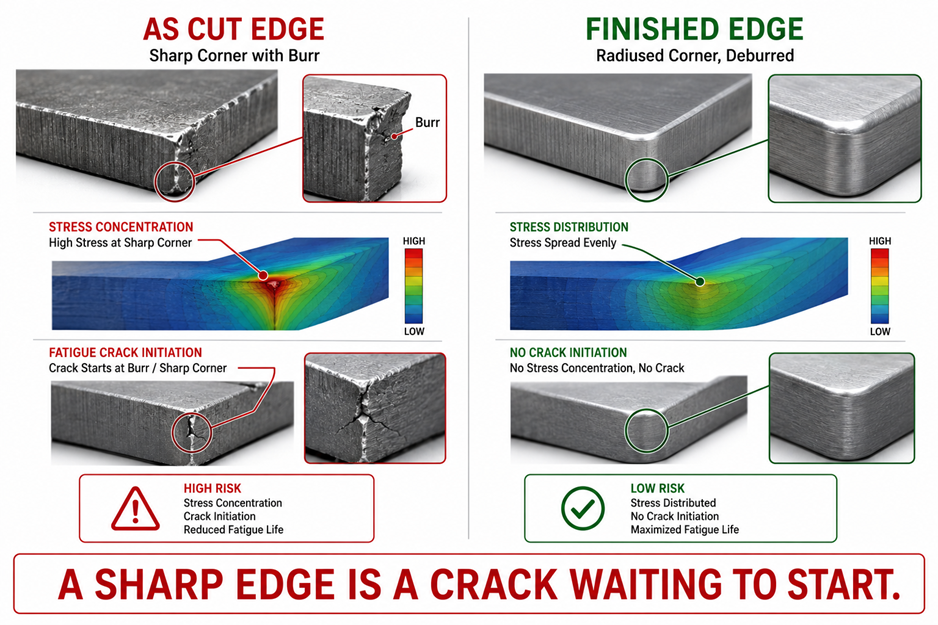
A burr is an assembly and safety problem. A sharp cut edge is a stress riser where fatigue cracks start.
Cutting and grinding leave edges, and edges matter more than most drawings admit. A burr interferes with assembly, cuts hands, sheds into the product, and ruins a coating. A sharp corner left straight off the saw or wheel is a stress concentration, and on a cyclically loaded part it is exactly where a fatigue crack will start. Treating edge condition as an afterthought means leaving crack initiation sites all over the part.
The cost. Cracks starting at sharp edges, assembly interference and rework, coating and paint failures at burrs, and injuries handling parts that were never deburred.
The fix. Make edge condition a specified requirement, not a shop decision. Call out deburring and an edge break or radius where it matters, especially on fatigue loaded and mating edges, and control burr direction and size at the cutting step rather than grinding it off later.
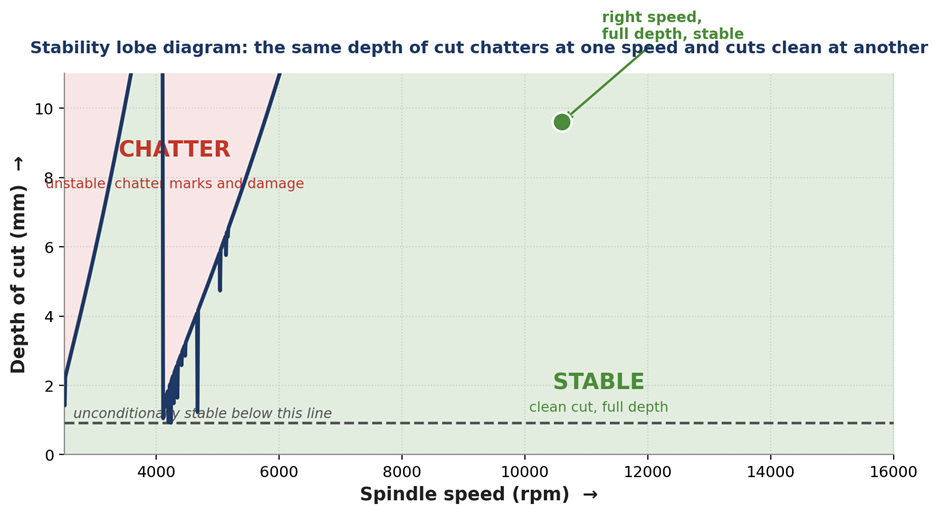
The same depth of cut chatters at one spindle speed and cuts clean at another. Chatter comes from soft workholding, resonance, or the wrong speed, not bad luck.
When a cut or a grind vibrates, the tool and the workpiece bounce against each other, leaving chatter marks, a poor finish, and dimensional error, and hammering the wheel or blade and the spindle in the process. Chatter is rarely random. It comes from soft workholding, a resonance between the tool and the structure, worn spindle bearings, or speeds and feeds that excite the system. A stability lobe diagram shows it plainly: at the right spindle speed you can take a full depth of cut, and at the wrong one the same cut chatters.
The cost. Rejected surface finish, features out of tolerance, shortened tool and wheel life, and the hidden cost of running everything slower to keep the chatter down.
The fix. Chase the stiffness and the frequencies, not just the feed. Stiffen and properly support the workpiece, check spindle and bearing condition, and tune speeds and feeds to stay off the resonances. If a part chatters no matter what, the fixture or the setup is usually the real problem.
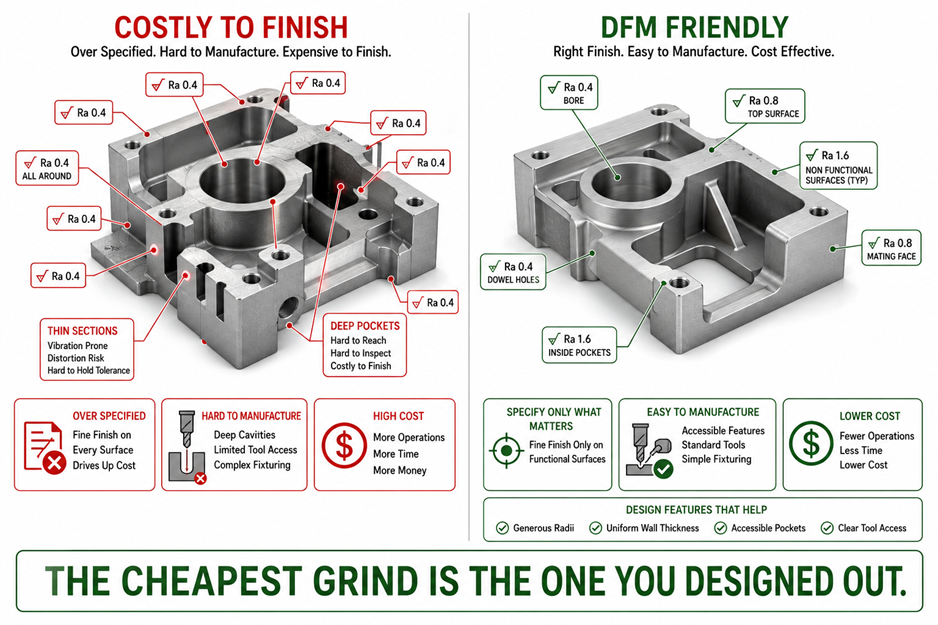
Tolerances and finishes specified where they are not needed, and features you cannot reach, force slow grinding and manual work that never had to exist.
The most expensive cutting and grinding is the kind that should never have been on the part. Tight tolerances and fine finishes called out on surfaces that do not need them, deep pockets and internal corners a wheel cannot reach, and thin sections that distort under cutting loads all force slow, manual, high reject operations. The cost is designed in long before the shop sees it.
The cost. Unnecessary grinding and finishing operations, high scrap on features that were always going to be hard to hold, and manual hand work that is slow, variable, and expensive.
The fix. Design for the finishing operation. Specify tight tolerances and fine finishes only where they are functional, keep ground and cut features accessible, support thin sections against cutting distortion, and question every callout that forces a grind. The cheapest grind is the one the design made unnecessary.
Cutting and grinding are the last things that happen to a part and the first things everyone stops paying attention to. That is the mistake. These operations set the surface, the edge, the residual stress, and the metallurgy that decide whether the part lives its rated life or fails early, and almost none of it shows up on a dimensional report. The drawing tells you the size. It does not tell you whether the part was burned getting there. Treat the final operations as engineering, specify what actually matters, and the part that leaves the shop is the part you designed.
At Developmech, we treat manufacturing as part of the design, not a step after it: process selection, edge and surface requirements, residual stress and fatigue, and the DFM that keeps parts cheap to cut, grind, and finish. If parts are failing or costing more than they should after the shop floor, we are glad to take a look.
